
Activist Shareholders: Definition, Tactics & Impact
An activist shareholder is a shareholder of a corporationCorporationA corporation is a legal entity created by individuals, stockholders, or shareholders, with the purpose of operating for profit. Corporations are allowed to enter into contracts, sue and be sued, own assets, remit federal and state taxes, and borrow money from financial institutions. who attempts to use his or her equity stake in a company to achieve certain goals. The main goal of activist shareholders is bringing change within or for the company. They intend to affect the behavior of a company by exercising their voting power or influencing other shareholders.
An activist shareholder does not necessarily need to own a large equity stakeStockholders EquityStockholders Equity (also known as Shareholders Equity) is an account on a company's balance sheet that consists of share capital plus in a company. A large equity stake provides the opportunity to exert a stronger influence on the company’s operations. However, obtaining the required shareholding can be problematic due to the high costs associated with the move or resistance of other shareholders.
The reasons for the shareholders’ activism may be financial or non-financial. Financial goals include cost-cutting, changes in the corporate or financial structureCapital StructureCapital structure refers to the amount of debt and/or equity employed by a firm to fund its operations and finance its assets. A firm's capital structure, or a spin-off or merger. Non-financial goals may be the abandonment of operations in certain markets or the adoption of socially or environmentally friendly policies.
Forms of Shareholder Activism
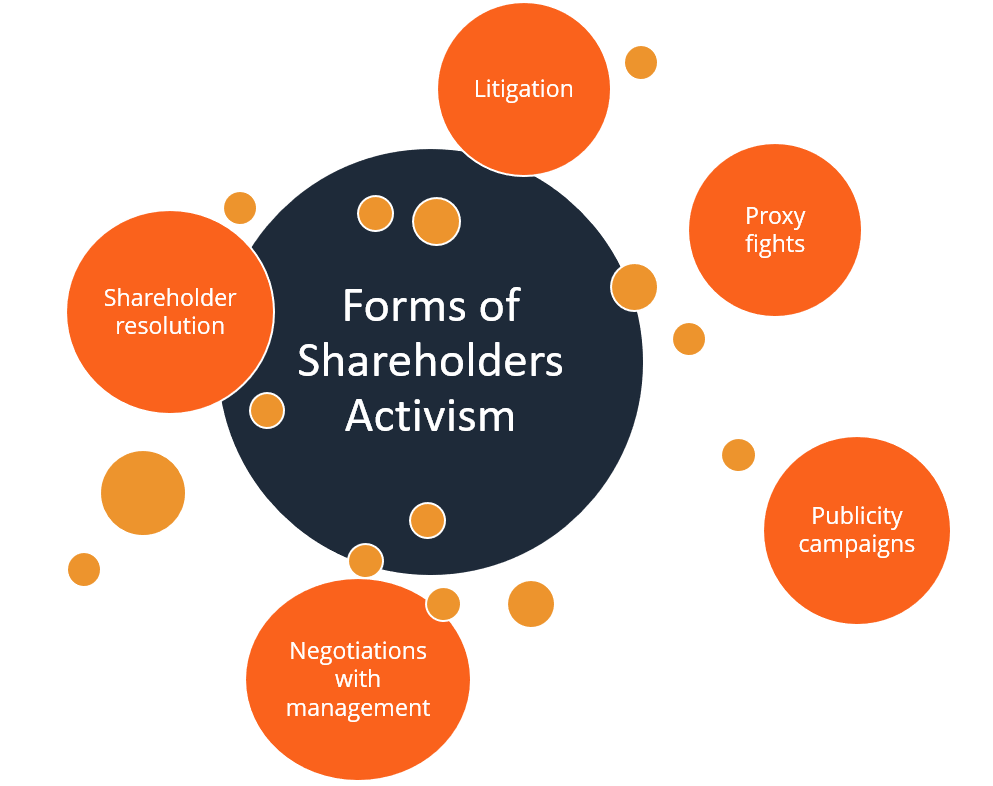
Activist shareholders can avail themselves of different methods to push the desired changes within or for the company. The most common forms of shareholder activism include:
1. Shareholder resolution
This is a proposal that can be submitted by the shareholders for a vote at the company’s annual meeting. Although the management of companies generally opposes the submission of shareholder resolutions, this activism method is reasonably effective at engaging the public’s attention.
2. Proxy Fights
When a group of shareholders is not content with the company’s management or its actions/decisions, it may persuade other shareholders to use their proxy votes to effect changes in the management. A proxy vote is a form of voting where a shareholder is not willing or is not able to attend the shareholders’ meeting and delegates their voting power to a representative.
3. Publicity campaigns
An activist shareholder may use mass media to draw the public’s attention to a problem or issue in a corporation. Sometimes, publicity campaigns can be used to put pressure on the company’s management.
4. Negotiations with management
Sometimes, activist shareholders can reach their goals through a simple negotiationNegotiation TacticsNegotiation is a dialogue between two or more people with the aim of reaching a consensus over an issue or issues where conflict exists. Good negotiation tactics are important for negotiating parties to know in order for their side to win or to create a win-win situation for both parties. with corporate management.
5. Litigation
Activist shareholders can also initiate legal action against the company’s management to reach their goals. However, this option is the least desirable for both parties. The litigation processes are extremely expensive and can create negative sentiments around the company.
Related Readings
CFI offers the Financial Modeling & Valuation Analyst (FMVA)™Become a Certified Financial Modeling & Valuation Analyst (FMVA)®CFI's Financial Modeling and Valuation Analyst (FMVA)® certification will help you gain the confidence you need in your finance career. Enroll today! certification program for those looking to take their careers to the next level. To keep learning and advancing your career, the following CFI resources will be helpful:
- Drag-Along RightsDrag Along RightsDrag Along Rights (also referred to as "drags" or drag-along provisions) are rights that give the majority owners the right to force minority owners to join in the sale of a company. The rights give the majority owners the ability to sell the entire company based on the terms and conditions they desire.
- Irrevocable ProxyIrrevocable ProxyAn irrevocable proxy is an enforceable power granted by the owner to another party to exercise his voting rights independently, without requiring his consent each time. Typically, most proxies are revocable, but some agreements may include specific clauses that require the proxy to be irrevocable for a specified period.
- Preferred SharesPreferred SharesPreferred shares (preferred stock, preference shares) are the class of stock ownership in a corporation that has a priority claim on the company’s assets over common stock shares. The shares are more senior than common stock but are more junior relative to debt, such as bonds.
- Voting TrustVoting TrustA voting trust is an arrangement where the voting rights of shareholders are transferred to a trustee for a specified period. The shareholders are then
-
Leverage in Finance: Strategies, Types & Risks
In finance, leverage is a strategy that companies use to increase assets, cash flows, and returns, though it can also magnify losses. There are two main types of leverage: financial and operating. To
-

Parent Company Explained: Definition, Control & Examples
A parent company is a company that owns more than 50% of the outstanding voting shares of another company. Therefore, it controls the other company or companies and can directly influence the business
finance
- Majority Shareholder: Definition, Rights & Implications
- Shareholders: Understanding Ownership and Dividends
- Shareholder Activism: Understanding Shareholder Activists and Their Tactics
- Shareholder Agreement: Definition, Purpose & Key Provisions | [Your Company Name]
- Understanding Your Company's Shareholder Base: A Comprehensive Guide
- Shareholder Letter: Understanding Company Performance & Outlook
- Stakeholders vs. Shareholders: Understanding the Key Differences
- Joint-Stock Company: Definition, Ownership & How They Work
- Shareholder Value: Definition, Calculation & Importance
-
 Understanding Dividends: A Comprehensive Guide
A dividend is a share of profits and retained earningsRetained EarningsThe Retained Earnings formula represents all accumulated net income netted by all dividends paid to shareholders. Retained Earnin...
-
 Understanding Financial Gearing: Debt & Leverage Explained
Gearing is the amount of debtNet DebtNet debt = total debt - cash. Net debt is a financial liquidity metric that measures a company’s ability to pay all its debts if they were due today. Compare...