
Understanding Simple Capital Structure: Definition & Components
A simple capital structure is a capital structure that contains no potentially dilutive securities. In other words, a simple capital structure consists only of common stockCommon StockCommon stock is a type of security that represents ownership of equity in a company. There are other terms – such as common share, ordinary share, or voting share – that are equivalent to common stock., nonconvertible debt, and nonconvertible preferred stock.

Quick Summary:
- A simple capital structure is a capital structure that contains no potentially dilutive securities.
- Such companies are only required to report basic earnings per share (EPS).
- Examples of potentially dilutive securities include convertible preferred stock, convertible debt, stock options, and warrants.
Types of Capital Structure
- Simple capital structure
- Complex capital structure
As outlined above, a simple capital structure does not contain any securities that could potentially dilute the company’s earnings. In contrast, a complex capital structure contains securities that could potentially dilute the company’s basic earnings.
Companies with a complex capital structure are required to report both basic and diluted earnings per share. Following, we outline potentially dilutive securities that could change a simple capital structure into a complex capital structure.
Understanding Potentially Dilutive Securities
Potentially dilutive securities are securities that could potentially be converted to common stock and dilute the earnings of shareholders. Companies with potentially dilutive securities have a complex capital structure. The following are common potentially dilutive securities:
1. Convertible preferred stock
Convertible preferred stock is a type of security that gives the holder the option to convert their preferred shares into a fixed number of common shares after a specified date.
For example, the holder may be entitled to convert one preferred stock into five common shares when the company goes public.
2. Convertible debt
Convertible debt is a type of security that gives the holder the option to convert, at the discretion of the debtholder, existing debt to a fixed amount of common stock.
For example, the holder may own a $1,000 par value bond paying a 6% coupon rate with a conversion ratio of 20 common shares for each $1,000 par value bond.
3. Stock options
Stock optionsEmployee Stock Ownership Plan (ESOP)An Employee Stock Ownership Plan (ESOP) refers to an employee benefit plan that gives the employees an ownership stake in the company. The employer allocates a percentage of the company’s shares to each eligible employee at no upfront cost. The distribution of shares may be based on the employee’s pay scale, terms of grant employees of a company the ability to buy shares of the company at a fixed price after a specified date.
For example, the holder may hold stock options with an exercise price of $50 that vest over a three-year period.
4. Warrants
WarrantsStock WarrantsStock warrants are options issued by a company that trade on an exchange and give investors the right (but not obligation) to purchase company stock at a specific price within a specified time period. When an investor exercises a warrant, they purchase the stock, and the proceeds are a source of capital for the company. are like stock options in that they grant an individual the ability to buy shares of the company at a fixed price. However, a major difference is that warrants are usually issued in conjunction with debt or equity securities to “sweeten” the deal while stock options are granted to employees.
For example, a company may attach five warrants to each $1,000 par value bond issued. Each warrant is convertible to 15 common shares with a strike price of $5 and an expiration date of June 1, 2025.
Example of Simple Capital Structure
An analyst is looking for warrants and stock options on the company’s annual report to determine additional capital that could be raised if they were exercised. The analyst finds that the company has 500,000 stock options outstanding with a weighted average price of $5. What does it indicate about the company’s capital structure?
The 500,000-stock options outstanding are indicative that the company owns potentially dilutive securities and, therefore, has a complex capital structure.
Identifying Companies’ Capital Structure
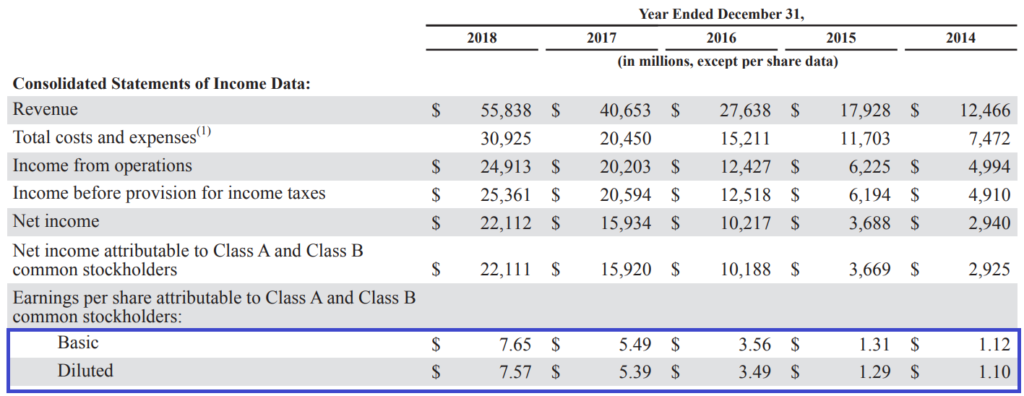
By looking at a company’s income statement, one can identify its capital structure. For example, in Facebook’s 2018 annual report, the company reported 2018 basic earnings per share of $7.65 and 2018 diluted earnings per share of $7.57. Therefore, Facebook has a complex capital structure. Shown below is an excerpt of the company’s income statement:
Additional Resources
CFI offers the Financial Modeling & Valuation Analyst (FMVA)™Become a Certified Financial Modeling & Valuation Analyst (FMVA)®CFI's Financial Modeling and Valuation Analyst (FMVA)® certification will help you gain the confidence you need in your finance career. Enroll today! certification program for those looking to take their careers to the next level. To keep learning and developing your knowledge base, please explore the additional relevant CFI resources below:
- Cost of CapitalCost of CapitalCost of capital is the minimum rate of return that a business must earn before generating value. Before a business can turn a profit, it must at least generate sufficient income to cover the cost of funding its operation.
- Debt vs. Equity FinancingDebt vs Equity FinancingDebt vs Equity Financing - which is best for your business and why? The simple answer is that it depends. The equity versus debt decision relies on a large number of factors such as the current economic climate, the business' existing capital structure, and the business' life cycle stage, to name a few.
- Preferred SharesPreferred SharesPreferred shares (preferred stock, preference shares) are the class of stock ownership in a corporation that has a priority claim on the company’s assets over common stock shares. The shares are more senior than common stock but are more junior relative to debt, such as bonds.
- WACC GuideWACCWACC is a firm’s Weighted Average Cost of Capital and represents its blended cost of capital including equity and debt.
-

Capital Employed: Definition, Calculation & Importance
Capital employed refers to the amount of capital investment a business uses to operate and provides an indication of how a company is investing its money. Although capital employed can be defined in d
-

Understanding Capital Gains: A Comprehensive Guide
A capital gain is an increase in the value of an asset or investment resulting from the price appreciation of the asset or investment. In other words, the gain occurs when the current or sale price of
finance
- Signaling Effects in Capital Structure: How Financial Decisions Influence Investors
- Basel I: Understanding Core Banking Regulations & Capital Requirements
- Understanding Capital: Types, Categories & Value Creation
- Capital Rationing: Definition, Strategy & Impact on Investment Decisions
- Understanding Capital Structure: Debt vs. Equity
- Understanding Corporate Structure: Types & Importance
- Cost of Capital: Definition, Calculation & Importance
- Founders Stock: Definition, Vesting, and Key Differences
- Restricted Stock: Definition, Types & How It Works
-
 Authorized Stock: Understanding Share Issuance Limits
Authorized stock or authorized shares refer to the maximum number of shares a corporation is legally permitted to issue according to its corporate bylawsCompany BylawsCompany bylaws are the rules that...
-
 Basel II: Understanding International Banking Regulations
Basel II is the second set of international banking regulations defined by the Basel Committee on Bank Supervision (BCBS). It is an extension of the regulations for minimum capital requirements as def...