
Capital Employed: Definition, Calculation & Importance
Capital employed refers to the amount of capital investment a business uses to operate and provides an indication of how a company is investing its money. Although capital employed can be defined in different contexts, it generally refers to the capital utilized by the company to generate profits. The figure is commonly used in the Return on Capital Employed (ROCE)Return on Capital Employed (ROCE) TemplateThis Return on Capital Employed (ROCE) template will help you calculate the profitability ratio used to measure how efficiently a company uses its capital. ratio to measure a company’s profitability and efficiency of capital use.

Formula
This metric can be calculated in two ways:
Capital Employed = Total Assets – Current Liabilities
Where:
- Total Assets are the total book value of all assets.
- Current Liabilities are liabilities due within a year.
or,
Capital Employed = Fixed Assets + Working Capital
Where:
- Fixed Assets, also known as capital assets, are assets that are purchased for long-term use and are vital to the operations of the company. Examples are property, plant, and equipment (PP&E)PP&E (Property, Plant and Equipment)PP&E (Property, Plant, and Equipment) is one of the core non-current assets found on the balance sheet. PP&E is impacted by Capex,.
- Working Capital is the capital available for daily operations and is calculated as current assets minus current liabilities.
Note: The formula chosen should be consistently applied (do not switch between formulas when conducting trend analysis or peer comparisons) as the calculation differs depending on which formula is used. Generally, total assets minus current liabilities is the most commonly used formula.
Sample Calculation
Mary is looking to calculate the capital employed of ABC Company, compiling the following information:
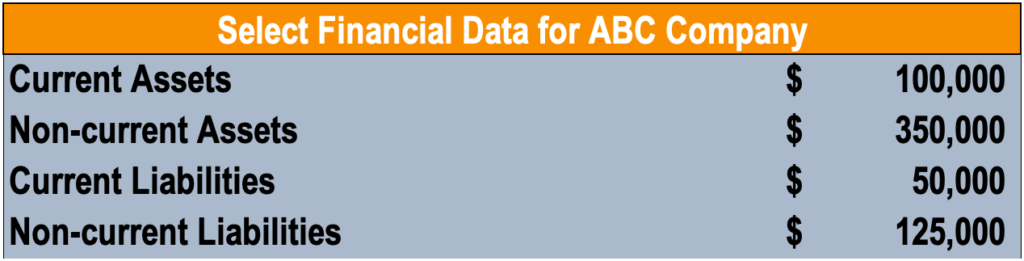
Using the first formula above, Mary calculates the amount as follows:
Capital Employed = $100,000 + $350,000 – $50,000 = $400,000
Interpreting Capital Usage
This metric provides an insight into how well a company is investing its money to generate profits. Although the figure varies depending on the formula used, the underlying idea remains the same.
The number in itself is seldom used by analysts. It is commonly used in conjunction with earnings before interest and tax (EBIT)EBIT GuideEBIT stands for Earnings Before Interest and Taxes and is one of the last subtotals in the income statement before net income. EBIT is also sometimes referred to as operating income and is called this because it's found by deducting all operating expenses (production and non-production costs) from sales revenue. in the return on capital employed (ROCE) ratio. As will be explained below, ROCE is a commonly used ratio by analysts for assessing the profitability of a company for the amount of capital used.
Return on Capital Employed
Return on capital employed (ROCE) is a profitability ratio that measures the profitability of a company and the efficiency with which a company is using its capital. The ROCE is considered one of the best profitability ratios,Profitability RatiosProfitability ratios are financial metrics used by analysts and investors to measure and evaluate the ability of a company to generate income (profit) relative to revenue, balance sheet assets, operating costs, and shareholders' equity during a specific period of time. They show how well a company utilizes its assets to produce profit as it shows the operating income generated per dollar of invested capital. The formula for ROCE is as follows:
ROCE = Earnings Before Interest and Tax (EBIT) / Capital Employed
Example of ROCE
Recall that the capital employed for ABC Company in our example above is $400,000. Assuming that earnings before interest and taxes figure of ABC Company is $30,000, what is the ROCE?
ROCE = $30,000 / $400,000 = 0.075 = 7.5%
For every dollar of invested capital, ABC Company generated 7.5 cents in operating income.
Related Readings
CFI offers the Financial Modeling & Valuation Analyst (FMVA)™Become a Certified Financial Modeling & Valuation Analyst (FMVA)®CFI's Financial Modeling and Valuation Analyst (FMVA)® certification will help you gain the confidence you need in your finance career. Enroll today! certification program for those looking to take their careers to the next level. To keep learning and advancing your career, the following CFI resources will be helpful:
- EBIT vs EBITDAEBIT vs EBITDAEBIT vs EBITDA - two very common metrics used in finance and company valuation. There are important differences, pros/cons to understand.
- Return on Total CapitalReturn on Total CapitalReturn on Total Capital (ROTC) is a return on investment ratio that quantifies how much return a company has generated through the use of its capital structure. This ratio is different from return on common equity (ROCE), as the former quantifies the return a company has made on its common equity investment.
- Types of AssetsTypes of AssetsCommon types of assets include current, non-current, physical, intangible, operating, and non-operating. Correctly identifying and
- Types of LiabilitiesTypes of LiabilitiesThere are three primary types of liabilities: current, non-current, and contingent liabilities. Liabilities are legal obligations or debt
-
Leverage in Finance: Strategies, Types & Risks
In finance, leverage is a strategy that companies use to increase assets, cash flows, and returns, though it can also magnify losses. There are two main types of leverage: financial and operating. To
-

Parent Company Explained: Definition, Control & Examples
A parent company is a company that owns more than 50% of the outstanding voting shares of another company. Therefore, it controls the other company or companies and can directly influence the business
finance
- Nominal Capital Explained: Definition & Importance for Businesses
- Contributed Capital: Definition & Understanding | [Your Company Name]
- Invested Capital: Definition & How It Fuels Business Growth
- Understanding Net Investment: A Key Metric for Business Growth
- Return on Capital Employed (ROCE): Definition & Calculation
- ROIC: Understanding Return on Invested Capital - Definition & Calculation
- Working Capital Management: A Comprehensive Guide
- Qualifying Transactions: Understanding Public Offerings via Capital Pool Companies
- Capital Rationing: Understanding Investment Constraints & Strategies
-
 Cost of Capital: Definition, Calculation & Importance
Cost of capital is the minimum rate of returnInternal Rate of Return (IRR)The Internal Rate of Return (IRR) is the discount rate that makes the net present value (NPV) of a project zero. In other word...
-
 Understanding Financial Gearing: Debt & Leverage Explained
Gearing is the amount of debtNet DebtNet debt = total debt - cash. Net debt is a financial liquidity metric that measures a company’s ability to pay all its debts if they were due today. Compare...