
Activist Investors: Definition, Strategy & Impact
An activist investor is an individual or institutional investor that seeks to acquire a controlling interest in a target company by gaining seats on the company’s board of directorsBoard of DirectorsA board of directors is a panel of people elected to represent shareholders. Every public company is required to install a board of directors.. Activist investors are looking to make significant changes to the target company and unlock perceived hidden value within the target company.
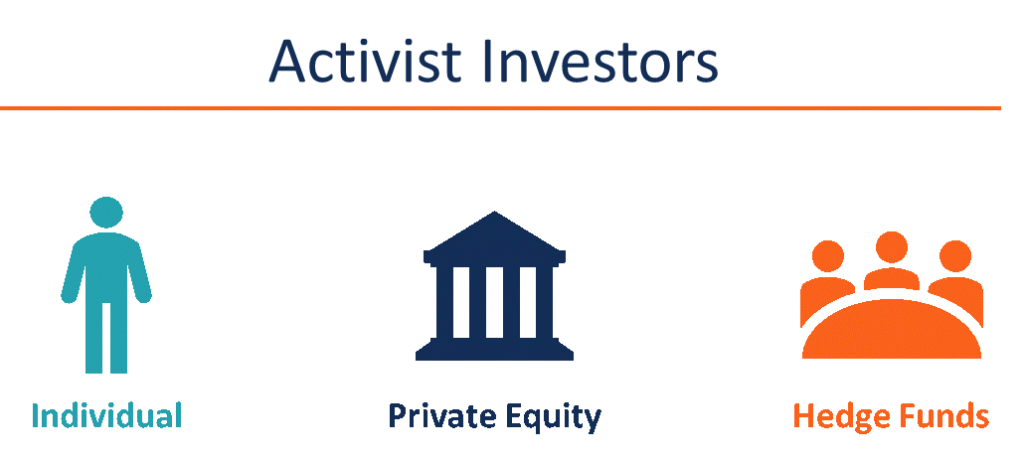
Activist investors usually seek companies that they believe demonstrate a structural flaw within their management and look to add value either by influencing the current management’s decisions or by replacing them with new management.
Types of Activist Investors
Activist investors come in many different forms, including:
1. Individual Activist Investors
Activist investors who are individuals are usually very wealthy and influential. They can leverage their capital to purchase a large number of a company’s shares to gain enough voting rights on the board of directors. They aim to influence the strategic directionCorporate StrategyCorporate Strategy focuses on how to manage resources, risk and return across a firm, as opposed to looking at competitive advantages in business strategy of the target company.
The individuals are usually well known within the finance industry and use their influence to make structural changes to a company’s strategy. For example, if an individual activist does not believe management is allocating capital properly, they can use their influence over the board of directors to push for different capital allocation.
Some examples of well-known activist shareholders are:
- Bill Ackman – Founder and chief executive officer (CEO) of Pershing Capital
- Carl Icahn – Founder of Icahn Enterprises
- David Einhorn – Founder and president of Greenlight Capital
- Dan Loeb – Founder of Third Point Partners
Advantages of Individual Activist Investors
Individual activist investors may be able to add value for current shareholders by guiding management actions to the shareholders’ best interests. The activist investors can provide a voice for fragmented shareholders who do not own enough shares to gain influence on management decisions.
Disadvantages of Individual Activist Investors
Individual activist shareholders may not share the same interests or goals as other shareholders and, therefore, may destroy shareholder value. For example, an activist shareholder may only prefer a short-term holding time horizon;. They will influence management to make decisions that benefit the company in the short term to the detriment of shareholders with a long-term holding time horizon.
2. Private Equity Firms
Activist investors in the form of private equity firmsTop 10 Private Equity FirmsWho are the top 10 private equity firms in the world? Our list of the top ten largest PE firms, sorted by total capital raised. Common strategies within P.E. include leveraged buyouts (LBO), venture capital, growth capital, distressed investments and mezzanine capital. employ many different strategies but usually will take control of a public company with the intention of taking it private. The structure of a private equity firm includes limited partners who own a significant amount of the fund and enjoy limited liability and a general partner who assumes unlimited liability. Private equity firms use capital from various investors who are willing to invest large amounts of capital for an extended period of time.
The investments of private equity firms come in many different situations, including:
- Leveraged buyouts: Buying a company as a whole with the intention of restructuring its capital structure to increase its value and exiting the investment by reselling the company or conducting an IPO (initial public offering)
- Distressed investment: Seeking companies or business lines that are distressed (on the verge of bankruptcy)
- Venture capital: Providing capital to startups or entrepreneurs, possibly helping the entrepreneur grow their venture and, in return, receiving an equity stake of the seed investment
Advantages of Private Equity Firms
Private equity firms give many companies and startups access to liquidity and capital in situations where they might be able to access to conventional financing. Additionally, private equity firms may provide value for current investors of a company that is underperforming in the public markets, allowing the company to steer away from the scrutiny of the public market.
Disadvantages of Private Equity Firms
Private equity firms face a more difficult time liquidating holdings since there is no official market to find buyers and sellers. It can take a significant amount of time to find a buyer to sell a private company. Furthermore, pricing is done through negotiations and, therefore, the realized return is subject to variations based on conditions not determined by the market.
3. Hedge Funds
Activist investors in the form of hedge funds can take control of a public company in a variety of ways. Hedge funds can take the approach of an individual activist investor or can act like private equity firms. The underlying goal of a hedge fund is to generate a return for investors no matter what, and the funds are not subject to constraints on the strategies that they can employ to do so.
Many individual activist investors act through opening hedge funds, and similarly to private equity firms, they are established with investments from several limited partners and a general partner. The investments are illiquid since they are usually locked up for at least one year to provide hedge fund managers with flexibility.
Advantages of Hedge Funds
Hedge funds do not have a mandate on how they generate alphaAlphaAlpha is a measure of the performance of an investment relative to a suitable benchmark index such as the S&P 500. An alpha of one (the baseline value is zero) shows that the return on the investment during a specified time frame outperformed the overall market average by 1%. and, therefore, can employ many different strategies without having to worry about conforming to investors or an investment policy statement (IPS)Investment Policy Statement (IPS)An investment policy statement (IPS), a document drafted between a portfolio manager and a client, outlines the rules and guidelines that the portfolio. It allows hedge funds to be aggressive in how they target companies and make changes. It provides them with opportunities to make activist investments and increase target shareholder value.
Disadvantages of Hedge Funds
Hedge funds are largely unregulated and, therefore, are prone to numerous controversies. Furthermore, hedge funds are more expensive to invest in; they are typically used by wealthy investors. Also, the funds typically underperform the broad market and provide very volatile returns.
Additional Resources
CFI is the official provider of the Commercial Banking & Credit Analyst (CBCA)™Program Page - CBCAGet CFI's CBCA™ certification and become a Commercial Banking & Credit Analyst. Enroll and advance your career with our certification programs and courses. certification program, designed to transform anyone into a world-class financial analyst.
In order to help you become a world-class financial analyst and advance your career to your fullest potential, these additional resources will be very helpful:
- High Net Worth Individuals (HNWI)High Net Worth Individual (HNWI)A high net worth individual (HNWI) refers to an individual with a net worth of a minimum of $1,000,000 in highly liquid assets, such as cash and cash
- Hostile TakeoverHostile TakeoverA hostile takeover, in mergers and acquisitions (M&A), is the acquisition of a target company by another company (referred to as the acquirer) by going directly to the target company’s shareholders, either by making a tender offer or through a proxy vote. The difference between a hostile and a friendly
- Institutional InvestorInstitutional InvestorAn institutional investor is a legal entity that accumulates the funds of numerous investors (which may be private investors or other legal entities) to
- Investing: A Beginner’s GuideInvesting: A Beginner's GuideCFI's Investing for Beginners guide will teach you the basics of investing and how to get started. Learn about different strategies and techniques for trading
-

Understanding Sophisticated Investors: Definition & Implications
A sophisticated investor is a term used to refer to an individual or a class of individuals with vast knowledge and experience in investment and business matters, alongside high net worth that allows
-

Venture Capital Funds: Investing in High-Growth Startups
A venture capital fund is a type of investment fund that invests in early-stage startup companies that offer a high return potential but also come with a high degree of risk. The fund is managed by a
invest
- Understanding Activist Investors: Influence & Corporate Change
- Basel I: Understanding Core Banking Regulations & Capital Requirements
- Understanding Capital: Types, Categories & Value Creation
- Capital Rationing: Definition, Strategy & Impact on Investment Decisions
- Cost of Capital: Definition, Calculation & Importance
- Venture Capital: Funding Startups & Understanding Equity
- Understanding Capital Losses: Definition, Calculation & Examples
- Margin Trading Explained: Borrowing Money to Invest
- Understanding Mispricing: Market Prices vs. True Value
-
 Seed Financing: A Comprehensive Guide for Startups
Seed financing (also known as seed capital, seed money, or seed funding) is the earliest stage of the capital-raising processCapital Raising ProcessThis article is intended to provide readers with a d...
-
 Series C Financing: A Comprehensive Guide for Startups
Series C financing (also known as series C round or series C funding) is one of the stages in the capital-raising processCapital Raising ProcessThis article is intended to provide readers with a deepe...