
Seed Financing: A Comprehensive Guide for Startups
Seed financing (also known as seed capital, seed money, or seed funding) is the earliest stage of the capital-raising processCapital Raising ProcessThis article is intended to provide readers with a deeper understanding of how the capital raising process works and happens in the industry today. For more information on capital raising and different types of commitments made by the underwriter, please see our underwriting overview. of a startup. Seed financing is a type of equity-based financing. In other words, investors commit their capital in exchange for an equity interest in a company. Generally, this is done in a less formal approach relative to other forms of equity-based financing such as venture capitalVenture CapitalVenture capital is a form of financing that provides funds to early stage, emerging companies with high growth potential, in exchange for equity or an ownership stake. Venture capitalists take the risk of investing in startup companies, with the hope that they will earn significant returns when the companies become a success..
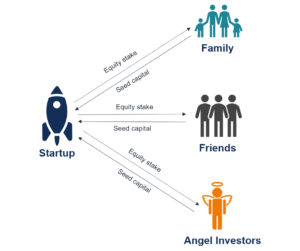
Uses of Seed Capital
Seed capital is primarily used to support the initial company’s operations. For example, proceeds from seed financing can be spent on market research or the initial steps of product development (e.g., the creation of a prototype), or on essential operating expenses such as legal costs.
The capital is commonly raised from family members, friends, or angel investors. Angel investorsAngel InvestorAn angel investor is a person or company that provides capital for start-up businesses in exchange for ownership equity or convertible debt. They may provide a one-time investment or an ongoing capital injection to help the business move through the difficult early stages. are the most crucial players in seed financing, as they can provide a substantial amount of capital.
Seed Financing as an Investment Vehicle
Seed financing is the riskiest form of investing. It involves investing in a company in its earliest stage of development, far before it generates revenues or profits. Due to such reasons, venture capitalists or banksTop Banks in the USAAccording to the US Federal Deposit Insurance Corporation, there were 6,799 FDIC-insured commercial banks in the USA as of February 2014. usually avoid seed financing.
In addition, seed financing is probably the most complicated form of investment. This is because a potential investor does not have enough information to make a completely informed decision. In most cases, the key factors for a successful seed investment include the viability of the idea behind the product or service to be developed by a company and the ability of its management to realize the idea.
The soft skills of the company’s management also play a crucial role in making the right seed investment decision. However, management experience is not always significant. For example, many tech giants such as Facebook and Google were founded by individuals with almost zero experience in running a business.
Despite the risky profile of seed financing opportunities, they may provide immense return opportunities to investors. One of the most notable examples is American entrepreneur and venture capitalist Peter Thiel’s investment in Facebook.
In 2004, Thiel became Facebook’s first outside investor after contributing $500,000 in exchange for a 10% stake in the social networking giant. In 2012 and 2017, Thiel sold most of his stake in the company, earning more than $1 billion in total for his shareholdings.
More Resources
Thank you for reading CFI’s explanation of seed financing. CFI offers the Financial Modeling & Valuation Analyst (FMVA)™Become a Certified Financial Modeling & Valuation Analyst (FMVA)®CFI's Financial Modeling and Valuation Analyst (FMVA)® certification will help you gain the confidence you need in your finance career. Enroll today! certification program for those looking to take their careers to the next level. To keep learning and advancing your career, the following resources will be helpful:
- Mezzanine FundsMezzanine FundA mezzanine fund is a pool of capital which invests in mezzanine finance for acquisitions, growth, recapitalization, or management/leveraged buyouts. In the capital structure of a company, mezzanine finance is a hybrid between equity and debt. Mezzanine financing most commonly takes the form of preferred stock or subordinated and unsecured debt.
- Private Equity vs Venture Capital, Angel/Seed InvestorsPrivate Equity vs Venture Capital, Angel/Seed InvestorsCompare private equity vs venture capital vs angel and seed investors in terms of risk, stage of business, size & type of investment, metrics, management. This guide provides a detailed comparison of private equity vs venture capital vs angel and seed investors. It's easy to confuse the three classes of investors
- Startup Valuation MetricsStartup Valuation Metrics (for internet companies)Startup Valuation Metrics for internet companies. This guide outlines the 17 most important e-commerce valuation metrics for internet starts to be valued
- Structured FinanceStructured FinanceStructured finance deals with financial lending instruments that work to mitigate serious risks related to complex assets. Borrowers with greater needs, such as corporations, seek structured finance to deal with complex and unique financial instruments and arrangements to satisfy substantial financial needs.
-
Venture Capital Funds: Investing in High-Growth Startups
A venture capital fund is a type of investment fund that invests in early-stage startup companies that offer a high return potential but also come with a high degree of risk. The fund is managed by a
-

Venture Capital Investing: A Comprehensive Guide
Venture capital investing is a type of private equity investing that involves investment in a business that requires capital. The business often requires capital for initial setup (or expansion). Vent
invest
- Basel I: Understanding Core Banking Regulations & Capital Requirements
- Understanding Capital: Types, Categories & Value Creation
- Capital Rationing: Definition, Strategy & Impact on Investment Decisions
- Understanding Business Financing: A Comprehensive Guide
- Understanding Capital Losses: Definition, Calculation & Examples
- Understanding Mispricing: Market Prices vs. True Value
- Series A Funding: Definition, Stages & What to Expect
- Series B Funding: A Comprehensive Guide for Startups
- Series C Financing: A Comprehensive Guide for Startups
-
 Capital Preservation: A Guide to Protecting Your Investments
Capital preservation is an investment strategy that promotes saving, i.e., preserving capital and avoiding loss of value. The strategy adopts a conservative approach towards investing specifically in ...
-
 Revenue-Based Financing: A Comprehensive Guide
Revenue-based financing, also known as royalty-based financing, is a type of capital-raising method in which investors agree to provide capital to a company in exchange for a certain percentage of the...