
Understanding Portfolio Active Return: Definition & Calculation
Active return refers to the gains or losses from a portfolio that are directly related to the decisions made by the portfolio manager. The active return can be positive or negative, depending on whether it overperforms or underperforms the market.
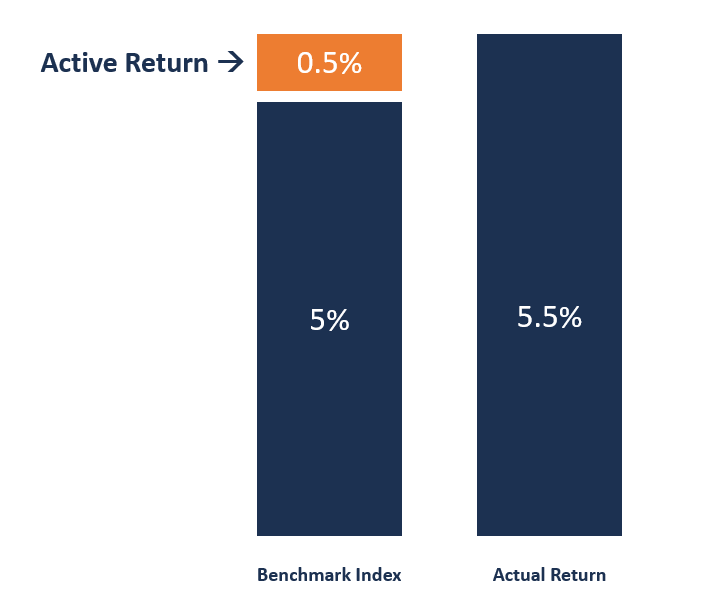
For example, if the benchmark is 5% and the actual return of a portfolio is 5.5%, the portfolio is said to have a positive active return of 0.5%. Similarly, if the benchmark is 6% and the actual return of the portfolio is 5.5%, the portfolio is said to have a -0.5% active return. The benchmark against which the actual return is compared may be a market index such as the Dow Jones Industrial Average (DJIA)Dow Jones Industrial Average (DJIA)The Dow Jones Industrial Average (DJIA), also referred to as "Dow Jones” or "the Dow", is one of the most widely-recognized stock market indices. or the Nasdaq Composite.
Summary
- An active return is the portion of return that is attributable to the investment decisions of the portfolio manager.
- It is obtained by finding the variance between the benchmark and the actual return.
- The benchmark used may be a market index such as the DJIA or the S&P 500.
Understanding Active Return
Active return refers to the portion of returns (profit or loss) in an investment portfolio that can be directly attributed to the active management decisions made by the portfolio managerPortfolio ManagerPortfolio managers manage investment portfolios using a six-step portfolio management process. Learn exactly what does a portfolio manager do in this guide. Portfolio managers are professionals who manage investment portfolios, with the goal of achieving their clients’ investment objectives.. The active return is obtained by deducting the investment return that is as a result of the overall market movements from the benchmark. The fund will be considered to have earned a positive active return if the actual return surpasses the market index.
Similarly, if the fund achieves results that are below the returns of the market index, the market will have a negative active return and will be considered to have underperformed. The benchmark used is the return that could be earned by the investor by opting for the passive investment approach.
Active Return in Actively Managed Funds
Portfolio managers seeking active returns attempt to exploit undervalued securities and short-term price movements using technical analysisTechnical Analysis - A Beginner's GuideTechnical analysis is a form of investment valuation that analyses past prices to predict future price action. Technical analysts believe that the collective actions of all the participants in the market accurately reflect all relevant information, and therefore, continually assign a fair market value to securities.. For example, the manager may create a portfolio comprising of overvalued securities that they can short sell for a profit. Depending on the goals of the fund, the manager attempts to reduce risk compared to a benchmark index.
When creating an investment portfolio, the manager may use various strategies such as asset allocationAsset AllocationAsset allocation refers to a strategy in which individuals divide their investment portfolio between different diverse categories, risk arbitrage, and short positions. The success of an actively managed fund depends on the skill of the portfolio manager and the research personnel.
Portfolio Management
Portfolio management is the professional management of both individual and company assets such as stocks, bonds, derivatives, and other assets such as real estate. Portfolio management is the responsibility of a portfolio manager, who takes into consideration the investment goals and risk profile of the investor.
In some cases, portfolio management may comprise complex processes such as financial analysis, monitoring and reporting, asset valuation, etc. The end goal of portfolio management is to maximize the returns expected, according to the level of risk exposure. The key elements of portfolio management include:
1. Diversification
Portfolio managers use diversification to create a basket of investments that have broad exposure to risks and returns within an asset class since they cannot predict with certainty that a specific investment will return consistent winners or losers. A good selection of assets should spread across different classes of securities, as well as the sectors of the economy. It will help capture the returns of the different sectors of the economy.
2. Asset allocation
Portfolio managers seek a mix of assets that have a low correlation with each other. It helps optimize the risk profile of an investor since some assets tend to be more volatile than others. A portfolio with a more aggressive mix of assets can weight their profile towards more volatile investments, while investors with a conservative mix of assets can weight their portfolio towards more stable investments. A portfolio can have a mix of different types of stocks, bonds, and derivatives.
Active vs. Passive Asset Management
Active and passive asset management are the two main investment strategies that can be used to generate returns on securities. Active asset management is a strategy where the portfolio manager makes decisions on how funds are going to be invested. The manager aims to outperform the benchmark index such as the S&P 500 by buying and selling securities such as stocks, futures contracts, and options contracts in the public exchange markets.
The management analyzes market trends, economic data, and the latest company-specific news to inform their decision of buying or selling a particular asset. The managers implement the decisions with the goal of outperforming fund managers who replicate the security holdings listed on an index.
Passive asset management lacks active management to make decisions. Rather, it focuses on mimicking the asset holdings of a specific market index. It sets up an investment that is similar to the specific index and applies the same weighting with the aim of generating identical results to the selected index. Passively managed funds have lower expenses than actively managed funds due to low turnover ratio and lack of an active management team who would otherwise earn management fees as compensation.
Related Readings
CFI offers the Financial Modeling & Valuation Analyst (FMVA)™Become a Certified Financial Modeling & Valuation Analyst (FMVA)®CFI's Financial Modeling and Valuation Analyst (FMVA)® certification will help you gain the confidence you need in your finance career. Enroll today! certification program for those looking to take their careers to the next level. To keep learning and advancing your career, the following resources will be helpful:
- Expected ReturnExpected ReturnThe expected return on an investment is the expected value of the probability distribution of possible returns it can provide to investors. The return on the investment is an unknown variable that has different values associated with different probabilities.
- Money vs. Time-Weighted ReturnMoney vs. Time-Weighted ReturnMoney and time-weighted returns are rates of return typically used to assess the performance of a managed investment portfolio. Today, the time-weighted rate of return is the industry standard since it provides a fairer assessment of an investment manager's performance.
- Investing: A Beginner’s GuideInvesting: A Beginner's GuideCFI's Investing for Beginners guide will teach you the basics of investing and how to get started. Learn about different strategies and techniques for trading
- Rate of ReturnRate of ReturnThe Rate of Return (ROR) is the gain or loss of an investment over a period of time copmared to the initial cost of the investment expressed as a percentage. This guide teaches the most common formulas
-
Internal Rate of Return (IRR): Definition & Calculation
The Internal Rate of Return (IRR) is the discount rate that makes the net present value (NPV)Net Present Value (NPV)Net Present Value (NPV) is the value of all future cash flows (positive and negative
-
Market Risk Premium: Definition & Calculation | Investopedia
The market risk premium is the additional return an investor will receive (or expects to receive) from holding a risky market portfolio instead of risk-free assets.The market risk premium is part of t
invest
- Active Bond Portfolio Management: Strategies & Benefits
- Active Management: Strategies & How It Works | [Your Company Name]
- Holding Period Return (HPR): Definition & Calculation
- K-Ratio Explained: Measuring Investment Growth & Consistency
- Modified Dietz Return: Calculation & Investment Portfolio Analysis
- Nominal Rate of Return: Definition & Calculation
- Portfolio Turnover Ratio: Definition, Calculation & Significance
- Understanding the Required Rate of Return: A Key Finance Concept
- Sortino Ratio: A Comprehensive Guide to Downside Risk
-
 Larry Portfolio: A Simple, Diversified Investing Strategy Explained
Recently, I wrote a three-part series on how to start investing. Today, I want to look at an advanced topic. Generally, I avoid advanced topics in investing, for two reasons: 1. Most peop...
-
 Portfolio Rebalancing: A Comprehensive Guide for Investors
So, what is it exactly? Portfolio rebalancing is moving your money between investments so you can maintain the perfect balance to help you achieve your financial goals.Every investor is different. Som...