
Behavioral Finance: Understanding Investor Psychology & Market Impacts
Behavioral finance is the study of the influence of psychology on the behavior of investors or financial analysts. It also includes the subsequent effects on the markets. It focuses on the fact that investors are not always rational, have limits to their self-control, and are influenced by their own biases.

Traditional Financial Theory
In order to better understand behavioral finance, let’s first look at traditional financial theory.
Traditional finance includes the following beliefs:
- Both the market and investors are perfectly rational
- Investors truly care about utilitarian characteristics
- Investors have perfect self-control
- They are not confused by cognitive errors or information processing errors
Learn more in CFI’s Behavioral Finance Course!
Behavioral Finance Theory
Now let’s compare traditional financial theory with behavioral finance.
Traits of behavioral finance are:
- Investors are treated as “normal” not “rational”
- They actually have limits to their self-control
- Investors are influenced by their own biases
- Investors make cognitive errors that can lead to wrong decisions
Decision-Making Errors and Biases
Let’s explore some of the buckets or building blocks that make up behavioral finance.
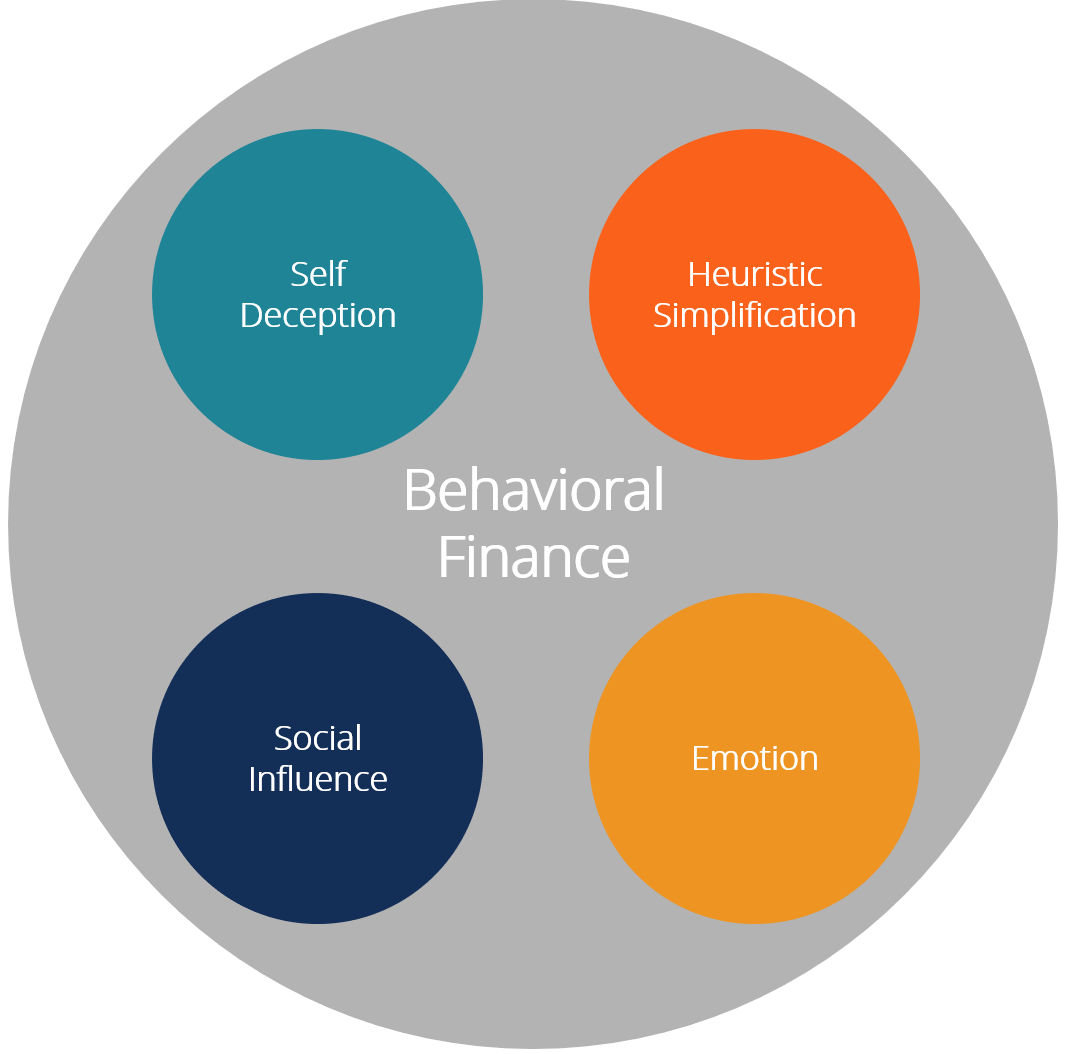
Behavioral finance views investors as “normal” but being subject to decision-making biases and errors. We can break down the decision-making biases and errors into at least four buckets.
Learn more in CFI’s Behavioral Finance Course!
#1 Self-Deception
The concept of self-deception is a limit to the way we learn. When we mistakenly think we know more than we actually do, we tend to miss information that we need to make an informed decision.
#2 Heuristic Simplification
We can also scope out a bucket that is often called heuristic simplification. Heuristic simplification refers to information-processing errors.
#3 Emotion
Another behavioral finance bucket is related to emotion, but we’re not going to dwell on this bucket in this introductory session. Basically, emotion in behavioral finance refers to our making decisions based on our current emotional state. Our current mood may take our decision making off track from rational thinking.
#4 Social Influence
What we mean by the social bucket is how our decision making is influenced by others.
Top 10 Biases in Behavioral Finance
Behavioral finance seeks an understanding of the impact of personal biases on investors. Here is a list of common financial biases.
Common biases include:
- Overconfidence and illusion of controlOverconfidence BiasOverconfidence bias is a false and misleading assessment of our skills, intellect, or talent. In short, it's an egotistical belief that we're better than we actually are. It can be a dangerous bias and is very prolific in behavioral finance and capital markets.
- Self Attribution BiasSelf Serving BiasA self serving bias is a tendency in behavioral finance to attribute good outcomes to our skill and bad outcomes to sheer luck. Put another way, we chose how to attribute the cause of an outcome based on what makes us look best.
- Hindsight BiasHindsight BiasHindsight bias is the misconception, after the fact, that one "always knew" that they were right. Someone may also mistakenly assume that they possessed special insight or talent in predicting an outcome. This bias is an important concept in behavioral finance theory.
- Confirmation BiasConfirmation BiasConfirmation bias is the tendency of people to pay close attention to information that confirms their belief and ignore information that contradicts it. This is a type of bias in behavioral finance that limits our ability to make objective decisions.
- The Narrative FallacyNarrative FallacyOne of the limits to our ability to evaluate information objectively is what’s called the narrative fallacy. We love stories and we let our preference for a good story cloud the facts and our ability to make rational decisions. This is an important concept in behavioral finance.
- Representative BiasRepresentativeness HeuristicRepresentativeness heuristic bias occurs when the similarity of objects or events confuses people's thinking regarding the probability of an outcome. People frequently make the mistake of believing that two similar things or events are more closely correlated than they actually are.
- Framing BiasFraming BiasFraming bias occurs when people make a decision based on the way the information is presented, as opposed to just on the facts themselves. The same facts presented in two different ways can lead to different judgments or decisions from people.
- Anchoring BiasAnchoring BiasAnchoring bias occurs when people rely too much on pre-existing information or the first information they find when making decisions. Anchors are an important concept in behavioral finance.
- Loss AversionLoss AversionLoss aversion is a tendency in behavioral finance where investors are so fearful of losses that they focus on trying to avoid a loss more so than on making gains. The more one experiences losses, the more likely they are to become prone to loss aversion.
- Herding MentalityHerd MentalityIn finance, herd mentality bias refers to investors' tendency to follow and copy what other investors are doing. They are largely influenced by emotion and instinct, rather than by their own independent analysis. This guide provides examples of herd bias
Overcoming Behavioral Finance Issues
There are ways to overcome negative behavioral tendencies in relation to investing. Here are some strategies you can use to guard against biases.
#1 Focus on the Process
There are two approaches to decision-making:
- Reflexive – Going with your gut, which is effortless, automatic and, in fact, is our default option
- Reflective – Logical and methodical, but requires effort to engage in actively
Relying on reflexive decision-making makes us more prone to deceptive biases and emotional and social influences.
Establishing logical decision-making processes can help protect you from such errors.
Get yourself focused on the process rather than the outcome. If you’re advising others, try to encourage the people you’re advising to think about the process rather than just the possible outcomes. Focusing on the process will lead to better decisions because the process helps you engage in reflective decision-making.
#2 Prepare, Plan and Pre-Commit
Behavioral finance teaches us to invest by preparing, by planning, and by making sure we pre-commit. Let’s finish with a quote from Warren Buffett.
“Investing success doesn’t correlate with IQ after you’re above a score of 25. Once you have ordinary intelligence, then what you need is the temperament to control urges that get others into trouble.”
Learn more in CFI’s Behavioral Finance Course!
Additional Resources
Thank you for reading this CFI introductory guide to behavioral finance. CFI is on a mission to help anyone become a world-class financial analyst with the Financial Modeling & Valuation (FMVA) certificationBecome a Certified Financial Modeling & Valuation Analyst (FMVA)®CFI's Financial Modeling and Valuation Analyst (FMVA)® certification will help you gain the confidence you need in your finance career. Enroll today!. To continue learning, these resources will be useful:
- Behavioral Finance GlossaryBehavioral Finance GlossaryThis behavioral finance glossary includes Anchoring bias, Confirmation bias, Framing bias, Herding bias, Hindsight bias, Illusion of control
- Behavioral Interview QuestionsBehavioral Interview QuestionsBehavioral interview questions and answers. This list includes the most common interview questions and answers for finance jobs and behavioral soft skills. Behavioral interview questions are very common for finance jobs, and yet applicants are often under-prepared for them.
- What is Financial Modeling?What is Financial ModelingFinancial modeling is performed in Excel to forecast a company's financial performance. Overview of what is financial modeling, how & why to build a model.
- Types of Financial ModelsTypes of Financial ModelsThe most common types of financial models include: 3 statement model, DCF model, M&A model, LBO model, budget model. Discover the top 10 types
-
Quantitative Finance: Models, Data & Market Analysis
Quantitative finance is the use of mathematical models and extremely large datasets to analyze financial markets and securitiesTrading SecuritiesTrading securities are securities purchased by a compan
-

Real Estate Project Finance: A Comprehensive Guide
Project finance is long-term financing of an independent capital investment, which are projects with cash flowsStatement of Cash FlowsThe Statement of Cash Flows (also referred to as the cash flow sta
invest
- Behavioral Finance Glossary: Key Terms & Concepts
- Understanding Finance: A Comprehensive Overview of Key Concepts
- Haircut (Finance): Definition, Calculation & Importance
- Understanding Islamic Finance: Principles and Practices
- Leveraged Finance Explained: Strategies & Applications
- Managerial Finance: Techniques for Business Decision-Making
- Structured Finance: Understanding Risk Mitigation & Lending Instruments
- Framing Bias: Understanding How Presentation Influences Decisions
- Hindsight Bias: Understanding the Illusion of Knowing Better After the Fact
-
 Corporate Finance: Definition, Importance & Key Concepts
Corporate finance deals with the capital structure of a corporation, including its funding and the actions that management takes to increase the value of the company. Corporate finance also includes t...
-
 Public Finance: A Comprehensive Overview - Revenue, Spending & Management
Public finance is the management of a country’s revenue, expendituresExpenditureAn expenditure represents a payment with either cash or credit to purchase goods or services. An expenditure is re...