
Understanding Call Provisions in Bonds: A Comprehensive Guide
A call provision refers to a clause – essentially, an embedded optionEmbedded OptionAn embedded option is a provision in a financial security (typically in bonds) that provides an issuer or holder of the security a certain right but not an obligation to perform some actions at some point in the future. The embedded options exist only as a component of financial security – in a bond purchase contract that gives the bond’s issuer the right to redeem the bond early, before its maturity date. Call provisions may also exist with preferred stock shares but are most commonly associated with bonds.

Call provisions are often included in corporate or municipal bonds, but government bonds issued by the U.S. Treasury do not carry call provisions.
Bonds with such provisions are referred to as callable bonds. Callable bonds usually offer higher yields than similar non-callable bonds to compensate investors for the risk of the bond being redeemed early, which will reduce the total amount of coupon payments (interest) that bondholders receive.
Summary
- A call provision refers to a clause in a bond purchase contract that gives the bond’s issuer the right to redeem the bond early, before its maturity date.
- Callable bonds usually pay a higher coupon rate than non-callable bonds.
- Call provisions specify the conditions under which the bond issuer may exercise an early redemption option – the conditions are usually time-specific or event-specific.
How Call Provisions Work
If a bond issuer believes that it may want to redeem issued bonds before maturity, then it may choose to include a call provision in the bond contract (which is known as the bond indenture) that outlines all the details of a bond that an investor is purchasing, such as the maturity date and the coupon rateCoupon RateA coupon rate is the amount of annual interest income paid to a bondholder, based on the face value of the bond. for the bond.
A call provision is an option, not an obligation. It does not mandate that the bond issuer redeem the bond early; it merely confers the option to do so.
If a call option is included with a bond, the bond indenture will outline the specific terms under which the issuer may call the bond. Call provisions are most commonly limited by time. That is, the bond issuer may only exercise its early redemption option after a certain period of time has passed since the bond’s original issue date.
However, some call provisions specify certain circumstances or events, rather than a time frame, that govern if and when a bond may be called. For example, a municipal bondMunicipal BondA municipal bond refers to a bond or fixed income security that is issued by a government municipality, township, or state to finance its governmental issue might include a call provision stating that the bond issuer can call the bond if the project that the bond issue raised money for is unexpectedly canceled.
A time-limited call provision for a bond with a scheduled 20-year-maturity may grant the bond issuer the option to call the bond three years, five years, or 10 years after the original issue date. Thus, the bond could not be called until, at the earliest, three years after issue, nor could it be called in any of the years not specified by the call provision. Here, the bond could be called five years after its issue date, but not in years six, seven, eight, or nine.
A call provision may grant the bond issuer the right to the early redemption of an entire bond issue or the right to redeem only a portion of the bonds issued.
When a bond is called, the bondholder receives the return of their invested principal and all interest payments due up to that time. Also, the terms of the call provision may require that the bond issuer pay the bondholder an additional premium upon early redemption of the bond.
Purpose of Call Provisions
Since including a call provision typically requires the bond issuer to pay bondholders a higher coupon rate, you might ask what prompts issuers to include provisions for early bond redemption.
The most common motivation for an issuer, including an early redemption option with a bond issue, is to be in a position to take advantage if prevailing interest rates decline significantly during the life of the bond.
In such a situation, the bond issuer can redeem its outstanding bonds early and then issue new bonds with a lower coupon rate, one that reflects the change in the interest rate market. The issuer can thereby borrow money at a lower interest rate.
Of course, should interest rates rise significantly after a bond issue, then the issuer has little cause to pursue its right of early redemption, as it is benefitting from paying a coupon rate on the bonds that is lower than prevailing interest rates.
More Resources
CFI is the official provider of the global Capital Markets & Securities Analyst (CMSA)™Program Page - CMSAEnroll in CFI's CMSA® program and become a certified Capital Markets &Securities Analyst. Advance your career with our certification programs and courses. certification program, designed to help anyone become a world-class financial analyst. To keep advancing your career, the additional resources below will be useful:
- Call PriceCall PriceA call price refers to the price that a preferred stock or bond issuer would pay to buyers if they chose to redeem the callable security
- Callable BondCallable BondA callable bond (redeemable bond) is a type of bond that provides the issuer of the bond with the right, but not the obligation, to redeem the bond before its maturity date. The callable bond is a bond with an embedded call option. These bonds generally come with certain restrictions on the call option.
- Call RiskCall RiskCall risk is the risk for a bond buyer that exists in purchasing a callable bond. The chance that the bond may be redeemed (i.e., called)
- 10-Year US Treasury Note10-Year US Treasury NoteThe 10-year US Treasury Note is a debt obligation that is issued by the US Treasury Department and comes with a maturity of 10 years.
-

Amortized Bonds: Understanding Principal Repayment
An amortized bond is a bond with the principal amount – otherwise known as face value –regularly paid down over the life of the bond. The bond’s principal is divided up according to
-
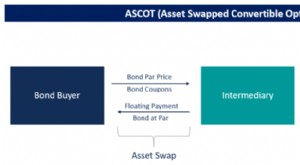
ASCOT Options: Understanding Asset-Swapped Convertible Options
The term ASCOT is short for Asset Swapped Convertible Option Transaction. It is an American style call option to buy back a convertible bond. It falls under the category of financial products called s
invest
- Understanding Call Dates: What You Need to Know
- Call Premium Explained: Understanding Issuer Redemptions & Option Pricing
- Understanding Call Prices: Callable Bonds & Preferred Stocks
- Understanding Call Protection in Bonds: Investor Protection Explained
- Understanding Call Risk in Bonds: A Comprehensive Guide
- Coupon Bonds: Understanding Fixed Income & Interest Payments
- Discount Bonds: Understanding Pricing & Secondary Markets
- Understanding Hard Call Protection in Callable Bonds
- Make-Whole Call Provisions: Understanding Early Bond Redemption
-
 Understanding Bond Accretion: A Comprehensive Guide
Accretion is a finance term that refers to the increment in the value of a bond after purchasing it at a discount and holding it until the maturity date. A bond is said to be purchased at a discount p...
-
 Understanding Amortizable Bond Premiums: A Comprehensive Guide
An amortizable bond premium refers to the excess amount paid for a bond over its face value or par valuePar ValuePar Value is the nominal or face value of a bond, or stock, or coupon as indicated on a...