
Equity-Linked Securities (ELKs): Understanding Investment Opportunities
Equity-linked securities (ELKS) are a type of debt instrument with unfixed payments that are linked to an underlying equity. They deliver the return of common sharesCommon StockCommon stock is a type of security that represents ownership of equity in a company. There are other terms – such as common share, ordinary share, or voting share – that are equivalent to common stock. in certain circumstances. ELKS are usually created as bonds by issuers as a capital financing method in private markets, which means investors cannot trade equity-linked securities in financial market exchanges.
Summary
- Equity-linked securities (ELKS) are a type of structured financial instrument with a return linked to a stock or a benchmark.
- If the underlying equity price remains above the predetermined downside threshold, the ELKS pay investors with fixed coupon payments during the term and the bond principal at maturity.
- If the underlying equity price goes below the predetermined downside threshold, investors receive the coupon return and the underlying equity return.
- ELKS provide upside potential and certain downside protection, but the risk of receiving less than the principal still exists.
How Do Equity-Linked Securities Work?
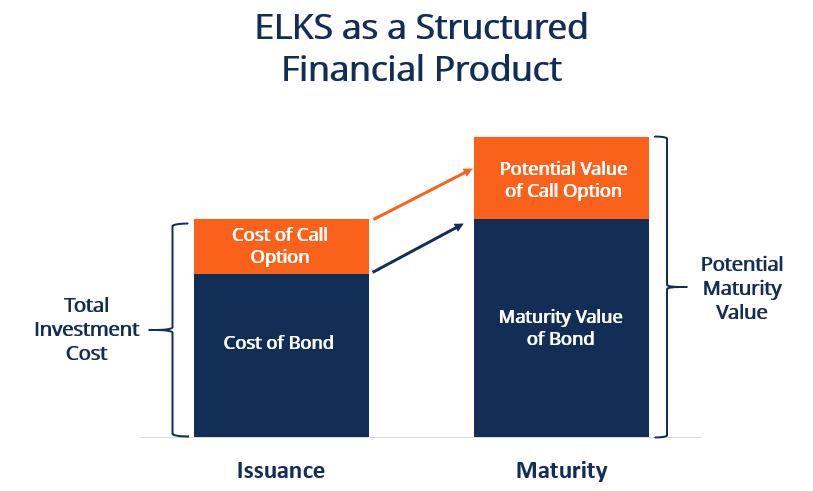
Equity-linked securities are a type of structured financial products that are combinations of more than one financial instrument and deliver returns of the combined instruments. ELKS share a few characteristics with both bonds and equities. Despite being in the form of debt, they generate returns impacted by the prices of the underlying stocks.
Typically, ELKS come with terms of maturity within one year and offer returns higher than both the dividend yields of equities and yields of vanilla bonds. They can be regarded as bonds with call optionsCall OptionA call option, commonly referred to as a "call," is a form of a derivatives contract that gives the call option buyer the right, but not the obligation, to buy a stock or other financial instrument at a specific price - the strike price of the option - within a specified time frame., which provide both principal protection and equity-linked returns.
A downside threshold price of the underlying equity is predetermined in ELKS. It is usually a discount of the equity price at the issuance of ELKS. Investors always receive fixed coupon payments during the term of the security regardless of where the equity price is. If the equity price remains above that predetermined level, investors will receive the repayment of principal at maturity. In this case, the security delivers the return as a bond.
For example, if an equity-linked security with a one-year maturity comes with a downside threshold of 90% of the equity price at issuance, which is $100, and an annual coupon of 8%. If the equity price remains above $90 during the entire term, investors will receive the 8% coupons and the bond principal at maturity. The total return is 10%.
Conversely, if the equity price goes below that threshold at any point before the security matures, the security will pay investors returns of the underlying equity. In this case, the security shows the characteristics of both bond and equity investment. The total return is the sum of the coupons paid and the return of the underlying equity at maturity.
In the same example above, if the equity price drops below $90 at some point during the term and then rises up to $110 at maturity, investors will receive a total return of 18% including the 8% of coupon return and 10% of equity return.
Types of ELKS
There are several types of ELKS. Depending on their issuers and equity types that they link to, there are three major categories: bank-offered ELKS, corporate ELKS, and market-linked securities.
1. Bank-Offered ELKS
Banks often offer ELKS investment opportunities to retail investors. For example, Citibank offers ELKS with maturities ranging from 6 to 13 months under its CitiFirst Performance Investments. Many ELKS are offered by banks alongside certificates of deposits (CDs)Certificate of Deposit (CD)A certificate of deposit (CD) refers to a financial product that is offered by financial institutions – such as banks and credit unions – that allow as equity-linked CDs. For example, Union Bank offers equity-linked CDs with 100% principal protection through its UnionBanc Investment Services.
2. Corporate ELKS
Corporates can use ELKS as a way of capital financing by working with investment banks for the issuance process. The ELKS are typically linked to the issuer corporates’ own common shares.
3. Market-Linked Securities
ELKS can be linked to a single stock or a market benchmark, which are thus known as market-linked securities. Such a type of ELKS offers exposure across industries with diversification benefits. Gold and currencies may also be the benchmarks for market-linked securities. Investors of gold-linked securities typically expect the same return as investing in gold directly.
Benefits and Risks of ELKS
With an upside potential and a certain amount of principal protection, ELKS enjoy the benefits of both equities and bonds. They offer period coupon income as bonds and potential for enhanced return through the option of equity. ELKS are particularly suitable for investors who are bullishBullish and BearishProfessionals in corporate finance regularly refer to markets as being bullish and bearish based on positive or negative price movements. A bear market is typically considered to exist when there has been a price decline of 20% or more from the peak, and a bull market is considered to be a 20% recovery from a market bottom. on the equity market but at the same time looking for some downside protection.
Even though ELKS offer some downside protection, there is still a risk that the payment at maturity may be below the principal amount. Let us continue on the same example discussed above and come up with a third scenario:
The equity price goes below $90 during the term and ends up at $85 at maturity. In this case, what investors receive at maturity is only $85, lower than the bond principal. The total investment return is thus -7% with an 8% return from coupons and a -15% return from the underlying equity. There is still the possibility of losing in ELKS.
Another concern for ELKS investment is that these products are illiquid, as investors often cannot redeem or trade ELKS before maturity without triggering any penalties.
More Resources
CFI is the official provider of the global Capital Markets & Securities Analyst (CMSA)™Program Page - CMSAEnroll in CFI's CMSA® program and become a certified Capital Markets &Securities Analyst. Advance your career with our certification programs and courses. certification program, designed to help anyone become a world-class financial analyst. To keep advancing your career, the additional CFI resources below will be useful:
- Coupon RateCoupon RateA coupon rate is the amount of annual interest income paid to a bondholder, based on the face value of the bond.
- Equity-Linked Note (ELN)Equity-Linked Note (ELN)An equity-linked note (ELN) refers to a debt instrument that does not pay a fixed interest rate. Instead, it is a type of structured product
- Held to Maturity SecuritiesHeld to Maturity SecuritiesHeld to maturity securities are securities that companies purchase and intend to hold until they mature. They are unlike trading securities or available for sale securities
- Underlying AssetUnderlying AssetUnderlying asset is an investment term that refers to the real financial asset or security that a financial derivative is based on. Thus, the
-

Understanding Securities: A Comprehensive Guide
What Is a Security? The term security refers to a fungible, negotiable financial instrument that holds some type of monetary value. It represents an ownership position in a publicly-traded
-

Credit Card ABS: Understanding Asset-Backed Securities
Credit card asset-backed securities (ABS) are fixed incomeFixed Income SecuritiesFixed income securities are a type of debt instrument that provides returns in the form of regular, or fixed, interest
invest
- Capital Markets Explained: Investing in Equity & Debt
- Commodity-Linked Securities: Explained | Investment Guide
- Understanding Distressed Securities: Risks & Opportunities
- Understanding Equity Derivatives: A Comprehensive Guide
- Hybrid Securities: A Comprehensive Guide to Balanced Investments
- Non-Marginable Securities: Definition & Investing Implications
- Understanding Private Equity Funds: An Investor's Guide
- Understanding Equity Issuance Fees: Costs of Raising Capital
- Securities Explained: A Beginner's Guide to Stocks, Bonds & More
-
 Understanding Security Types: A Comprehensive Guide
There are four main types of security: debt securities, equity securities, derivative securities, and hybrid securities, which are a combination of debt and equity. Fig. 1. Types of Securities&nb...
-
Mid-Cap Equity Funds: Understanding Risk, Returns & Investment
The right equilibrium between risk and returns is best achieved with the help of mid-cap equity funds. Check out this post to know what they are, how they work, and whether or not you should invest in...