
Understanding Equity Derivatives: A Comprehensive Guide
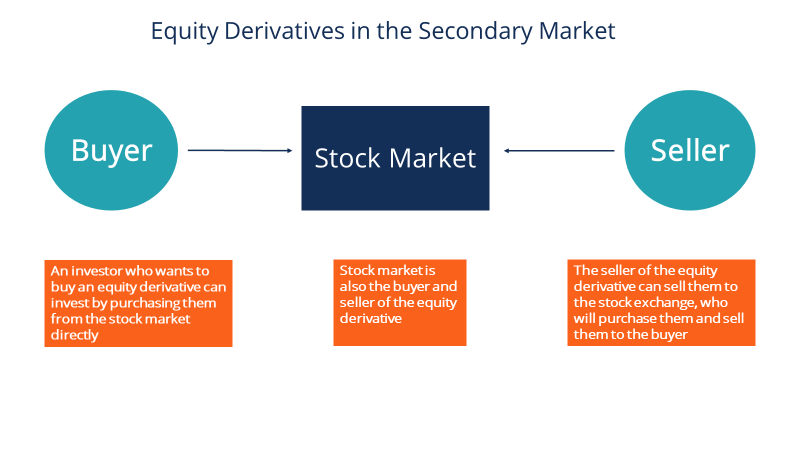
Equity derivatives are financial products/instruments whose value is derived from the increase or decrease in the underlying assets, i.e., equity stocks or shares in the secondary marketSecondary MarketThe secondary market is where investors buy and sell securities from other investors. Examples: New York Stock Exchange (NYSE), London Stock Exchange (LSE)..

Summary
- Equity derivatives are agreements between a buyer and a seller to either buy or sell the underlying asset in the future at a specific price. They can either hold the right or the obligation to trade the asset at the expiry of the contract.
- To trade an equity derivative, the investor needs to be very knowledgeable about the product and the industry, as derivatives allow an investor to speculate and make large gains or losses.
- Investing in equity derivatives comes with a number of risks, such as interest rate risk, currency risk, and commodity price risk.
How They are Traded
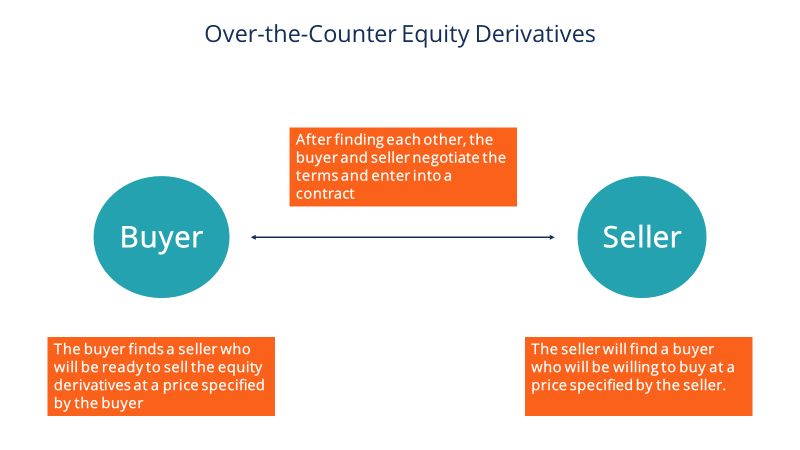
The diagram below explains how equity derivatives are traded in the primary and secondary markets:
Why Invest in an Equity Derivative?
One risk associated with an investment is the ownership of the investment. Equity derivatives allow the investor to buy only into the performance of the underlying investment without taking ownership of the company. Hence, the risk of losing money is less compared to owning the product.
Investment products are beneficial in the long term. However, if an investor is looking for better returns in the short term, equity derivatives are the best options. An investor who owns a portfolio with long-term investments can add equity derivatives to achieve a well-built portfolio that pays short-term and long-term returns.
Investing in equity derivatives is very tricky and requires the investor to know as much about the business as possible. It means the investor needs to undergo training to learn about derivatives trading. By doing so, the investor can then work better with a financial advisor, as they are more aware of how their money is being handled and where it is being invested.
Types of Equity Derivatives
Options
Options give the holder of the option the right, but not the obligation, to buy (call option) or sell (put option) a particular stock at a given price. The contract provides information about the given price, which is called the strike priceStrike PriceThe strike price is the price at which the holder of the option can exercise the option to buy or sell an underlying security, depending on, the expiration date, and the terms and conditions of the contract. An options contract is best suited for investors who want to protect or hedge themselves from increases or decreases in prices in the future.
Warrants
Just like options, warrants give the holder the right, but not the obligation, to buy (call warrants) or sell (put warrants) the underlying investment in the future. The company issues the warrants to the holders of its bonds or preferred stock as an incentive to buying the issue.
Futures
Futures contracts are traded on the secondary market. In a futures contract, the buyer agrees to buy the asset on a future date and at a specific price. Unlike options, in a futures contractFutures ContractA futures contract is an agreement to buy or sell an underlying asset at a later date for a predetermined price. It’s also known as a derivative because future contracts derive their value from an underlying asset. Investors may purchase the right to buy or sell the underlying asset at a later date for a predetermined price., the buyer has an obligation to buy the asset. In simple terms, the buyer must buy the asset on the date mentioned on the contract at the specified price.
Forwards
Like a futures contract, a forward contract specifies the future date and price that the buyer should purchase the underlying asset from the seller. The only difference is that a forward contract takes place in the private market and terms are tailored to the parties to the contract.
Convertible bonds
Convertible bonds allow the holder the option to convert the bonds into shares of the company. Along with the features of the bond (coupon and maturity date), convertible bonds also come with a conversion rate and price associated with it. Because of the conversion feature, such types of bonds pay a lower rate of interest compared to normal bonds.
Swaps
Swaps are derivatives where returns of two different equity stocks are exchanged between two parties. Apart from equity returns, the exchange can also be related to floating and fixed interest rates, currencies of different countries, etc.
Risks Associated With Derivatives
Interest rate riskInterest Rate RiskInterest rate risk is the probability of a decline in the value of an asset resulting from unexpected fluctuations in interest rates. Interest rate risk is mostly associated with fixed-income assets (e.g., bonds) rather than with equity investments.
An investor expecting the interest rates to rise in the future and enters into a derivative contract to pay a fixed interest rate in the future can face a risk of interest rates going down. By paying a fixed rate of interest, they may be locked into paying more money rather than taking a loan in the future at a lower rate.
Currency risk
Importers and exporters enter into derivative contracts to hedge themselves with fluctuating currency rates. The risk associated with this is if the currency falls or goes in the opposite direction compared to what the investor is expecting.
Commodity price risk
Commodity derivatives are traded if investors expect the prices of the underlying asset to go down in the future. The most common type of commodities derivative traded in the market is the oil futures. The risk associated here is the price of the commodity going up in the future. This is because the investor now has to sell the commodity at the specified price, which is lower compared to the current price that has gone up.
Additional Resources
CFI is the official provider of the global Capital Markets & Securities Analyst (CMSA)®Program Page - CMSAEnroll in CFI's CMSA® program and become a certified Capital Markets &Securities Analyst. Advance your career with our certification programs and courses. certification program, designed to help anyone become a world-class financial analyst. To keep advancing your career, the additional CFI resources below will be useful:
- Currency RiskCurrency RiskCurrency risk, or exchange rate risk, refers to the exposure faced by investors or companies that operate across different countries, in regard to unpredictable gains or losses due to changes in the value of one currency in relation to another currency.
- Derivatives MarketDerivatives MarketThe derivatives market refers to the financial market for financial instruments such as futures contracts or options.
- Options: Calls and PutsOptions: Calls and PutsAn option is a derivative contract that gives the holder the right, but not the obligation, to buy or sell an asset by a certain date at a specified price.
- Underlying SecurityUnderlying SecurityUnderlying security is a term in investing that denotes the negotiable financial instrument upon which a financial derivative, such as an
-
![Growth Equity: Investing in Expanding Businesses | [Your Company Name]](https://www.etffin.com/article/uploadfiles/202110/2021100815235075_S.jpeg)
Growth Equity: Investing in Expanding Businesses | [Your Company Name]
Growth equity (also known as growth capital or expansion capital) is a type of investment opportunity in relatively mature companies that are going through some transformational event in their lifecyc
-

Understanding Hedging Strategies: A Comprehensive Guide
Hedging is a financial strategy that should be understood and used by investorsPrivate Equity vs Venture Capital, Angel/Seed InvestorsCompare private equity vs venture capital vs angel and seed invest
invest
- Understanding Price Indices: A Comprehensive Guide
- Understanding Candlestick Patterns: A Comprehensive Guide
- Understanding Financial Derivatives: A Comprehensive Guide
- Donchian Channels: A Comprehensive Guide for Traders
- Equity Syndicates: A Comprehensive Guide for Investors
- Understanding Exchange-Traded Derivatives: Options & Futures
- Understanding Momentum Indicators in Trading
- Understanding Option Greeks: A Comprehensive Guide
- Understanding Private Equity Funds: An Investor's Guide
-
 Understanding Equity Derivatives: A Comprehensive Guide
Equity derivatives are financial products/instruments whose value is derived from the increase or decrease in the underlying assets, i.e., equity stocks or shares in the secondary marketSecondary Mark...
-
 Understanding Forward Prices: Definition & How They Work
Forward price refers to the predetermined and agreed upon price of an underlying asset in a forward contract. It is also known as the forward rate. A forward contract refers to an agreement...