
EONIA Explained: Understanding the Euro Overnight Index Average
The Euro Overnight Index Average (EONIA) is a benchmark reference rate for the euro. It is calculated using a weighted average that measures overnight unsecured lending transactions that take place in the interbank market in the European Union. The EONIA is closely related to another EU benchmark, the Euribor, but is more similar to the LIBOR (London Interbank Offered Rate)LIBORLIBOR, which is an acronym of London Interbank Offer Rate, refers to the interest rate that UK banks charge other financial institutions for – the benchmark in the UK.
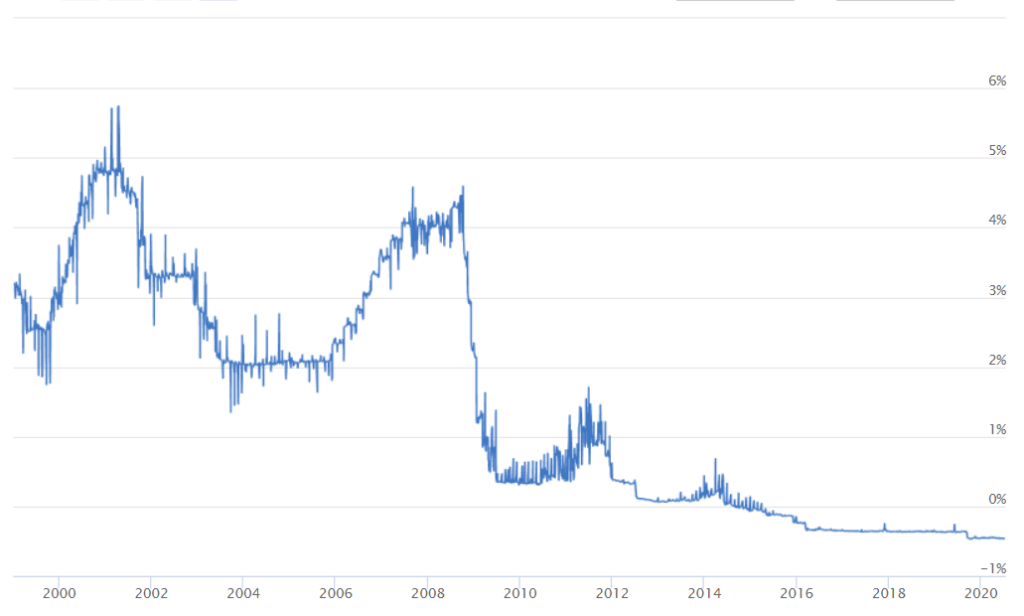
Both the Euribor and the EONIA are administered by the European Money Markets Institute (EMMI), in accordance with benchmark regulations of the EU; however, the actual index calculation is done by the European Central BankEuropean Central Bank (ECB)The European Central Bank (ECB) is one of the seven institutions of the EU and the central bank for the entire Eurozone.. Both benchmarks are calculated using figures from the same panel of approximately 30 banks.
One notable problem with the EONIA is the fact that there isn’t really a strict definition of what the interbank market is; therefore, making the criteria for what constitutes an interbank loan is somewhat subjective.
Summary
- The Euro Overnight Index Average (EONIA) is a benchmark reference lending rate for the euro, designed to reflect overnight lending rates in the European interbank market.
- Previously calculated using a weighted average of overnight rates offered by a group of 20-30 banks, the EONIA is now calculated as a “rate plus” of the euro short-term rate – €STR, as determined by the European Central Bank.
- The EONIA is set to be phased out of use by 2022, in favor of the €STR.
EONIA vs. Euribor
The primary differences between the EONIA benchmark and the EuriborEuro Interbank Offered Rate (Euribor)The Euro Interbank Offered Rate, or Euribor, is a daily reference interest rate that is published by the European Money Markets Institute are related to time. The EONIA is a daily index of overnight interbank lending, while the Euribor index covers a much broader period of time.
The Euribor benchmark is calculated by averaging interest rates for loans of varying maturities, with loans with a one-year maturity being the longest used in the measure.
Both benchmarks are considered critically important in the financial services industry in the EU, as they are used as reference interest rates for nearly $200 trillion of financial transactions, including many residential mortgagesFannie MaeThe Federal National Mortgage Association, typically known as Fannie Mae, is a United States government-sponsored entity that was established to expand the secondary mortgage market by making mortgages available to low and middle-income borrowers. It does not provide mortgages to borrowers, but purchases and guarantees mortgages.
Changes to the EONIA
The EONIA is, as of June 2020, set to be gradually phased out by the EU by 2022, in favor of a new benchmark, the €STR – short for “euro short-term rate.” Initial concerns regarding the reliability of the EONIA centered around questions of how truly representative the index is.
The shift away from using the EONIA benchmark comes in the wake of the LIBOR scandal in 2012 when it was discovered that many banks whose figures were used to calculate the LIBOR were submitting false numbers designed to favor their trading positions in the financial markets.
In any event, beginning in October 2019, the EONIA’s been calculated differently – now based on tracking the €STR, which is the current wholesale lending rate used by the European Central Bank. Since the change, the EONIA is calculated much more simply – the €STR benchmark rate plus 8.5 basis points.
Further adjustments to the EONIA benchmark calculation may occur before its use is discontinued.
Additional Resources
CFI offers the Commercial Banking & Credit Analyst (CBCA)™Program Page - CBCAGet CFI's CBCA™ certification and become a Commercial Banking & Credit Analyst. Enroll and advance your career with our certification programs and courses. certification program for those looking to take their careers to the next level. To keep learning and advancing your career, the following resources will be helpful:
- Maastricht TreatyMaastricht TreatyThe Treaty of the European Union, which is known as the Maastricht Treaty, is the international agreement that led to the formation of the European Union.
- Negative Interest RatesNegative Interest RatesNegative interest rates are a monetary policy tool used by central banks to increase borrowing in times of economic recession.
- Quantitative EasingQuantitative EasingQuantitative easing (QE) is a monetary policy of printing money, that is implemented by the Central Bank to energize the economy. The Central Bank creates
- Zero Lower BoundZero Lower BoundThe Zero Lower Bound refers to the belief that interest rates cannot be lowered beyond zero. Traditionally, central banks used monetary policy to manipulate the interest rate in the economy to meet their fiscal objective(s). Therefore, the banks would lower the interest rate during a recession
-

NASDAQ-100 Index: Definition, Components & Historical Data
The NASDAQ-100 Index is a stock market index that includes 100 of the largest, most actively traded, non-financial companies that are listed on the Nasdaq Stock Market. A stock market index helps inve
-

Nominal Rate of Return: Definition & Calculation
The nominal rate of return is the total rate of return earned on an investment before adjusting for any deductions and premiums, such as investment fees, trading costs, tax expenses, and inflationInfl
invest
- Understanding the Overnight Interest Rate: A Comprehensive Guide
- Understanding Average Annual Growth Rate (AAGR): Definition & Uses
- EAFE Index: Understanding Developed Market Performance
- EUR/USD Exchange Rate: A Comprehensive Guide
- Understanding Implied Rates: A Comprehensive Guide
- Nikkei Index: Understanding Japan's Top Stock Market Indicator
- Price-Weighted Index Explained: How It Works & Examples
- Understanding the S&P 500: Top Holdings & Long-Term Performance
- Understanding the Overnight Interest Rate: Impact on the Economy
-
 Interbank Rate Explained: Understanding Foreign Exchange Rates
The interbank rate or interbank exchange rate is a financial concept used to express foreign exchange rates, which are paid by banks when they conduct currency trading with other banks. Interbank, or ...
-
 KBW Bank Index: Tracking US Banking Sector Performance
The KBW Bank Index serves as a benchmark that is used to track the performance of leading banking institutions and publicly-traded assets in the United States. The KBW Index comprises 24 banking equit...