
Fixed Income Portfolio: Definition, Types & Benefits
A fixed income portfolio comprises investment securities that pay a fixed interest until their maturity date. Upon maturity, the principal amount of the security is paid back to the investor.

Some examples of fixed income securities are:
- Certificates of deposit (CDs)
- Government-issued bonds
- Corporate-issued bonds
- Treasury billsTreasury Bills (T-Bills)Treasury Bills (or T-Bills for short) are a short-term financial instrument issued by the US Treasury with maturity periods from a few days up to 52 weeks.
- Bond mutual funds
Summary
- A fixed income portfolio comprises investment securities that pay a fixed interest until its maturity date. Upon maturity, the principal amount of the security is paid back to the investor.
- The fixed income investing strategy basically focuses on generating returns off of low-risk securities with a fixed (known or certain) interest rate.
- A fixed income portfolio comprises certificates of deposits (CDs), Treasury bills, bonds, and mutual funds, which are typically low-risk securities with an ascertained interest.
What is Fixed Income Investing?
The fixed income investing strategy basically focuses on generating returns off of low-risk securities with a fixed (known or certain) interest rate. A fixed income portfolio comprises certificates of deposits (CDs), Treasury bills, bondsBondsBonds are fixed-income securities that are issued by corporations and governments to raise capital. The bond issuer borrows capital from the bondholder and makes fixed payments to them at a fixed (or variable) interest rate for a specified period., and mutual funds, which are typically low-risk securities with an ascertained interest.
Fixed Income Investing Strategies – Types
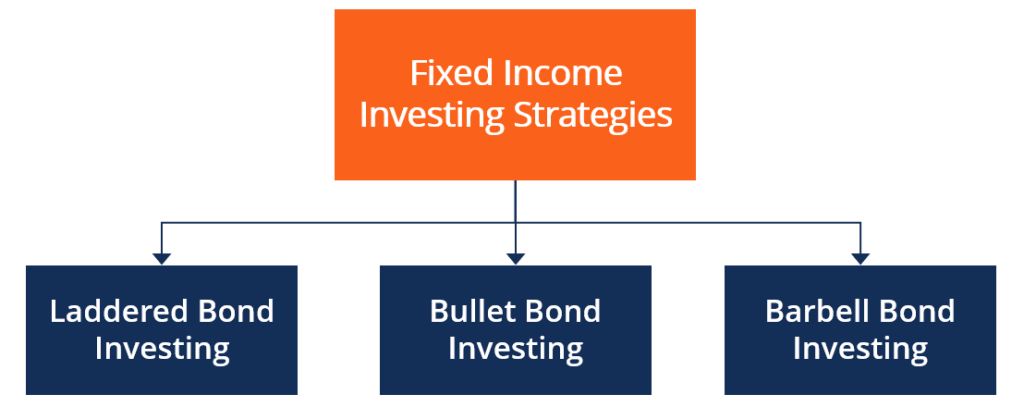
1. Laddered bond portfolio investing
The laddered bond portfolio investing strategy, commonly referred to as bond ladder investing, focuses on diversifying the portfolio by purchasing fixed income securities with different maturity dates in a ladder-like fashion, i.e., low to high rung-like fashion.
The diversified portfolio helps mitigate risk and benefit off of short-term bonds one at a time as and when they mature, then reinvesting the principal in higher-rung bonds. It ensures increasing returns and a profitable investment portfolio.
2. Bullet bond portfolio investing
Commonly referred to as bullet investing, the bullet bond portfolio investing strategy requires building a portfolio by purchasing fixed income securities at different dates but with the same maturity date. It diversifies the investment portfolio and, at the same time, ensures a future “bullet” of profitable returns.
The bullet investing strategy is generally adopted by investors who may need large amounts of funds in the future. It may be to fund a college education, pay for a wedding, purchase a large property, and many others.
3. Barbell bond portfolio investing
Barbell bond portfolio investing, commonly referred to as barbell investing, is a fixed income investing strategy that requires building a portfolio with two extremes, i.e., short-term and long-term bonds without intermediate bonds. The key fundamental factor behind the barbell investing strategy is to pay close attention to the short-term bonds of the portfolio and keep rolling them into new issues upon maturing.
Short-term bonds for a barbell portfolio are with a maturity of less than or equal to five years, and long-term bonds mature in ten years or higher. The strategy requires active managementActive ManagementActive management is the use of human capital to manage a portfolio of funds. Active managers rely on analytical research, personal judgment, and forecasts as one needs to focus on the short-term bonds to efficiently keep rolling them into new issues upon maturity.
Fixed Income Securities – Benefits
A portfolio primarily consisting of fixed income securities is beneficial in a number of ways, including:
1. Diversification
Building a portfolio essentially with fixed income securities brings diversificationDiversificationDiversification is a technique of allocating portfolio resources or capital to a variety of investments.The goal of diversification is to mitigate losses to the table. Diversification is a high priority characteristic that one needs to keep in mind when building their portfolio. It is especially true when the market is highly volatile and uncertain, with prices going up and down drastically.
Diversification helps bring resilience to the investment portfolio against such volatility and price corrections. It creates a sense of balance wherein if one section of the portfolio suffers, the portfolio is diverse enough to cover up the slack by having another section of high-performing securities.
2. Fixed income
The term “fixed income” securities provides some insight into why a portfolio that consists mainly of fixed income securities is preferred. Fixed income securities not only pay dividends and provide good returns but also offer a steady stream of income.
3. Risk level
Compared to equities, fixed income securities generally come with relatively lower exposure to risk. For the most part, it involves “default risk,” which is when the issuer of bonds is not able to meet their financial obligations.
Related Readings
CFI is the official provider of the global Capital Markets & Securities Analyst (CMSA)®Program Page - CMSAEnroll in CFI's CMSA® program and become a certified Capital Markets &Securities Analyst. Advance your career with our certification programs and courses. certification program, designed to help anyone become a world-class financial analyst. To keep advancing your career, the additional resources below will be useful:
- Investing: A Beginner’s GuideInvesting: A Beginner's GuideCFI's Investing for Beginners guide will teach you the basics of investing and how to get started. Learn about different strategies and techniques for trading
- Mutual FundsMutual FundsA mutual fund is a pool of money collected from many investors for the purpose of investing in stocks, bonds, or other securities. Mutual funds are owned by a group of investors and managed by professionals. Learn about the various types of fund, how they work, and benefits and tradeoffs of investing in them
- Default RiskDefault RiskDefault risk, also called default probability, is the probability that a borrower fails to make full and timely payments of principal and interest,
- Investment PortfolioInvestment PortfolioAn investment portfolio is a set of financial assets owned by an investor that may include bonds, stocks, currencies, cash and cash equivalents, and commodities. Further, it refers to a group of investments that an investor uses in order to earn a profit while making sure that capital or assets are preserved.
-

Income Smoothing: Definition, Methods & Implications
Income smoothing is a term used to refer to the different strategies and approaches used by accountants and financial analystsFinancial Analysts - What Do They Do to monitor or control the impact of h
-
Understanding Net Income: A Comprehensive Guide
Net income is the amount of accounting profit a company has left over after paying off all its expenses. Net income is found by taking sales revenueSales RevenueSales revenue is the income received by
invest
- Understanding Discretionary Income: Definition & Examples
- EBITDA Explained: Understanding Earnings Before Interest, Taxes, Depreciation & Amortization
- Understanding Financial Benchmarks: A Comprehensive Guide
- Fixed Income Forward Contracts: Definition & Uses
- Understanding Fixed Income Portfolio Mandates: A Comprehensive Guide
- Understanding Fixed Income Securities: A Comprehensive Guide
- Fixed Income ETFs: A Beginner's Guide to Lower-Risk Investing
- Understanding Fixed Income: A Comprehensive Guide
- Portfolio Rebalancing: A Comprehensive Guide for Investors
-
 Understanding Accounting Income: A Key Financial Metric
Accounting income is the profit a company retains after paying off all relevant expenses from sales revenue earned. It is synonymous with net incomeNet IncomeNet Income is a key line item, not only in...
-
 Accrued Income Explained: Definition & Accounting
Accrued income is income that a company will recognize and record in its journal entries when it has been earned – but before cash payment hast been received. There are times when a company will...