
Understanding Discretionary Income: Definition & Examples
Discretionary income is the amount of income that is left for an individual, household, or business after paying the necessary or essential expenses.

Necessary expenses are expenses that are required either by law or are needed for survival.
Discretionary income can be spent on non-essential goods and servicesProducts and ServicesA product is a tangible item that is put on the market for acquisition, attention, or consumption while a service is an intangible item, which arises from, vacations, luxury items, etc.
Understanding Discretionary Income
Discretionary income is the primary driver for a market-based economyMarket EconomyMarket economy is defined as a system where the production of goods and services are set according to the changing desires and abilities of. Since the overall economy’s success is based on the growth of production and spending, a key component of a flourishing economy is increasing discretionary income.
The three ways that discretionary income can be allocated include:
1. Spending
When individuals and households spend more of their discretionary income on goods and services, vacations, luxury items, and other nonessential items, money is funneled towards businesses that provide those goods and services.
The businesses can then reinvest the earnings to grow their operations, which leads to more jobs and further increases in discretionary income. Also, businesses can return the earnings to shareholders, which increases the shareholders’ discretionary income.
2. Investing
When individuals and households invest more of their discretionary income in various types of investments, it provides capital for businesses as well. The capital can be used to expand the businesses and lead to more jobs, as well as increased discretionary income.
The investments are expected to generate some sort of return to the investor, which increases the investor’s discretionary income later.
3. Saving
When individuals and households save more of their discretionary income, they usually do so through a bank or other financial institution.
A part of the banks’ business models is taking money from depositors/savers, keeping it safe for them, and lending out a portion of it to those who need the funds now. Borrowers can be individuals or businesses that usually use the funds for activities that further grow the economy.
Impact on the Economy
The economy will benefit from greater spending as opposed to saving, and central banks influence consumers’ propensity to consume or spend through monetary policyMonetary PolicyMonetary policy is an economic policy that manages the size and growth rate of the money supply in an economy. It is a powerful tool to.
An expansionary monetary policy that features low interest rates will incentivize individuals and households to save less and spend more.
On the other hand, a tight monetary policy that features higher interest rates will incentivize individuals and households to save more and spend less.
Discretionary Income vs. Disposable Income
Discretionary income is the income available after paying the necessary or essential expenses.
Examples of necessary expenses for an individual include:
- Taxes
- Certain forms of insurance
- Rent or mortgage payments
- Utility or other bill payments
- Food
- Clothing
Examples of necessary expenses for a business include:
- Paying employee salaries
- Inventories
- Supplies
- Rent
- Interest expenses to debt holders
- Debt repayments
- Utilities
Disposable income, on the other hand, refers to the income that is left after paying taxes. This is the take-home income that is available to pay for both essential and nonessential expenses.
Practical Example
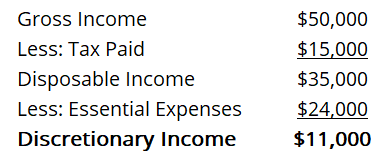
An individual receives an annual gross (pre-tax) income of $50,000. He pays a 30% tax rate over the year and incurs essential expenses of $2,000/month for bills, rent, and groceries, etc. What is his disposable income?
The amount of taxes paid is calculated as pre-tax income multiplied by the tax rate, as shown below:
$50,000 x 30% = $15,000
After taxes, the amount of disposable income is $35,000 ($50,000 – $15,000).
What is his discretionary income?
The amount spent on essential expenses over the year is the monthly expenses multiplied by twelve months in the year.
$2,000 x 12 months = $24,000
After taxes and essential expenses, the discretionary income is $11,000.
Related Readings
CFI is the official provider of the global Commercial Banking & Credit Analyst (CBCA)™Program Page - CBCAGet CFI's CBCA™ certification and become a Commercial Banking & Credit Analyst. Enroll and advance your career with our certification programs and courses. certification program, designed to help anyone become a world-class financial analyst. To keep advancing your career, the additional resources below will be useful:
- Marginal Propensity to ConsumeMarginal Propensity to ConsumeThe Marginal Propensity to Consume (MPC) refers to how sensitive consumption in a given economy is to unitized changes in income levels. MPC
- Cash FlowCash FlowCash Flow (CF) is the increase or decrease in the amount of money a business, institution, or individual has. In finance, the term is used to describe the amount of cash (currency) that is generated or consumed in a given time period. There are many types of CF
- Discretionary ExpenseDiscretionary ExpenseA discretionary expense is a non-essential expense that is incurred by an individual, household or business. Another way to think of discretionary
- Gross IncomeGross IncomeGross income refers to the total income earned by an individual on a paycheck before taxes and other deductions. It comprises all incomes
-

Understanding Federal Income Tax: A Comprehensive Guide
In many countries, taxes are imposed at the federal, state/provincial, and local level. The income tax that one pays at the federal level is determined by applying a predetermined rate to the earnings
-
Understanding Flow-Through Entities: Tax Advantages & Types
A flow-through entity – also known as a “pass-through entity” or “fiscally-transparent entity” – is a legal business entity where its profits flow directly to the i
finance
- Discretionary Income: Definition, Impact & Spending Trends
- EBITDA Explained: Understanding Earnings Before Interest, Taxes, Depreciation & Amortization
- Understanding Income: Definition, Types & Uses
- Understanding Income Properties: A Guide to Real Estate Investment
- Understanding Income Tax: A Comprehensive Guide for Individuals & Businesses
- Understanding Interest Income: A Comprehensive Guide
- Understanding Taxable Income: Definition & Calculation
- Understanding Accounting Income: A Key Financial Metric
- Net Income Explained: A Comprehensive Guide for Businesses & Individuals
-
 Understanding Discretionary Expenses: Definition & Examples
A discretionary expense is a non-essential expense that is incurred by an individual, household, or business. Another way to think of discretionary expenses is to classify them as “wants” ...
-
 EBIT Explained: Understanding Earnings Before Interest & Taxes
EBIT stands for Earnings Before Interest and Taxes and is one of the last subtotals in the income statementIncome StatementThe Income Statement is one of a companys core financial statements...