
Understanding Exchange-Traded Derivatives: Options & Futures
Exchange-traded derivatives consist mostly of options and futures traded on public exchanges, with a standardized contract. Through the contracts, the exchange determines an expiration dateExpiration Date (Derivatives)The expiration date refers to the date in which options or futures contracts expire. It is the last day of the validity of the derivatives contract., settlement process, and lot size, and specifically states the underlying instruments on which the derivatives can be created.
Hence, exchange-traded derivatives promote transparency and liquidity by providing market-based pricing information. In contrast, over-the-counter derivatives are traded privately and are tailored to meet the needs of each party, making them less transparent.
Summary
- Exchange-traded derivatives are futures and options with a standardized contract, traded on public exchanges.
- Common ETDs include stock, index, currency, commodities, and real estate derivatives.
- Standardized contracts increase liquidity and market depth. On the other hand, they reduce flexibility and eliminate the benefits of negotiation.
Types of Exchange-Traded Derivatives
1. Stock derivatives
Common stock is the most commonly traded asset classAsset ClassAn asset class is a group of similar investment vehicles. They are typically traded in the same financial markets and subject to the same rules and regulations. used in exchange-traded derivatives. Global stock derivatives are seen to be a leading indicator of future trends of common stock values.
2. Index derivatives
Index-related derivatives are sold to investors that would like to buy or sell an entire exchange instead of simply futures of a particular stock. Physical delivery of the index is impossible because there is no such thing as one unit of the S&P or TSX.
3. Currency derivatives
Exchange-traded derivatives markets list a few currency pairs for trading. Futures contracts or options are available for the pairs, and investors can choose to go long or short.
4. Commodities derivatives
The commodity market relates to the raw materials sector. Derivatives trading in commodities includes futures and options that are secured by physical assets or commodities.
5. Real estate derivatives
Real estate derivatives allow people to invest in real estate without ever owning physical buildings. They are widely traded and were at the heart of the 2008 Global Financial Crisis2008-2009 Global Financial CrisisThe Global Financial Crisis of 2008-2009 refers to the massive financial crisis the world faced from 2008 to 2009. The financial crisis took its toll on individuals and institutions around the globe, with millions of American being deeply impacted. Financial institutions started to sink, many were absorbed by larger entities, and the US Government was forced to offer bailouts.
Clearing and Settlement of Exchange-Traded Derivatives
Exchange-traded derivatives require an initial deposit settled through a clearinghouse. Clearinghouses will handle the technical clearing and settlement tasks required to execute trades. Most are also traded with a central clearing counterparty (CPP), which are highly regulated institutions that manage credit risk between two trading parties.
Benefits of Exchange-Traded Derivatives
1. Highly liquid
Exchange-traded derivatives have standardized contracts with a transparent price, which enables them to be bought and sold easily. Investors can take advantage of the liquidity by offsetting their contracts when needed. They can do so by selling the current position out in the market or buying another position in the opposite direction.
The offsetting transactions can be performed in a matter of seconds without needing any negotiations, making exchange-traded derivatives instruments significantly more liquid.
High liquidity also makes it easier for investors to find other parties to sell to or make bets against. Since more investors are active at the same time, transactions can be completed in a way that minimizes value loss.
2. Intermediation reduces the risk of default
Exchange-traded derivatives are also beneficial because they prevent both transacting parties from dealing with each other through intermediation. Both parties in a transaction will report to the exchange; therefore, neither party faces a counterparty risk.
The intermediate party, the exchange, is believed to be a credible party by most traders around the world. The exchange will act as an intermediary and assume the financial risk of their clients. By doing so, it effectively reduces default and credit risk for transacting parties.
3. Regulated exchange platform
The exchange is considered to be safer because it is subject to a lot of regulation. The exchange also publishes information about all major trades in a day. Therefore, it does a good job of preventing the few big participants from taking advantage of the market in their favor.
Disadvantage of Exchange-Traded Derivatives
Loss of flexibility
The standardized contracts of exchange-traded derivatives cannot be tailored and therefore make the market less flexible. There is no negotiation involved, and much of the instruments’ properties have been already outlined in the contracts.
Additional Resources
In order to help you become a world-class financial analyst and advance your career to your fullest potential, these additional resources will be very helpful:
- Capital MarketsCapital MarketsCapital markets are the exchange system platform that transfers capital from investors who want to employ their excess capital to businesses
- Credit RiskCredit RiskCredit risk is the risk of loss that may occur from the failure of any party to abide by the terms and conditions of any financial contract, principally,
- Commodity ValuationCommodity ValuationCommodity valuation is the process of deriving the intrinsic value of a commodity under optimal market conditions. In a perfectly competitive free market,
- Options: Calls and PutsOptions: Calls and PutsAn option is a derivative contract that gives the holder the right, but not the obligation, to buy or sell an asset by a certain date at a specified price.
-

Managed Futures: A Comprehensive Guide for Diversified Investing
Managed futures is a subclass of alternative investment strategies used by large funds and institutional investors to achieve both portfolio and market diversification. With the ability to take both l
-

Understanding Management Fees: What They Are & How They Work
Management fees are fees paid to professionals entrusted with managing investments on a client’s behalf. Typically determined as a percentage of the total assets under management (AUM)Assets Und
invest
- Baby Bonds: A Comprehensive Guide to Investing in Children's Futures
- Understanding Bonds: A Comprehensive Guide for Investors
- Understanding Commodities: A Beginner's Guide to Investing
- Defensive Industries: Stability in Economic Uncertainty | [Your Company Name]
- Understanding Financial Derivatives: A Comprehensive Guide
- Understanding Distressed Securities: Risks & Opportunities
- Understanding Equity Derivatives: A Comprehensive Guide
- Interest Rate Derivatives (IRDs): A Comprehensive Guide
- Vanguard ETFs: A Comprehensive Guide to Index-Tracking Investments
-
 Investment-Grade Bonds: Understanding Credit Risk & Ratings
An investment-grade bond is a bond classification used to denote bonds that carry a relatively low credit riskCredit RiskCredit risk is the risk of loss that may occur from the failure of any party to...
-
 Understanding Junk Bonds: Risks, Rewards, and Investment Strategies
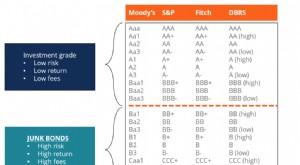
Junk bonds, also known as high-yield bonds, are bonds that are rated below investment grade by the big three rating agencies (see image below). Junk bonds carry a higher risk of defaultMarket Ri...