
Laddered Bond Portfolio: A Risk-Mitigating Investment Strategy
A laddered bond portfolio is an investment portfolio strategy that is composed of fixed income securities with different maturity dates. It is also referred to as a “bond ladder” portfolio.
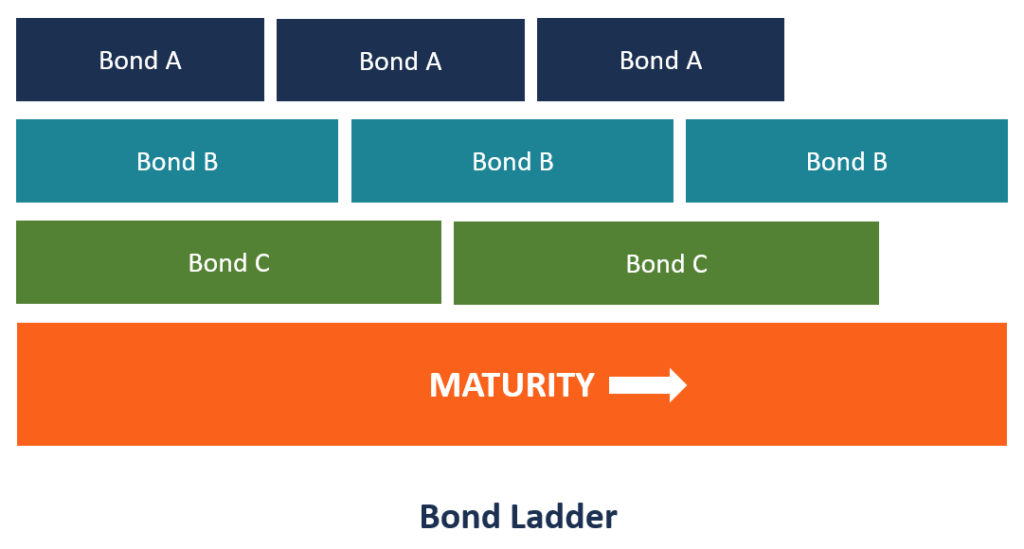
Summary
- A laddered bond portfolio is an investment portfolio strategy that is composed of fixed income securities with different maturity dates.
- A laddered bond portfolio involves several fixed income securities with significantly different maturity dates to minimize risk through a diversified portfolio.
- It is commonly referred to as the “bond ladder” portfolio in the investment world.
Why use a Bond Ladder?
A bond ladder allows an investor to mitigate risks through diversificationDiversificationDiversification is a technique of allocating portfolio resources or capital to a variety of investments.The goal of diversification is to mitigate losses. It comes with several fixed income securities with significantly different maturity dates to minimize risk through a diversified portfolio. It also helps to achieve increased liquidity of the portfolio.
How does a Laddered Bond Portfolio Work?
A laddered bond investment strategy requires the portfolio to be diversified with fixed income securities ranging from short-term to long-term bonds. The strategy works by diversifying the investment portfolio maturity date-wise to mitigate risk along the interest rate curve.
A laddered bond portfolio simply works by dispersing risk in a ladder-like fashion. If the short-term bonds or lower-rung bonds are maturing at a time when market conditions are unfavorable with rising interest rates, the principal amount can be reinvested in the higher-rung bonds. It mitigates interest rate riskInterest Rate RiskInterest rate risk is the probability of a decline in the value of an asset resulting from unexpected fluctuations in interest rates. Interest rate risk is mostly associated with fixed-income assets (e.g., bonds) rather than with equity investments., reinvestment risk, credit risk, and liquidity risk.
Bond Ladder Portfolio – Features
1. Multi-maturity investment strategy
The laddered bond portfolio is a multi-maturity investment strategy since it contains several fixed income bond investments with different maturity dates. The portfolio is diversified from short-term to long-term bonds and in a “ladder-like” fashion; that’s why it is also referred to as a laddered bond investment portfolio.
2. Diversification
The laddered bond portfolio includes several small fixed income securities with a range of maturity dates. It allows diversification to minimize risk.
3. Risk mitigation
The bond ladder portfolio strategy focuses on four different kinds of risk mitigation: interest-rate risk, credit riskCredit RiskCredit risk is the risk of loss that may occur from the failure of any party to abide by the terms and conditions of any financial contract, principally,, reinvestment risk, and liquidity risk. The diversification of the portfolio helps to achieve the purpose of mitigating any type of risk.
4. Flexibility with cash flow position
Since a laddered bond portfolio involves fixed income securities with a range of maturity dates spaced out from one another, the investor isn’t locked into one investment position until the maturity of the security. It provides some level of flexibility to adjust one’s cash flow position according to the prevailing market conditions.
5. Steady stream of income
The laddered bond portfolio also provides a steady stream of income, given the flexibility it offers to adjust one’s cash flowCash FlowCash Flow (CF) is the increase or decrease in the amount of money a business, institution, or individual has. In finance, the term is used to describe the amount of cash (currency) that is generated or consumed in a given time period. There are many types of CF position based on market conditions.
Why are Callable Bonds Avoided while Building a Laddered Bond Portfolio?
Callable bonds are essentially avoided while building a laddered bond portfolio since the essence of a laddered bond investment strategy is to diversify the portfolio with different fixed income securities with specified maturity dates. However, callable bonds forfeit this purpose because:
- They are callable prior to maturity.
- When they are called prior to maturity, the interest payments are no longer received, and the principal amount is returned as of the call date.
Illustrative Example
An investor decides to invest $90,000 using the bond ladder investment strategy. He creates an investment portfolio with a one-year bond of $15,000 at 4.25%, a two-year bond of $22,000 at 6%, a three-year bond of $25,000 at 6.25%, and a four-year bond of $28,000 at $6.50%.
When the one-year bond matures, the investor reinvests the principal in the bond at the higher rung, similarly following the same practice for the succeeding mature bonds, and so on. It is the bond ladder investment strategy.
Related Readings
CFI is the official provider of the Financial Modeling and Valuation Analyst (FMVA)™Become a Certified Financial Modeling & Valuation Analyst (FMVA)®CFI's Financial Modeling and Valuation Analyst (FMVA)® certification will help you gain the confidence you need in your finance career. Enroll today! certification program, designed to transform anyone into a world-class financial analyst.
To keep learning and developing your knowledge of financial analysis, we highly recommend the additional CFI resources below:
- RiskRiskIn finance, risk is the probability that actual results will differ from expected results. In the Capital Asset Pricing Model (CAPM), risk is defined as the volatility of returns. The concept of “risk and return” is that riskier assets should have higher expected returns to compensate investors for the higher volatility and increased risk.
- Callable BondCallable BondA callable bond (redeemable bond) is a type of bond that provides the issuer of the bond with the right, but not the obligation, to redeem the bond before its maturity date. The callable bond is a bond with an embedded call option. These bonds generally come with certain restrictions on the call option.
- Liquidity EventLiquidity EventA liquidity event is a process by which an investor liquidates their investment position in a private company and exchanges it for cash. The main purpose of a liquidity event is the transfer of an illiquid asset (an investment in a private company) into the most liquid asset – cash.
- Non-Callable BondNon-Callable BondA non-callable bond is a bond that is only paid out at maturity. The issuer of a non-callable bond can’t call the bond prior to its date of maturity. It is different from a callable bond, which is a bond where the company or entity that issues the bond owns the right to repay the face value of the bond
-

Understanding Amortizable Bond Premiums: A Comprehensive Guide
An amortizable bond premium refers to the excess amount paid for a bond over its face value or par valuePar ValuePar Value is the nominal or face value of a bond, or stock, or coupon as indicated on a
-

Amortized Bonds: Understanding Principal Repayment
An amortized bond is a bond with the principal amount – otherwise known as face value –regularly paid down over the life of the bond. The bond’s principal is divided up according to
invest
- Active Bond Portfolio Management: Strategies & Benefits
- Barbell Bond Portfolio: Strategy, Benefits & Risk
- Understanding Financial Benchmarks: A Comprehensive Guide
- Bullet Bond Portfolios: A Comprehensive Guide
- Coupon Bonds: Understanding Fixed Income & Interest Payments
- Discount Bonds: Understanding Pricing & Secondary Markets
- Understanding Noncallable Securities: A Comprehensive Guide
- Samurai Bonds: A Guide to Understanding Yen-Denominated Corporate Debt
- Treasury Bonds: A Comprehensive Guide to U.S. Government Debt
-
 Understanding Bond Accretion: A Comprehensive Guide
Accretion is a finance term that refers to the increment in the value of a bond after purchasing it at a discount and holding it until the maturity date. A bond is said to be purchased at a discount p...
-
![Active Management: Strategies & How It Works | [Your Company Name]](https://www.etffin.com/article/uploadfiles/202110/2021100815211459_S.jpeg) Active Management: Strategies & How It Works | [Your Company Name]
Active Management: Strategies & How It Works | [Your Company Name]Active management is the use of human capital to manage a portfolio of funds. Active managers rely on analytical research, personal judgment, and forecasts to make decisions on what securities to buy,...