
Long Strangle Options Strategy: Definition & How It Works
A long strangle is a neutral-approach options strategy – otherwise known as a “buy strangle” or purely a “strangle” – that involves the purchase of a call and a put. Both optionsOptions: Calls and PutsAn option is a derivative contract that gives the holder the right, but not the obligation, to buy or sell an asset by a certain date at a specified price. are out-of-the-money (OTM), with the same expiration dates.

In order to make any type of profit, a significant price swing is crucial. The primary goal is to make a profit off of the stock, provided it moves either up or down by a substantial amount. Having both a call and a put increases the cost of the position while doubling its chances of success.
Summary:
- The long strangle is a low-cost, high-potential-reward options strategy whose success depends on the underlying stock either rising or falling in price by a substantial amount.
- The maximum cost and potential loss of the long strangle strategy is the price paid for the two options, plus transaction costs.
- Maximum potential profit is unlimited.
Using the Long Strangle Strategy
First, a trader must find a stock that likely to swing significantly, either up or down, in the near future. Keep in mind that while a stock near an earnings announcementEarnings CallAn earnings call is a conference call (typically held in the form of a teleconference or a webcast) during which the management of a public company announces and discusses the financial results of a company for a quarter or a year. Generally, the earnings call is accompanied by an official press release is a tempting play, it should usually be avoided. In reality, the price of the options is usually “baked in,” meaning, you aren’t likely to see a serious profit, despite the fact that the stock is likely to spike.
Instead, look for other factors that may make a stock price rise or fall substantially, such as the following:
- A controversy
- The hiring of new fundamental role-players: CEOCEOA CEO, short for Chief Executive Officer, is the highest-ranking individual in a company or organization. The CEO is responsible for the overall success of an organization and for making top-level managerial decisions. Read a job description, CFO, etc.
- The launch of a new good or service
Now, it’s time to put in a purchase for an out of the money put and an equally out of the money call. Both positions are long; remember that the closer the contract gets to their dates of expiration, the positions will decline in value.
Time works against the trader using the long strangle strategy, so it’s best to purchase options that come with a decent amount of time – at least a couple of months – before expiration. Doing so also makes the long strangle strategy more likely to be profitable, as the “losing” option, whichever one that turns out to be, will still retain some time value even if it is well out of the money.
Profit and Loss with a Long Strangle
The basic idea behind using a long strangle strategy is as follows:
As long as the price of the underlying stock moves significantly in one way or the other – either toward making the call option profitable or toward making the put option profitable – the profit realized from the winning option will be more than sufficient to show a net profit after deducting the cost of implementing the strategy. The total cost of the strategy is the premium paid for each of the options, plus transaction fees such as commissionCommissionCommission refers to the compensation paid to an employee after completing a task, which is, often, selling a certain number of products or services.
The illustration below shows the profit/loss scenario for a stock that is trading at $40 when the option investor buys a $50 strike price call and a $30 strike price put option. Let’s assume that the premium – the cost – of each option is $100. It makes the total investment for the strategy $200 plus transaction costs, which represents the maximum potential loss. The maximum loss will occur only if the stock stays – until the expiration of the options – at or near the same price it was trading at when the options were purchased.
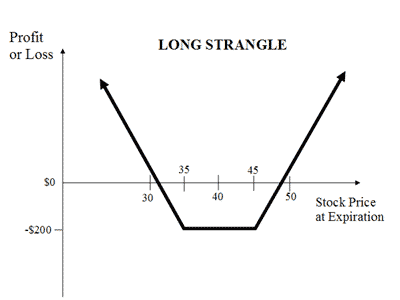
Any substantial movement in the price of the stock, either up or down, can make the strategy profitable. Staying with the example of the strategy implemented by purchasing a $50 call and $30 put on a stock trading at $40 – if the stock’s price rises to, say, $48, then the call option increases in value considerably. Also, if the stock’s price drops to $32, then the put option significantly increases in value.
Once the price of either one of the options becomes greater than the total cost of both options, then the investor can sell both options for a profit. For example, if the stock’s price rises to $48, making the $50 call option just out of the money, that option’s premium value may increase from $100 to perhaps $250. The $30 strike price put option’s value may decline to $25. The investor can then liquidate both option positions for a total of $275. His profit would then be $75 ($275 – $200 cost of the options), minus transaction fees.
The maximum potential profit with a long strangle is unlimited. The strategy generates considerable profits if the underlying stock moves enough to place one option or the other in-the-money.
The attractiveness of a long strangle option strategy is its relatively low risk/cost that secures an opportunity for a substantial profit in the near term.
Related Readings
CFI is the official provider of the Financial Modeling and Valuation Analyst (FMVA)™Become a Certified Financial Modeling & Valuation Analyst (FMVA)®CFI's Financial Modeling and Valuation Analyst (FMVA)® certification will help you gain the confidence you need in your finance career. Enroll today! certification program, designed to transform anyone into a world-class financial analyst.
To keep learning and developing your knowledge of financial analysis, we highly recommend the additional resources below:
- Long and Short PositionsLong and Short PositionsIn investing, long and short positions represent directional bets by investors that a security will either go up (when long) or down (when short). In the trading of assets, an investor can take two types of positions: long and short. An investor can either buy an asset (going long), or sell it (going short).
- Short CoveringShort CoveringShort covering, also called "buying to cover", refers to the purchase of securities by an investor to close a short position in the stock market. The process is closely related to short selling. In fact, short covering is part of short selling
- Swing TradingSwing TradingSwing trading is a trading technique that traders use to buy and sell stocks when indicators point to an upward (positive) or downward (negative) trend
- Top Accounting ScandalsTop Accounting ScandalsThe last two decades saw some of the worst accounting scandals in history. Billions of dollars were lost as a result of these financial disasters. In this
-

Anchoring Bias: Understanding How First Impressions Influence Decisions
Anchoring bias occurs when people rely too much on pre-existing information or the first information they find when making decisions. For example, if you first see a T-shirt that costs $1,200 –
-
Arbitrage Explained: Understanding and Capitalizing on Price Differences
Arbitrage is the strategy of taking advantage of price differences in different markets for the same assetTypes of AssetsCommon types of assets include current, non-current, physical, intangible, oper
invest
- PC Banking: A Comprehensive Guide to Online Banking Security & Features
- IRA CDs: Secure Retirement Savings with FDIC Insurance
- Long-Term Debt (LTD): Definition, Types & Impact
- Basis Trading: Definition, Strategy & How It Works
- Understanding Strangle Options: A Comprehensive Guide
- Synthetic Long Assets: Strategy, Risks & Rewards
- Long-Term Assets: Definition, Examples & Importance
- Understanding Cryptocurrency: A Beginner's Guide to Digital Currency
- Understanding Market Positions: Long, Short, and Flat Strategies
-
 0x: A Comprehensive Guide to Decentralized Ethereum Trading
What Is 0x? 0x is a decentralized exchange for trading ERC 20 tokens. (See also: What Is ERC 20 And What Does It Mean For Ethereum?). It is among the most high-profile examples of decentra...
-
Annuities Explained: A Simple Guide to Retirement Income
So you're wondering what is an annuity? There are dozens of different flavours of annuities that perform different functions and pay their holders out in different ways, but for our purposes let’...