
Understanding Strangle Options: A Comprehensive Guide
Strangle is an investment methodInvestment MethodsThis guide and overview of investment methods outlines they main ways investors try to make money and manage risk in capital markets. An investment is any asset or instrument purchased with the intention of selling it for a price higher than the purchase price at some future point in time (capital gains), or with the hope that the asset will directly bring in income (such as rental income or dividends). in which an investor holds a call and a put option with the same maturity date, but has different strike prices. In a strangle strategy, a holder in effect, combines the features of both a call and a put option into a single trade, and the overall position is the net of the two options.
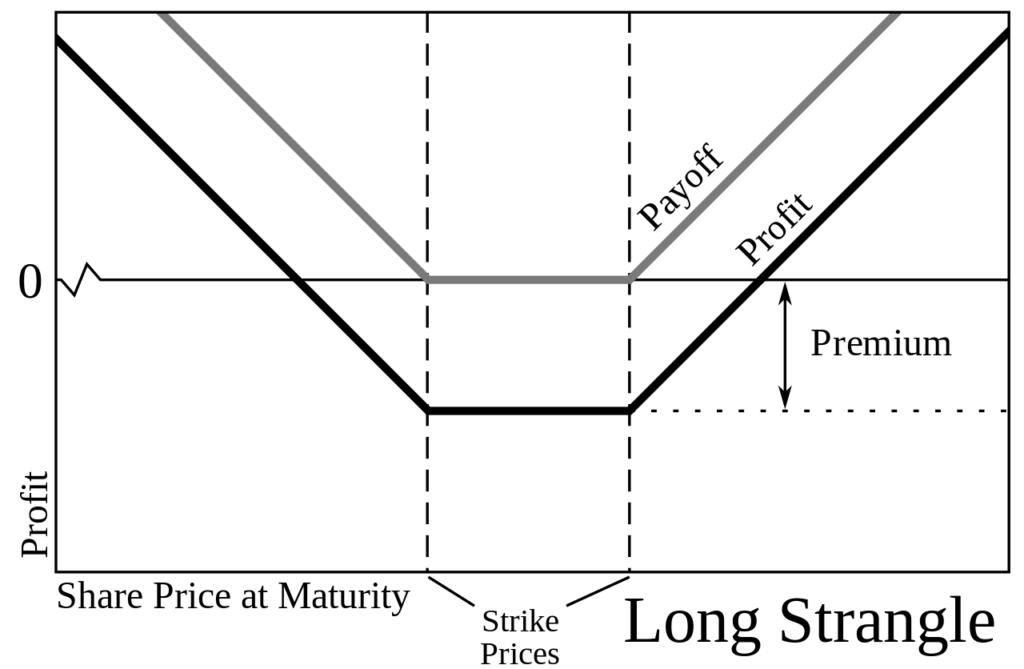
A strangle is a good investing strategy if the investor thinks that the underlying security is vulnerable to a large near term price movement. Executing a strangle means that the investor is betting for a large price movement upwards or downwards in the underlying stock.
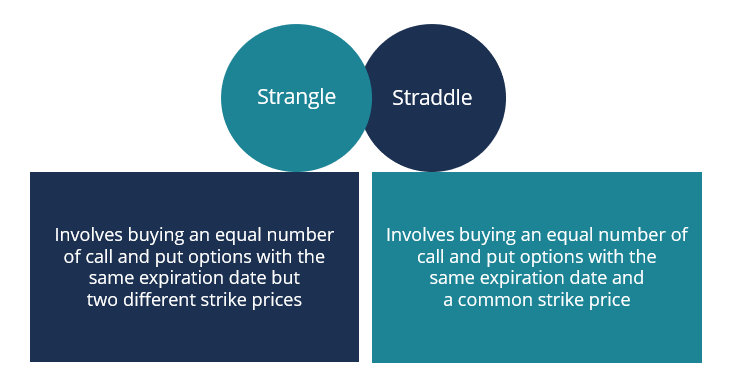
Although a strangle and straddle are similar, the former involves two different strike prices. In a straddle, both call and put options share similar strike pricesStrike PriceThe strike price is the price at which the holder of the option can exercise the option to buy or sell an underlying security, depending on and expiration dates.
Summary
- Strangle refers to a trading strategy in which the investor holds a position in a security with both a call and a put option with different strike prices, but the same expiration date..
- It is used when the investor believes there will be a large price swing in the underlying asset, but is unsure of the direction..
- A strangle shares similar trading features with a straddle, except that the former involves two different strike prices, and the latter used the same strike price.
How a Strangle Works
Long Strangle
A long strangle is a popular strategy among investors, where both a long call and long put with different strike prices – but with the same expiration date – are purchased simultaneously.
Typically, the call option has a higher strike price than the current market price of the underlying stock, while the put option has a strike price that is lower than the current market price. This trading strategy has unlimited profit potential on both sides of the market. Profit is earned when the underlying asset moves beyond a break-even point in either direction.
The maximum loss is limited to the premium paid for the two options and occurs when the underlying asset, at expiration, is between the market prices. It has two break-even points – the call strike option’s market price plus the debit, and the strike price of the put option less the debit.
A long strangle is affected by the time decay’s effects. Before the expiration date, a strangle value increases with an increase in volatilityVolatilityVolatility is a measure of the rate of fluctuations in the price of a security over time. It indicates the level of risk associated with the price changes of a security. Investors and traders calculate the volatility of a security to assess past variations in the prices and decreases with a decrease in volatility.
Short Strangle
On the other hand, a short strangle involves the investor simultaneously selling call and put options at different market prices but with the same maturity date. The strategy is beneficial to investors since a premium is collected from the sale of both options, but only if the price of the underlying asset stays within the two strike prices and the options both expire.
Investors execute the short strangle strategy with the expectation that the underlying stock’s price will fluctuate back and forth within a range, resulting in the time decay of both options. If the price increases beyond the call options strike price or below the put options strike price the option will be exercised and the short strangle will lead to a loss.
Investors realize the maximum profit which is the net premium for writing the two options, when the underlying asset stays between the strike prices of both options. The back-and-forth fluctuation leads to a profit since the options will not be exercised by the holder of the options.
As with long strangle, short strangle has two break-even points – the sum of the premium credit collected and the short call’s market price, and the short put’s strike price less the collected premium.
Strangle vs. Straddle
A strangle and a straddle share a few characteristics because they earn profits when there are large back-and-forth movements in an underlying security. Similarly, a short straddle and short strangle are the same, with a limited profit equal to the collected premium from both options less trading costs.
Nevertheless, a long straddle involves buying both the call and put options at the same strike price, where profits can be made when prices are either up or down. The options purchased are in-the-money options.
With a long straddle, investors profit before expiration when the strike price of a call or put option exceeds the total premium paid from both sides of a trade. This implies that a straddle does not necessarily require a large price jump to be profitable.
Another difference that sets the two strategies apart is that a strangle is generally less expensive but laden with higher risk because the underlying asset must make a bigger movement to generate a profit. This is because out of the money options are purchased.
Pros and Cons of a Strangle
Pros
- Offers profit potential on upward or downward price movements
- Less expensive compared to other trading strategies such as straddle
- Offers unlimited profit potential in both directions
Cons
- Only profitable following a massive change in the underlying asset’s strike price
- Comes with more risks compared to other strategies, as out of the money options are used.
- Effects of time decay reduce profits
Additional Resources
CFI offers the Capital Markets & Securities Analyst (CMSA)™Program Page - CMSAEnroll in CFI's CMSA® program and become a certified Capital Markets &Securities Analyst. Advance your career with our certification programs and courses. certification program for those looking to take their careers to the next level. To keep learning and advancing your career, the following resources will be helpful:
- StraddleStraddleA straddle strategy is a strategy that involves simultaneously taking a long position and a short position on a security. Consider the following example: A trader buys and sells a call option and put option at the same time for the same underlying asset at a certain point of time
- Options: Calls and PutsOptions: Calls and PutsAn option is a derivative contract that gives the holder the right, but not the obligation, to buy or sell an asset by a certain date at a specified price.
- Market PriceMarket PriceThe term market price refers to the amount of money for what an asset can be sold in a market. The market price of a given good is a point of convergence
- Call PremiumCall PremiumA call premium refers to the amount above par value an investor receives when the debt issuer redeems the security earlier than its maturity date.
-
Understanding Dealer Markets: How Market Makers Function
A dealer market is a financial market where dealers post prices they would be willing to buy and sell specific securitiesTrading SecuritiesTrading securities are securities purchased by a company for
-

Understanding Delta: A Key Risk Measure in Derivatives
Delta is a risk sensitivity measure used in assessing derivativesDerivativesDerivatives are financial contracts whose value is linked to the value of an underlying asset. They are complex financial in
invest
- Understanding Divergence in Technical Analysis: A Guide
- Understanding Forward Prices: Definition & How They Work
- Understanding Hedging Strategies: A Comprehensive Guide
- Long Strangle Options Strategy: Definition & How It Works
- Understanding Slippage in Trading: Causes & Impact
- Understanding Strangle Options: A Comprehensive Guide
- Understanding Volatility: A Key Indicator of Investment Risk
- Price Discrimination Explained: Types, Examples & Strategies
- What is Price Fixing?
-
 Commodity Valuation: Understanding Intrinsic Value & Market Pricing
Commodity valuation is the process of deriving the intrinsic value of a commodity under optimal market conditions. In a perfectly competitive free market, the price of a commodity reflects the intrins...
-
 Covered Calls: A Comprehensive Guide for Investors
A covered call is a risk management and an options strategy that involves holding a long position in the underlying asset (e.g., stockStockWhat is a stock? An individual who owns stock in a company is...