
Timberland Investment: A Guide to Growing Wealth with Trees
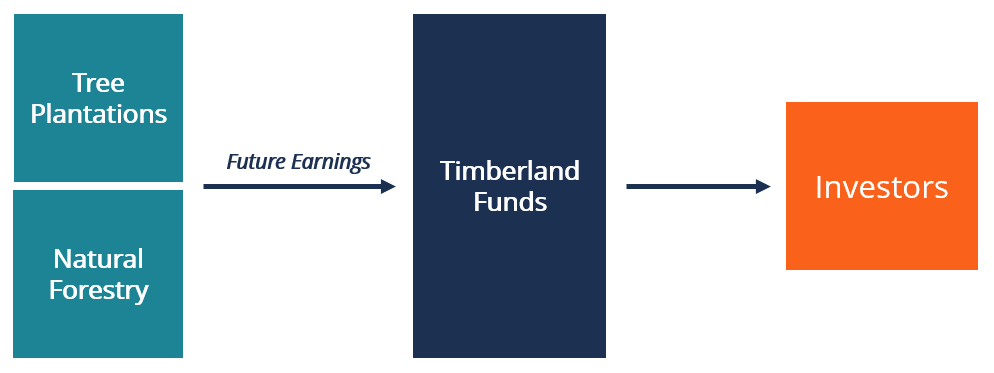
Timberland refers to an alternative form of investment that involves putting money into trees, either in managed tree plantations or natural forests. Investors bank on the predictable biological growth of the trees to increase in value so that they can be sold at a future date for their wood. Timberland investments provide an opportunity for investors who want to diversify their portfolio of investments.

Trees offer a greater sense of reassurance because they increase in volume by an average of 5% each year, depending on the tree species, climate, age, and other factors. The tangible growth provides an alternative investment opportunity for investors looking to put their money in safer investments that are not affected by the ever-unpredictable economic climate.
In the United States, there are millions of tree plantations and natural forests that are owned by pension funds, individual investorsInvestorAn investor is an individual that puts money into an entity such as a business for a financial return. The main goal of any investor is to minimize risk and, university endowment funds, etc. Investors can become shareholders in such ventures through a variety of investment vehicles.
Quick Summary
- Timberland is an alternative form of investment that involves investing in forests and banking on the biological growth of trees to earn a return when they are harvested.
- Timberland investments are used by institutional investors such as pension funds, charitable funds, and university endowments to diversify their portfolio of investments.
- The underlying assets of timberlands are the tree plantations or maintained natural forests.
How Timberland Investment Diversity Stock Portfolio
Timberland, as an investment instrument, is popular among large institutional investors such as pension funds and university endowments, with the main underlying assets being managed tree plantations and tree farms. It is estimated that Timber Investment Management Organizations (TIMO), which are tasked with managing timberland investments, manage over 23 million acres of forest plantations, accounting for about 7% of privately-owned forest farms and managed tree plantations in the US.
As an alternative investment, timberland provides a good opportunity for diversifying a portfolio of stocks and fixed-income investments, as well as a hedge against inflationInflationInflation is an economic concept that refers to increases in the price level of goods over a set period of time. The rise in the price level signifies that the currency in a given economy loses purchasing power (i.e., less can be bought with the same amount of money).. Both the timber and land components appreciate in value over time, and they are not tied to traditional financial markets.
Investors get periodic cash returns from the sale of timber. In addition, they can lease out part of the undeveloped land to earn lease income from other investors. Landowners can also exploit the value of the land by introducing various outdoor activities such as camping, fishing, and hiking that serve as an additional income stream.
Why Timberland is an Attractive Alternative Investment
The following are some of the reasons why timberland makes a good alternative investment for investors looking to diversify their portfolio of investments:
1. Ease of investing
Becoming a timberland investor is a straightforward process, and investors can achieve this in two ways. The first option is to acquire forest land directly from the owner. It requires a high capital input since the investor will be acquiring the trees and the land itself where the trees are planted. An investor can finance the land acquisition using a mortgage obtained from a financial institution.
The other alternative is to purchase shares of real estate investment trusts (REIT)Real Estate Investment Trust (REIT)A real estate investment trust (REIT) is an investment fund or security that invests in income-generating real estate properties. The fund is operated and owned by a company of shareholders who contribute money to invest in commercial properties, such as office and apartment buildings, warehouses, hospitals, shopping centers, student housing, hotels that focus on timber. REITs invest in the real estate industry. They allow investors to purchase shares in public exchanges in order to become part-owners of a company. The capital input can range from a few hundred dollars to millions of dollars, depending on what the investor can afford. The revenues earned by the REIT from selling trees and forest land are then distributed to the investors as dividends.
2. Biological growth
One of the attractive features of trees is that they grow physically. They increase in weight and density on a consistent basis from one year to the next. The growth is dependent on various factors such as climate, type of soil, species, etc.
In addition, better site conditions and proper tree management will improve the annual growth rates of the trees in the plantation. The US Forest Service uses a model that predicts the growth and model for different species of trees in various states.
3. Price appreciation
Stocks are volatile by nature, requiring investors to keep abreast of the happenings in the financial markets to know when to buy or sell their stocks. The only proof that investors own the shares is the stock certificate, and it can be devalued during periods of hyperinflationHyperinflationIn economics, hyperinflation is used to describe situations where the prices of all goods and services rise uncontrollably over a defined.
On the contrary, timber is a limited physical product that has experienced a steady price appreciation over the years. The price appreciation directly correlates to the increasing demand for timber, which is an important material in the construction industry.
The growth of the housing market offers an advantage to timberland investors who are banking on the biological growth of the tree plantations to meet the demand, and, in exchange, earn a return on their investment.
4. Land appreciation
Land appreciation is the increase in the value of land over a given period of time. Historically, land has been known to appreciate at a slow pace, but there are certain things that landowners can do to increase its value.
First, having a well-maintained forest with a good road network in a high population area can attract a high value. The forest land can be leased for use in recreational activities such as camping, hiking, hunting, etc. When the trees have matured, they can be harvested, and the land can be converted into an industrial park, golf course, or even a shopping mall.
Related Readings
CFI offers the Financial Modeling & Valuation Analyst (FMVA)™Become a Certified Financial Modeling & Valuation Analyst (FMVA)®CFI's Financial Modeling and Valuation Analyst (FMVA)® certification will help you gain the confidence you need in your finance career. Enroll today! certification program for those looking to take their careers to the next level. To keep learning and developing your knowledge base, please explore the additional relevant resources below:
- DiversificationDiversificationDiversification is a technique of allocating portfolio resources or capital to a variety of investments.The goal of diversification is to mitigate losses
- FarmlandFarmlandFarmland refers to land that is specifically used for growing crops or raising livestock and that's been allocated in zoning laws for agricultural purposes
- Investing: A Beginner’s GuideInvesting: A Beginner's GuideCFI's Investing for Beginners guide will teach you the basics of investing and how to get started. Learn about different strategies and techniques for trading
- Rate of ReturnRate of ReturnThe Rate of Return (ROR) is the gain or loss of an investment over a period of time copmared to the initial cost of the investment expressed as a percentage. This guide teaches the most common formulas
-

Micro-Investing Platforms: A Beginner's Guide to Small Investments
A micro-investing platform is an application that eases the process of investment by enabling users to save and invest small amounts of money periodically. Micro-investing platforms are different from
-

Non-Qualifying Investments: Understanding Tax Implications
A non-qualifying investment is a type of investment that can never be subject to any tax benefits. Tax benefits include deductions, exemptions, and credits. The benefits are used to reduce taxable inc
invest
- Alternative Investments: A Comprehensive Guide to Tangible & Financial Assets
- Understanding Investments: A Beginner's Guide to Growth & Income
- AIM Explained: Investing in High-Growth Companies on the London Stock Exchange
- Understanding Drawdowns: A Key Investment Risk
- Farmland Investing: A Sustainable Alternative Asset Class
- Understanding Investment Horizon: A Comprehensive Guide
- Brownfield Investment: Definition, Benefits & Examples
- Investment Trusts Explained: A Comprehensive Guide
- Hedging Explained: Protect Your Investments from Risk
-
 Investment Portfolio: Definition, Types & Building a Strong One
An investment portfolio is a set of financial assets owned by an investor that may include bondsBondsBonds are fixed-income securities that are issued by corporations and governments to raise capital....
-
 Loss Aversion: Understanding the Psychology of Financial Decisions
Loss aversion is a tendency in behavioral financeBehavioral FinanceBehavioral finance is the study of the influence of psychology on the behavior of investors or financial practitioners. It also inclu...