
Understanding Net Unrealized Appreciation (NUA) for Employees
Net unrealized appreciation (NUA) occurs when employees own stock in the company where they are employed, and there is a difference between the average cost basisAverage Cost BasisAverage cost basis is defined as the means to attribute the purchase price to shares underlying a mutual fund or an account managed by a custodian (broker) and the current market value of the shares owned.
Several companies give employees stock ownership in the company as a form of compensation or incentive.

Summary
- Net unrealized appreciation (NUA) occurs when there is a difference between the average cost basis and the current market value of the shares owned by the employee.
- NUA can lead to significant tax savings for the person holding the stock.
- Under the Internal Revenue Code (IRC), a stock needs to meet three criteria in order for the favorable NUA tax treatment to hold – stock should be distributed in-kind, lump-sum distribution should be made by the employer retirement plan, and lump-sum distribution should be made after a triggering event.
Taxation for NUA Stock
When employees retire or exit a company, they can deal with the company stock they’ve accumulated over time from the employer in two ways:
The first way is to roll the assets over to an IRA (individual retirement account)SEP IRAA SEP IRA (Simplified Employee Pension Individual Retirement Arrangement) is a slight variation of traditional IRAs that are used by businesses for, which is a tax-advantaged tool for those who want to set aside funds for retirement.
The second way is called the net unrealized appreciation method, which allows employees to distribute the stock in a taxable account under distinct tax policies, leading to significant tax savings relative to the first approach.
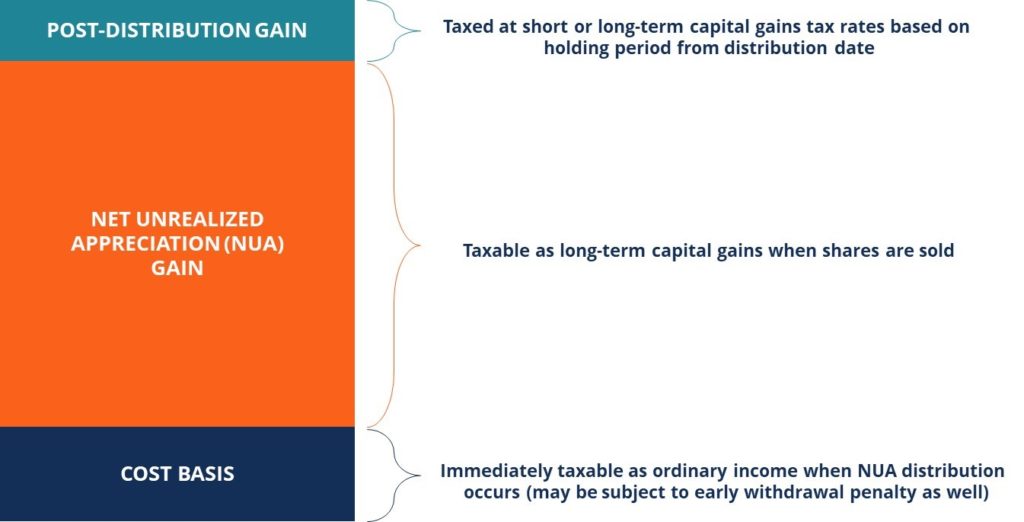
The employees pay income tax on the cost basis of the stock they own and pay a lower capital gains taxCapital Gains TaxCapital gains tax is a tax imposed on capital gains or the profits that an individual makes from selling assets. The tax is only imposed once the asset has been converted into cash, and not when it’s still in the hands of an investor. on the remaining distribution (only when the stock is sold, and gains are realized).
If the shares are held after the distribution, subsequent gains will be taxed at the short or long-term capital gains tax rate, based on the period from the distribution date to the date of sale.
In such a scenario, if a loss occurs, the amount of net unrealized appreciation gain will be reduced by the corresponding amount.
The age of the investor is an important aspect to consider regarding the effectiveness of the tax treatment of NUA. The older a person is, the shorter their retirement time horizon, and therefore, the NUA is more beneficial.
For a younger person, there is a lot of time for the assets to roll over to an IRA and grow on a deferred tax basis. This may result in the lower capital gains tax rate benefit being offset by the growth in your account.
The figure below illustrates the taxation treatment for different components of an NUA stock. There is a possibility that NUA gains may be deferred for a significant period of time, as there is no requirement that the NUA stock is to be sold immediately.
Requirements for NUA Tax Treatment
According to the Internal Revenue Code (IRC), a stock needs to meet three criteria in order for the above mentioned NUA tax treatment to hold:
1. Stock should be distributed in-kind
For the above condition to hold, the stock owned by the employee must be transferred directly to a taxable investment account. They are not allowed to sell shares and transfer the cash or use stock options or repurchases, and the NUA tax treatment will not hold for the options.
2. Lump-sum distribution should be made by the employer retirement plan
Under such a condition, the complete account balance of the retirement plan401(k) PlanThe 401(k) plan is a retirement savings plan that enables employees to save a portion of their salary before taxes throguh contributing to a retirement fund must be distributed over a single tax year. No amount can stay in the plan after the distribution.
3. Lump-sum distribution should be made after a triggering event
For the above two conditions to hold, the distribution must be made after a triggering event.
A triggering event can be characterized by death, disability, ending of service, or reaching retirement age. Therefore, a stock will not qualify for NUA treatment if a person is working, and a triggering event has not occurred.
Tax Savings Example Using NUA
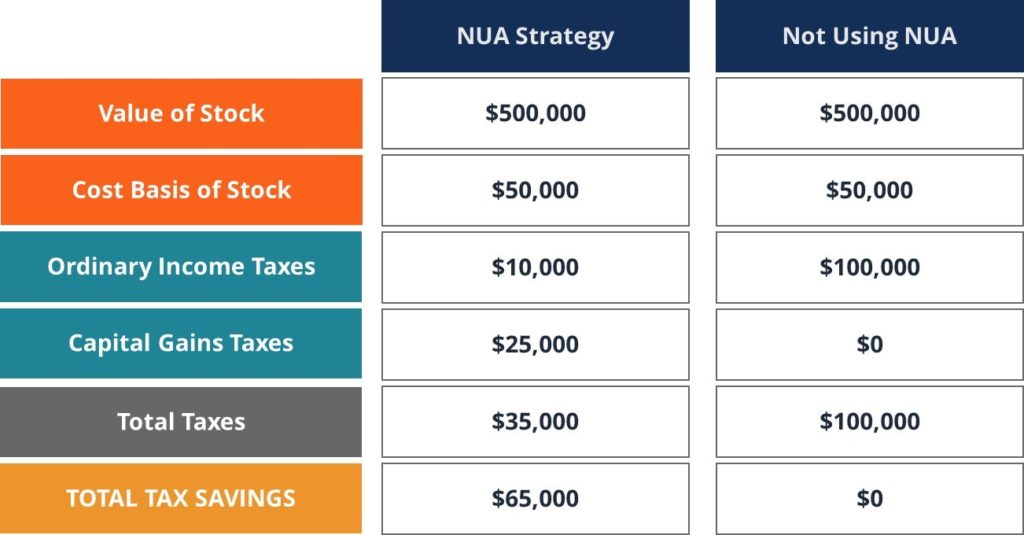
A person owns $500,000 worth of company stock. We assume that they fall in the 20% marginal tax rate bracket. They assign a cost basis of $50,000 to the stock.
Suppose the person uses the NUA strategy and distributes their cost basis out to their non-retirement account. They will need to pay a 20% tax on the cost basis of $50,000 ($10,000). When the person sells the stock, they pay capital gains tax amounting to $25,000. Therefore, their total taxes are equal to $35,000.
Let’s consider the same example without using the NUA strategy. When the person withdraws the amount invested in the stock, they pay the income tax on the entire value of the stock and not only the cost basis.
Therefore, they will pay a 20% tax on $500,000 ($100,000). It is their total taxes for the year. We can see that using the NUA strategy, the person was able to save $65,000 in taxes on an annual basis.
Related Readings
CFI offers the Commercial Banking & Credit Analyst (CBCA)™Program Page - CBCAGet CFI's CBCA™ certification and become a Commercial Banking & Credit Analyst. Enroll and advance your career with our certification programs and courses. certification program for those looking to take their careers to the next level. To keep learning and advancing your career, the following resources will be helpful:
- Stock OptionStock OptionA stock option is a contract between two parties which gives the buyer the right to buy or sell underlying stocks at a predetermined price and within a specified time period. A seller of the stock option is called an option writer, where the seller is paid a premium from the contract purchased by the stock option buyer.
- Employee Stock Ownership Plan (ESOP)Employee Stock Ownership Plan (ESOP)An Employee Stock Ownership Plan (ESOP) refers to an employee benefit plan that gives the employees an ownership stake in the company. The employer allocates a percentage of the company’s shares to each eligible employee at no upfront cost. The distribution of shares may be based on the employee’s pay scale, terms of
- Income Tax PayableIncome Tax PayableIncome tax payable is a term given to a business organization’s tax liability to the government where it operates. The amount of liability will be based on its profitability during a given period and the applicable tax rates. Tax payable is not considered a long-term liability, but rather a current liability,
- Stock-Based CompensationStock Based CompensationStock Based Compensation (also called Share-Based Compensation or Equity Compensation) is a way of paying employees and directors of a
-

Black Tuesday: Causes, Impact, and Historical Significance
Black Tuesday is the stock market crash that occurred on October 29, 1929. It is considered the most disastrous market crash in the history of the United States. The Black Tuesday event was preceded b
-

Defensive Stocks: A Guide to Stable Investments
A defensive stock is a stock that demonstrates relatively stable performance regardless of the current state of the economy. Defensive stocks are also called non-cyclical stocks, as they are less pron
invest
- Understanding Stock Price Appreciation: A Guide for Investors
- Understanding Net of Tax: Definition & Calculation
- Understanding Downtrends: Definition, Identification & Reversal
- Understanding Net Change: Definition & Calculation
- Understanding Non-Assessable Stock: Limited Liability Explained
- Understanding Overweight Stocks: A Comprehensive Guide
- Understanding Qualifying Dispositions: Tax Benefits for Stock Sales
- Stock Indexes Explained: A Beginner's Guide to Market Benchmarks
- Net Income After Tax (NIAT): Definition & Importance
-
 Allotment Explained: Resource & Equity Distribution in Business
The term allotment, in business, refers to the structured and systematic distribution of the business’ resources. Commonly, the term allotment is used in the context of equity distribution in fi...
-
 Black Monday 1987: Causes, Impact & Historical Significance
“Black Monday” – as it is referenced today – took place on October 19 (a Monday) in 1987. On this day, stock markets around the world crashed, though the event didn’t hap...