
NIFTY 50 Index: Understanding India's Top 50 Stocks | NSE
NIFTY 50 is the most important index of the National Stock Exchange of India Limited (NSE)National Stock Exchange of India Limited (NSE)The National Stock Exchange of India Limited (NSE) is the largest financial exchange in the Indian market. It was established in 1992 on the recommendation, which is located in Mumbai. It evaluates the performance of 50 blue-chip stocks, the most reliable and liquid among Indian securities.

Blue-chip stocksBlue ChipA blue chip is a stock of a well-established corporation with a reputation for reliability, quality, and financial stability. Blue chip stocks are usually the market leaders in their sectors and have a market capitalization running into billions of dollars. refer to shares of the most well-recognized and trustworthy enterprises with a reputation for financial soundness. Of the approximately 1600 companies listed and traded on NSE, the 50 stocks make up an efficient portfolio since they cover major sectors of the Indian stock market like financials, energy, utilities, and technology.
Blue-chip stocks that make up the index must be domiciled in India and listed and traded on the NSE. Some of the companies that currently make up the index are State Bank of India Ltd., Bharat Petroleum Corporation Ltd., JSW Steel Ltd., and Bharti Airtel Ltd.
The components of the index are not constant; old companies are removed (if their performance deteriorates consistently), and new companies are added (once they fill certain criteria regarding liquidity, free-float market capitalization, listing history, and trading frequency) regularly.
Summary
- NIFTY 50 is the most important index of the National Stock Exchange of India Limited (NSE), located in Mumbai.
- A stock market index measures the performance of the entire market or a subset thereof.
- The NIFTY 50 index is calculated using a process called the free-float market capitalization-weighted method.
What is a Stock Market Index?
A stock market index measures the performance of the entire market or a subset thereof. A selected group of stocks that reflect the state of either the entire market or a segment of the market constitutes the index.
Fluctuations in the prices of the stocks are an indicator of market movements, and investors can compare price levels in different periods to evaluate market performance.
How is the NIFTY 50 Index Calculated?
The NIFTY 50 index is calculated using a process called the free-float market capitalization-weighted method. It reflects the total market value of all stocks in the index relative to a base period value (November 3, 1995).
Market capitalizationMarket CapitalizationMarket Capitalization (Market Cap) is the most recent market value of a company’s outstanding shares. Market Cap is equal to the current share price multiplied by the number of shares outstanding. The investing community often uses the market capitalization value to rank companies, or market cap, is the total value of a company’s shares held by all investors, including the organization itself. Free-float market cap captures the total market value of those shares which are available for public trading, that is, that are not held by company owners or the government.
Using the weighted method means that the component of each stock in calculating the index is assigned a weight according to the total value of its outstanding shares.
The total market cap of each stock is computed by multiplying it with a float-factor or Investible Weight Factor (IWF). It considers only those shares that are available for public trading and exclude the following categories:
- Shares held by company owners and promoters
- Shares held by the government
- Shares held through American/Global Depository Receipts (shares held by foreigners indirectly through foreign financial institutions in India)
- Strategic stakes by corporate bodies
- Investments held under FDIForeign Direct Investment (FDI)Foreign direct investment (FDI) is an investment from a party in one country into a business or corporation in another country with the intention of establishing a lasting interest. Lasting interest differentiates FDI from foreign portfolio investments, where investors passively hold securities from a foreign country.
- Shares held by associate companies (cross-holdings)
- Employee Welfare Trusts (for example, shares given to employees of the company as some form of security)
- Locked-in shares (shares that cannot be traded, due to some regulation imposed on the company by a regulatory authority)
Market capitalization = Shares Outstanding * Current Price
Free-float Market Capitalization = Market Cap * IWF
Index Value = (Current Market Value/Base Market Capital) * 1000
The current market value is the weighted aggregate market cap of all the 50 companies. The base market capital is the weighted aggregate market cap of all 50 companies as in the base period.
Computing the Index: An Illustration
Let stocks A, B, and C form the NIFTY index. The following information (hypothetical) is given about the stocks (all values in INR).
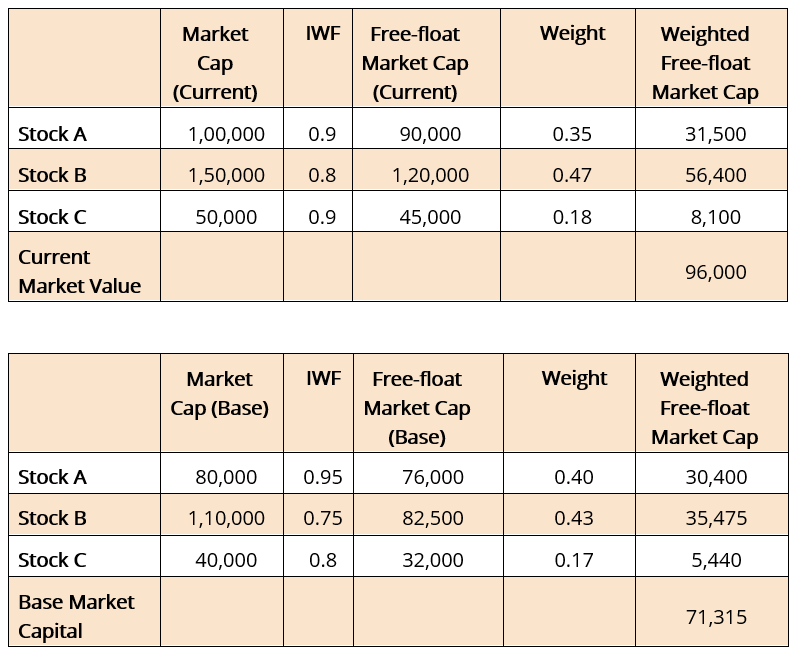
Whenever the price of an individual stock changes, its weight in the index value also changes. The base market capital is INR 2.06 trillion. Given the current index value, one can easily calculate the current market value.
Stocks in the NIFTY 50 capture approximately 65% of the float-adjusted market capitalization of the NSE, and the index is therefore considered a true reflection of the Indian stock market.
Related Readings
CFI is the official provider of the Commercial Banking & Credit Analyst (CBCA)™Program Page - CBCAGet CFI's CBCA™ certification and become a Commercial Banking & Credit Analyst. Enroll and advance your career with our certification programs and courses. certification program, designed to transform anyone into a world-class financial analyst. In order to help you become a world-class financial analyst and advance your career to your fullest potential, these additional resources will be very helpful:
- Market IndexMarket IndexMarket index is a portfolio of securities that represent a section of the stock market, deriving its value from the values of its underlying securities
- Dow Jones Industrial Average (DJIA)Dow Jones Industrial Average (DJIA)The Dow Jones Industrial Average (DJIA), also referred to as "Dow Jones” or "the Dow", is one of the most widely-recognized stock market indices.
- FTSE IndicesFTSE IndicesFTSE indices refer to several major UK stock market indexes. Indices provide market analysts and investors with a gauge for monitoring the overall equity market. Specifically, the FTSE (Financial Times Stock Exchange) indices represent stocks traded on the London Stock Exchange (LSE). They reflect the performance of UK stock shares
- Nikkei IndexNikkei IndexThe Nikkei Index, or Nikkei 225, is the most recognized Japanese stock market index. It comprises Japan's top 225 companies listed on the Tokyo Exchange.
-
Arms Index (TRIN): Understanding Short-Term Market Sentiment
The Arms Index, also known as the Short-Term Trading Index (TRIN), refers to a short-term technical analysis trading indicator that compares the number of advancing and declining stocks issues with th
-
Understanding Blockage Discounts in Stock Trading
Blockage discount – also sometimes referred to as the blockage factor – is the discounted price or value the market gives stocks when a block of shares is sold. The exact number of shares
invest
- Understanding the Call Market: Trading Hours & Price Determination
- Capitalization-Weighted Index (CWI): Explained
- EAFE Index: Understanding Developed Market Performance
- Understanding the EMBI: A Guide to Emerging Market Bond Performance
- Equal-Weighted Index Explained: Benefits & How It Works
- Understanding Market Indexes: A Comprehensive Guide
- Russell 2000 Index: Definition, Performance & Investing
- Understanding the S&P 500: A Comprehensive Guide
- Nifty 50: History, Significance & Key Stocks - A Comprehensive Guide
-
 Advance-Decline Line: Understanding Market Sentiment & Trends
The advance-decline line (ADL) is a technical indicator that plots the difference between the number of advancing stocks to declining stocks on a daily basis. Understanding the Advance-Decl...
-
Understanding the S&P 500: Top Holdings & Long-Term Performance
The Standard & Poor’s 500 index, or S&P 500, is a collection of about 500 of the largest publicly traded companies in the U.S. It’s an ironic name for one of the best collection...