
Understanding Normal-Course Issuer Bids (NCIBs)
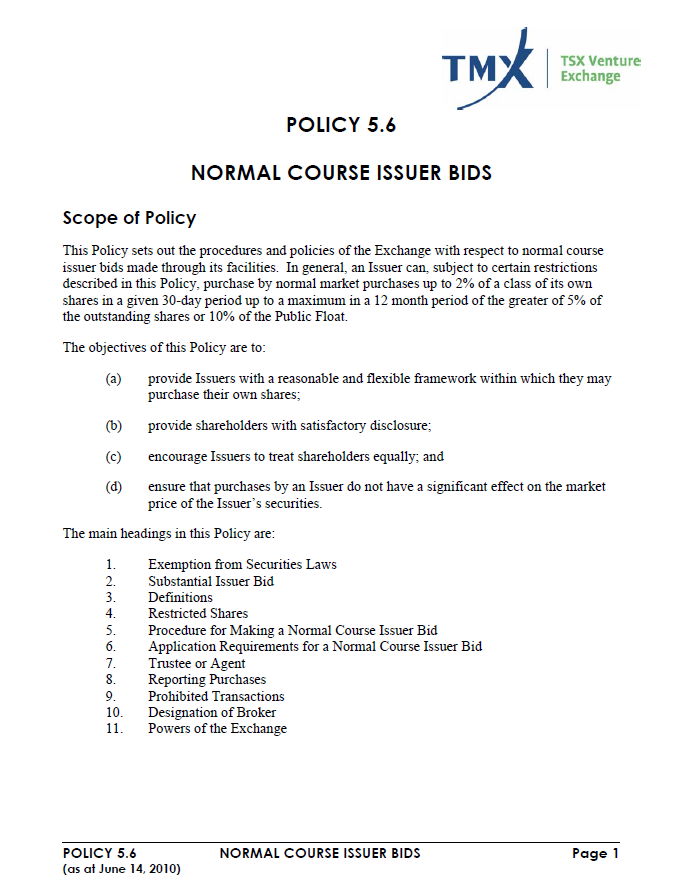
Normal-Course Issuer Bid (NCIB) is a Canadian-based stock buyback program, where a listed public company repurchases its shares to cancel them. The publicly-traded companyPublic CompaniesPublic companies are entities that trade their stocks on the public exchange market. Investors can become shareholders in a public company by purchasing shares of the company's stock. The company is considered public since any interested investor can purchase shares of the company in the public exchange to become equity owners., under certain restrictions outlined in Policy 5.6, is only allowed to buy between 5% and 10% of its shares over 12 months, depending on the transaction.
Summary
- Normal-Course Issuer Bid (NCIB) is a Canadian-based stock buyback program, where a publicly-traded company repurchases its shares to cancel them.
- Making a normal-course issuer bid requires a company to first place a Notice of Intention.
- An issuer may repurchase its shares to regain a controlling interest in its stock ownership to thwart any takeover attempt.
How an NCIB Works
In principle, the move aims to reduce the amount of to make a normal-course issuer bid with the stock exchanges on which they are listed and get approved before engaging in the repurchase. The statutory requirement limits the number of shares a company can buy in one day.
The other approach to the NCIB involves a company buying numerous shares from its shareholders at a predetermined price and date. If the company purchases all its outstanding stocksOutstanding SharesOutstanding shares represent the number of a company’s shares that are traded on the secondary market and, therefore, available to investors. Outstanding shares include all restricted shares held by the company’s officers and insiders (senior employees), as well as the equity portion owned by institutional investors, the transaction is referred to as “going private.”
In case the repurchasing company owns a class of restricted shares, as documented in Policy 3.5, the filed Notice of Intention to make a normal-course issuer bid must clearly outline the voting rightsVoting SharesVoting shares are shares of a company that entitle the shareholder to vote on key issues of the company. It is generally one vote per share. The shares of all the issuer’s stock. If a company fails to describe the voting rights as required, it must state the reasons for restricting the NCIB in Item 8 of the notice.
After approval, the issuer can proceed with buying its stock securities as it deems fit during the proposed period. Also, the company can opt not to purchase all the shares that it is allowed.
As is the case with any stock-buying program, a company initiates a normal-course issuer bid because its publicly traded shares are undervalued. Repurchasing shares reduces the number of shares in the market that investors can buy. To illustrate, the practice increases demand and reduces supply, leading to increased stock prices.
The company can sell off some of its stock once its value reaches anticipated levels in a bid to expand its investor base, raise cash, and increase its liquidity. A company can seize the opportunity of the current discount on the current prices of shares through an NCIB.
How to Make a Normal-Course Issuer Bid
Notice of Intention
A Notice of Intention is a requisite for conducting a normal course issuer bid for any publicly-traded company, in line with the requirements of Section 6 of the policy. The board of directors must specify the number of shares for acquisition. Nevertheless, the Notice of Intention does not need to be filed if, presently, the company does not intend to purchase securities.
In case the company does not meet the continued listing requirements, the exchange will not consent to the Notice of Intention. It applies even after the issuer’s completed all the contemplated purchases in the notice. An NCIB must not exceed one year, following the commencement date of the purchases.
News Release
The next step when making the bid involves making a news release to communicate the company’s intentions to make a normal-course issuer bid. The contents of the news release should embody a summary of the material aspects of the notice.
Some of the key elements of the release include the name of the member carrying out the bid on behalf of the company, the previous purchase, the reason for the bid, and the percentage of the outstanding and the number of stock sought.
Should the news release delay, the issuer is required to issue draft news to the exchange, followed by a news release as soon as the exchange approves the notice.
Disclosure
Subsequently, the company’s next report must capture a summary of the material information outlined in the notice. The disclosure must be mailed to the shareholders and needs to indicate how its copy can be obtained without charge.
Thereafter, the start of the purchase begins three days after receiving all the documentation. Upon accepting the Notice of Intention, the exchange is required to publish an exchange circular reporting the bid.
Amendment
The exchange’s publication is followed by an amendment, where the company can adjust its notice to increase the number of shares to be purchased, provided they are within the prescribed number of shares in the policy.
If the normal-course issuer bid is large enough, it can change the concept of stock ownership. The company can regain a controlling interest in its stock ownership to prevent third parties from challenging the company’s ownership.
More Resources
CFI is the official provider of the global Commercial Banking & Credit Analyst (CBCA)™Program Page - CBCAGet CFI's CBCA™ certification and become a Commercial Banking & Credit Analyst. Enroll and advance your career with our certification programs and courses. certification program, designed to help anyone become a world-class financial analyst. To keep advancing your career, the additional resources below will be useful:
- Capital Raising ProcessCapital Raising ProcessThis article is intended to provide readers with a deeper understanding of how the capital raising process works and happens in the industry today. For more information on capital raising and different types of commitments made by the underwriter, please see our underwriting overview.
- Dividend vs. Share Buyback/RepurchaseDividend vs Share Buyback/RepurchaseShareholders invest in publicly traded companies for capital appreciation and income. There are two main ways in which a company returns profits to its shareholders – Cash Dividends and Share Buybacks. The reasons behind the strategic decision on dividend vs share buyback differ from company to company
- Private vs Public CompanyPrivate vs Public CompanyThe main difference between a private vs public company is that the shares of a public company are traded on a stock exchange, while a private company's shares are not.
- Vancouver Stock Exchange (VSE)Vancouver Stock Exchange (VSE)The Vancouver Stock Exchange (VSE) started operations out of Vancouver, British Columbia in 1907. The VSE continued to function as a standalone exchange
-

Skin in the Game: Understanding Risk & Accountability
“Skin in the Game” is a phrase popularized by world-famous investor Warren Buffet signifying a condition in which high-ranking insiders buy the stocks of the company they are a part of usi
-

Understanding Voting Shares: Your Right to Participate in Company Decisions
Voting shares are shares of a company that entitle the shareholder to vote on key issues of the company. It is generally one vote per share. The shares represent an ownership interest in a corporation
invest
- Understanding Bought Deals: A Comprehensive Guide
- Clientele Effect: How Investor Preferences Impact Stock Prices
- Understanding Stock Dilution: Causes, Effects & Prevention
- Understanding Initial Public Offerings (IPOs): A Comprehensive Guide
- Free Float Explained: Understanding Publicly Traded Shares
- Understanding 'Hit the Bid': A Guide for Investors
- Understanding the Icahn Effect: How Activist Investing Impacts Stock Prices
- Understanding Lock-Up Periods After an IPO: A Comprehensive Guide
- Understanding the Primary Market: A Comprehensive Guide
-
 Understanding the Earnings Multiplier (P/E Ratio): A Comprehensive Guide
The earnings multiplier, or the price-to-earnings ratio, is a method used to compare a company’s current share price to its earnings per share (EPS)Earnings Per Share (EPS)Earnings per share (EP...
-
 Understanding the IPO Process: A Comprehensive Guide
The Initial Public Offering IPO Process is where a previously unlisted company sells new or existing securitiesMarketable SecuritiesMarketable securities are unrestricted short-term financia...