
Understanding Noncallable Securities: A Comprehensive Guide
Noncallable, also called non-redeemable, refers to the type of securities that cannot be called (redeemed) by their issuer(s) before their maturities unless penalties are paid to security holders. Two common examples are noncallable bonds and noncallable preferred stocks.
Most Treasury and municipal bondsMunicipal Bond Credit AnalysisMunicipal bond credit analysis involves evaluating a municipal bond to determine its viability as an investment opportunity. A municipal bond is a type of are noncallable. Issuers of noncallable securities bear more risks and are sold at higher prices than issuers of callable securities.
Summary
- Noncallable refers to securities that cannot be called (redeemed) by their issuers unless penalties are paid to the security holders.
- Callable securities can be redeemed by the issuers in the circumstances or days specified in the call provision.
- Noncallable securities protect investors from reinvestment risk, but limit the issuers’ flexibility to restructure their financing. Therefore, investors in callable securities are compensated with a call premium from issuers.
Noncallable vs. Callable
The issuer of a noncallable security cannot redeem or buy back the security unless a penalty is paid. Conversely, a callable security can be redeemed by its issuer in particular circumstances or days specified in the call provision.
A call provision is settled when a callable corporate bond or preferred sharePreferred SharesPreferred shares (preferred stock, preference shares) are the class of stock ownership in a corporation that has a priority claim on the company’s assets over common stock shares. The shares are more senior than common stock but are more junior relative to debt, such as bonds. is issued. It stipulates the triggering events for the call option, for example, when the asset price or interest rate reaches a specific value, or on a specific date.
A callable security gives the issuer greater flexibility to restructure their debts, but greater reinvestment risk to investors when the security is redeemed. Therefore, callable securities are usually issued at lower prices than the noncallable securities with the same nature to compensate the investors.
Noncallable Bond
Treasury securities and municipal bonds are noncallable in general. If a bond is completely noncallable, the issuer cannot redeem this bond during the entire term to maturity. The issuer must pay the interest specified in the contract regardless of the change of the rate in the current market. Thus, the issuer bears interest risk.
When the market rate drops, the issuer must continue to pay the higher original interest according to the contract, which leads to a higher cost of financing. However, holders of noncallable bonds can benefit from this guaranteed interest rate and get protected from reinvestment risk.
Corporate bonds are often callable. Callable bond issuers have the option to choose whether to redeem the bond before its maturity or not. Compared with noncallable bond issuers, callable bond issuers bear much lower interest risk.
When the market rate drops to a certain level, the issuer can redeem the bond by paying the principal and interest up to the date, then issue another bond at the lower current market interest rate. The bondholders are thus exposed to reinvestment risk, as they need to reinvest at the lower return of lending.
To compensate the bondholders for the risk, a callable bond usually pays a higher interest rate than a noncallable bond, which means that the price of a callable bond is usually lower. The value of a callable bond is the value of a straight (neither callable nor puttable) bond minus the value of the call option.
Many bonds include both a callable term and a noncallable term. They are noncallable for a period of time after the issuance and turn callable after that. The noncallable time period is known as the call protection period in which bondholders receive guaranteed interest paymentsInterest PayableInterest Payable is a liability account shown on a company’s balance sheet that represents the amount of interest expense that has accrued regardless of the change in the current market rate.
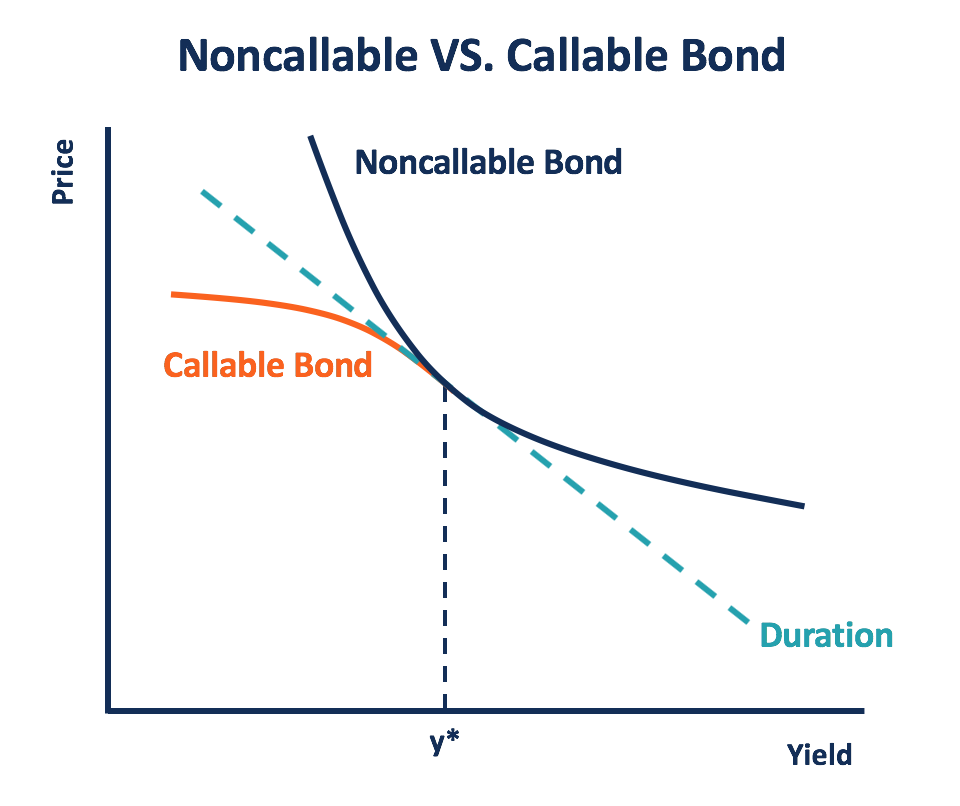
The relationship between the yield and value of a noncallable bond can be plotted as a convex curve. The price of the bond drops with an increase in yield and raises with a decrease. The change in price is more sensitive to a decrease than an increase in yield.
Callable bonds show the same pattern as noncallable bonds as yield increases because it is less likely for issuers to redeem when the market rate goes up. However, when the market rate goes down, the possibility of redemption raises, which makes it riskier to bondholders.
Thus, when the interest rate decreases, the price increase of a callable bond is much smaller than that of a noncallable bond. The lower the market rate, the less increase in the callable price.
Noncallable Preferred Stock
Noncallable preferred stocks are similar to noncallable bonds in that the issuer cannot buy back the preferred shares at a specified price. Noncallable preferred shares better protect investors from reinvestment risk than callable shares.
The issuers of callable preferred shares can buy back the shares when they have the opportunity to reissue shares at a lower dividend rate. To redeem shares, the issuer usually needs to pay investors a price higher than the par value as compensation for their reinvestment risk. The part of the value that the issuer pays above the par price is the call premium.
Callable preferred shares generally have a call protection period, which is predetermined in the call provision. The issuer is only allowed to redeem after the call protection period.
Related Readings
CFI is the official provider of the global Commercial Banking & Credit Analyst (CBCA)™Program Page - CBCAGet CFI's CBCA™ certification and become a Commercial Banking & Credit Analyst. Enroll and advance your career with our certification programs and courses. certification program, designed to help anyone become a world-class financial analyst. To keep advancing your career, the additional CFI resources below will be useful:
- Non-Callable Preferred StockNon-Callable Preferred StockNon-callable preferred stock (also known as non-redeemable preferred stock) is a type of preferred stock shares that do not include a callable feature. In other words, the issuer of non-callable preferred shares does not have the option to buy back the issued shares
- Options: Calls and PutsOptions: Calls and PutsAn option is a derivative contract that gives the holder the right, but not the obligation, to buy or sell an asset by a certain date at a specified price.
- Callable BondCallable BondA callable bond (redeemable bond) is a type of bond that provides the issuer of the bond with the right, but not the obligation, to redeem the bond before its maturity date. The callable bond is a bond with an embedded call option. These bonds generally come with certain restrictions on the call option.
- Held to Maturity SecuritiesHeld to Maturity SecuritiesHeld to maturity securities are securities that companies purchase and intend to hold until they mature. They are unlike trading securities or available for sale securities
-
Understanding Call Protection in Bonds: Investor Protection Explained
Call protection refers to protection from investment risk to bond investors that exists by limiting the conditions under which a bond issuer may elect to call, i.e., redeem bonds before a bond’s
-

Understanding Call Provisions in Bonds: A Comprehensive Guide
A call provision refers to a clause – essentially, an embedded optionEmbedded OptionAn embedded option is a provision in a financial security (typically in bonds) that provides an issuer or hold
invest
- Personal Bond Explained: Release from Jail Without Bail
- Understanding Bond Duration: A Key Fixed Income Metric
- Understanding Bond Accretion: A Comprehensive Guide
- Coupon Bonds: Understanding Fixed Income & Interest Payments
- Discount Bonds: Understanding Pricing & Secondary Markets
- Samurai Bonds: A Guide to Understanding Yen-Denominated Corporate Debt
- Treasury Bonds: A Comprehensive Guide to U.S. Government Debt
- Zero-Coupon Bonds: Definition, How They Work & Examples
- Understanding Bonds: A Comprehensive Guide for Investors
-
 Understanding Call Dates: What You Need to Know
A call date refers to the date when a callable bondCallable BondA callable bond (redeemable bond) is a type of bond that provides the issuer of the bond with the right, but not the obligation, to rede...
-
 Understanding Call Prices: Callable Bonds & Preferred Stocks
A call price refers to the price that a preferred stock or bond issuer would pay to buyers if they chose to redeem the callable security before the maturity date. The price is set during the issuance ...