
Understanding Bought Deals: A Comprehensive Guide
A bought deal is a type of securities offering in which the underwriter commits to buying the entire offering from the issuer company before a preliminary prospectusProspectusA prospectus is a legal disclosure document that companies are required to file with the Securities and Exchange Commission (SEC). The document provides information about the company, its management team, recent financial performance, and other related information that investors would like to know. is filed. A bought deal eliminates the financing risk faced by the issuer company.

How It Works
In a bought deal, the underwriter purchases the entire offering from the issuer company. As the entire offering is purchased, financing riskRiskIn finance, risk is the probability that actual results will differ from expected results. In the Capital Asset Pricing Model (CAPM), risk is defined as the volatility of returns. The concept of “risk and return” is that riskier assets should have higher expected returns to compensate investors for the higher volatility and increased risk. is eliminated for the issuer company. To compensate for eliminating the financing risk faced by the issuer company, the underwriter would negotiate a discounted price for the entire offering.
In such a scenario, the underwriter faces the risk of losing money by not being able to resell the securities at a higher price. In a bought deal, the underwriter acts as the principal rather than the agent. An illustration of a bought deal is provided below:

Example of a Bought Deal
An issuer company is looking to offer 40 million shares. The projected market value per share is $10, but there is no guarantee that all shares of the issuer company would be purchased. In order to avoid financing risk (the risk of not being able to sell all of its shares at the market price), the issuer company engages in a bought deal with its underwritersUnderwritingIn investment banking, underwriting is the process where a bank raises capital for a client (corporation, institution, or government) from investors in the form of equity or debt securities. This article aims to provide readers with a better understanding of the capital raising or underwriting process. The underwriters and the issuer company come to a heavily discounted consensus price of $6 per share, and the underwriters purchase the entire offering at $240 million (40 million shares at $6 per share).
As the underwriters now own the entire offering, they must resell the issuer’s shares at a price of at least $6 per share or face the risk of generating a net loss. The issuer company is alleviated of financing risk but receives financing at a discounted price per share ($6) as opposed to the market value per share ($10).
Advantages of a Bought Deal
A bought deal offers several advantages to both the underwriter and the issuer company.
Advantages to Underwriters
- The underwriters are able to purchase the offering at a steep discount to market value; and
- The higher the price that the underwriters are able to resell on the market, the greater the profits realized by the underwriters.
Advantages to Issuer Company
- The issuer company faces no financing risk; and
- The issuer company receives funds instantly.
Disadvantages of a Bought Deal
A bought deal comes with a few disadvantages for the underwriter and the issuer company.
Disadvantages to Underwriters
- The underwriters see their capital tied up, which potentially could’ve otherwise been put to better use; and
- The underwriters face the risk of not being able to resell the issue;
Disadvantages to Issuer Company
- The issuer company generally must agree to a large per-share discount.
Bought Deal in a Press Release
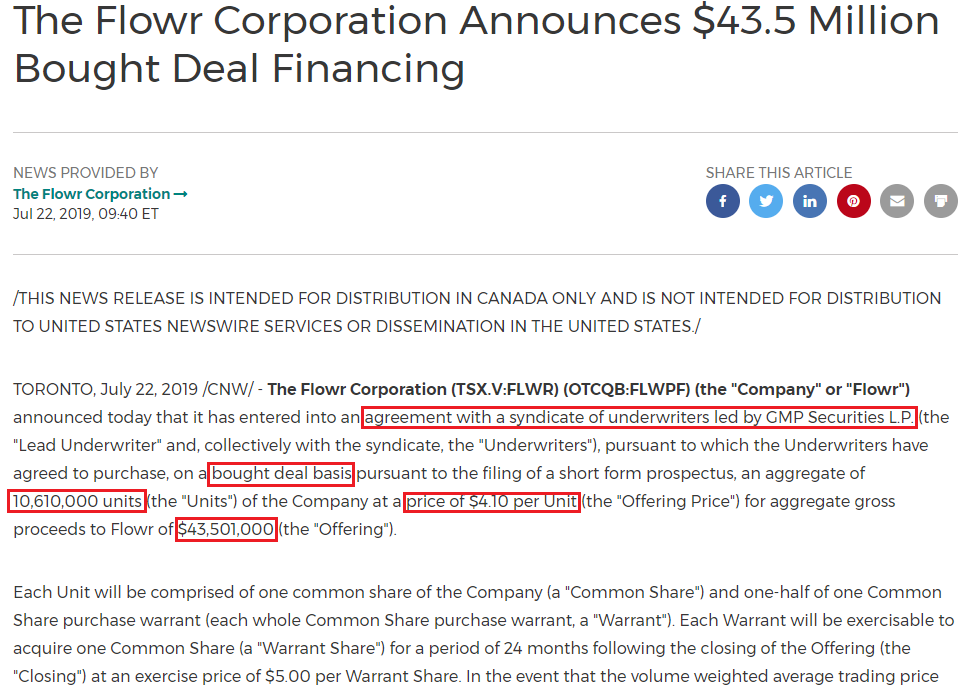
Bought deals are common to see in the news. For example, the following is an excerpt of a press release involving The Flowr Corporation (TSX.V: FLWR). From the discussion above, readers should be able to interpret that the underwriters are purchasing 10,610,000 units of The Flowr Corporation at a price of $4.10 per unit (valued at $43,501,000).
Related Readings
CFI is the official provider of the global Financial Modeling & Valuation Analyst (FMVA)™Become a Certified Financial Modeling & Valuation Analyst (FMVA)®CFI's Financial Modeling and Valuation Analyst (FMVA)® certification will help you gain the confidence you need in your finance career. Enroll today! certification program, designed to help anyone become a world-class financial analyst. To keep advancing your career, the additional resources below will be useful:
- Best EffortsBest EffortsIn a securities offering, “best efforts” refers to a contractual term in which the underwriter promises to do the best it can to sell as much of a
- Capital Raising ProcessCapital Raising ProcessThis article is intended to provide readers with a deeper understanding of how the capital raising process works and happens in the industry today. For more information on capital raising and different types of commitments made by the underwriter, please see our underwriting overview.
- Flotation CostsFlotation CostsFlotation costs are the costs that are incurred by a company when issuing new securities. The costs can be various expenses including, but not limited to, underwriting, legal, registration, and audit fees. Flotation expenses are expressed as a percentage of the issue price.
- Initial Public Offering (IPO)Initial Public Offering (IPO)An Initial Public Offering (IPO) is the first sale of stocks issued by a company to the public. Prior to an IPO, a company is considered a private company, usually with a small number of investors (founders, friends, family, and business investors such as venture capitalists or angel investors). Learn what an IPO is
-
Revenue-Based Financing: A Comprehensive Guide
Revenue-based financing, also known as royalty-based financing, is a type of capital-raising method in which investors agree to provide capital to a company in exchange for a certain percentage of the
-
Understanding Stock Market Signaling: Insider Information Explained
Signaling refers to the act of using insider information to initiate a trading position. It occurs when an insider releases crucial information about a company that triggers the buying or selling of i
invest
- Acquirer Definition: Understanding Corporate Acquisitions
- Understanding Clawbacks: Protecting Stakeholders from Failed Performance
- Understanding Financial Gearing: Debt & Leverage Explained
- Leverage in Finance: Strategies, Types & Risks
- Parent Company Explained: Definition, Control & Examples
- Understanding Stocks: A Beginner's Guide to Share Ownership
- Allotment Explained: Resource & Equity Distribution in Business
- Understanding Net-Net: A Financial Health Indicator
- Understanding Normal-Course Issuer Bids (NCIBs)
-
 Joint Bonds: Understanding Joint and Several Liability
A joint bond, also known as a joint-and-several bond, is a type of bond that involves an issuer and at least two guarantorsGuarantorA guarantor is a third party that pays for a debt if the borrower mi...
-
 Lock-Up Agreements: Understanding Insider Restrictions During IPOs
A lock-up agreement refers to a legally binding contract made between the insiders and underwriters of a company during its initial public offering (IPO)Initial Public Offering (IPO)An Initial Pu...