
Capitalization-Weighted Index (CWI): Explained
The Capitalization-Weighted Index (cap-weighted index, CWI) is a type of stock market index in which each component of the index is weighted relative to its total market capitalizationMarket CapitalizationMarket Capitalization (Market Cap) is the most recent market value of a company’s outstanding shares. Market Cap is equal to the current share price multiplied by the number of shares outstanding. The investing community often uses the market capitalization value to rank companies. In a capitalization-weighted index, companies with larger market capitalization exert a greater impact on the index value. Companies with a smaller market capitalization carry less significance.

The capitalization-weighted index is currently the most common stock market index. The largest and most prominent market indices – including S&P 500, the NASDAQ CompositeNASDAQ CompositeThe NASDAQ Composite is an index of more than 3,000 common equities listed on the NASDAQ stock market. The index is one of the most followed indices in the, and the FTSE 100 – are capitalization-weighted indices.
Breaking Down the Capitalization-Weighted Index
Capitalization-weighted indexes are widely used because the values change proportionally to the price changes of each component (since market capitalization is determined by the stock price multiplied by the number of shares outstanding). The indices also consider the shareholder base of each component.
Since some companies own shares that are not fully available to the public, most of the indices use the free float factor to adjust calculations. The free float is the percentage of the shares available for trading.
Some investors criticize capitalization-weighted indexes for providing a distorted view of the stock marketsStock MarketThe stock market refers to public markets that exist for issuing, buying and selling stocks that trade on a stock exchange or over-the-counter. Stocks, also known as equities, represent fractional ownership in a company. Many believe that the primary reason for the distortion is the overweighting toward companies with the largest market capitalization.
Example of How to Calculate a Capitalization-Weighted Index
The CWI Composite is a capitalization-weighted index. It consists of four companies only: Company A, Company B, Company C, and Company D. The summary of the current stock prices and the total number of the shares outstanding for each company is given in the table below:
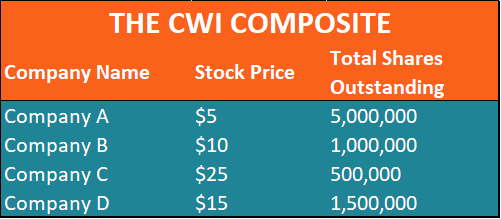
Using the information from the table above, we can calculate the market capitalization of each index component. The market capitalization can be found through the following formula:
Market Capitalization = Stock Price x No. of Shares Outstanding
Thus, the market capitalization of each company in the index is:
- Company A = $5 x 5,000,000 = $25,000,000
- Company B = $10 x 1,000,000 = $10,000,000
- Company C = $25 x 500,000 = $12,500,000
- Company D = $15 x 1,500,000 = $22,500,000
The total market capitalization of the index is the sum of the market capitalization of all the components. Therefore, the market capitalization of the CWI Composite is:
CWI Composite = $25,000,000 + $10,000,000 + $12,500,000 + $22,500,000 = $70,000,000
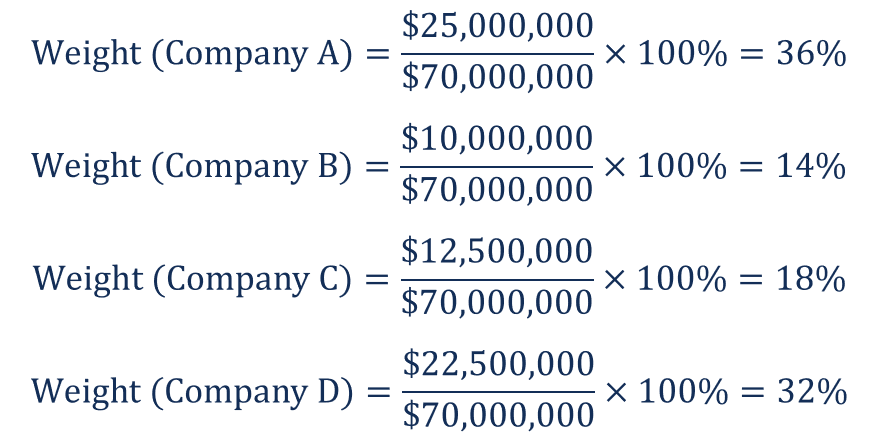
The weight of each index component is determined using the formula below:

Related Readings
Thank you for reading CFI’s explanation of a capitalization-weighted index. CFI is the official provider of the global Financial Modeling & Valuation Analyst (FMVA)™Become a Certified Financial Modeling & Valuation Analyst (FMVA)®CFI's Financial Modeling and Valuation Analyst (FMVA)® certification will help you gain the confidence you need in your finance career. Enroll today! certification program, designed to help anyone become a world-class financial analyst. To keep advancing your career, the additional resources below will be useful:
- Common StockCommon StockCommon stock is a type of security that represents ownership of equity in a company. There are other terms – such as common share, ordinary share, or voting share – that are equivalent to common stock.
- Diluted Shares OutstandingDiluted Shares OutstandingFully diluted shares outstanding is the total number of shares a company would have if all dilute securities were exercised and converted into shares.
- Nikkei IndexNikkei IndexThe Nikkei Index, or Nikkei 225, is the most recognized Japanese stock market index. It comprises Japan's top 225 companies listed on the Tokyo Exchange.
- Weighted Average Shares OutstandingWeighted Average Shares OutstandingWeighted average shares outstanding refers to the number of shares of a company calculated after adjusting for changes in the share capital over a reporting period. The number of weighted average shares outstanding is used in calculating metrics such as Earnings per Share (EPS) on a company's financial statements
-

Advance-Decline Line: Understanding Market Sentiment & Trends
The advance-decline line (ADL) is a technical indicator that plots the difference between the number of advancing stocks to declining stocks on a daily basis. Understanding the Advance-Decl
-
Arms Index (TRIN): Understanding Short-Term Market Sentiment
The Arms Index, also known as the Short-Term Trading Index (TRIN), refers to a short-term technical analysis trading indicator that compares the number of advancing and declining stocks issues with th
invest
- Capitalization-Weighted Index: Definition & How It Works
- Understanding the Call Market: Trading Hours & Price Determination
- EAFE Index: Understanding Developed Market Performance
- Understanding the EMBI: A Guide to Emerging Market Bond Performance
- Understanding Market Indexes: A Comprehensive Guide
- NIFTY 50 Index: Understanding India's Top 50 Stocks | NSE
- Russell 2000 Index: Definition, Performance & Investing
- Understanding the S&P 500: A Comprehensive Guide
- Profitability Index (PI): Definition, Formula & Investment Ranking
-
 Stock Market Indexes: A Comprehensive Guide to Understanding
A stock market index, also known as a stock index, measures a section of the stock market. In other words, the index measures the change in the share prices of different companies. The stoc...
-
Understanding the S&P 500: Top Holdings & Long-Term Performance
The Standard & Poor’s 500 index, or S&P 500, is a collection of about 500 of the largest publicly traded companies in the U.S. It’s an ironic name for one of the best collection...