
Pairs Trading: A Comprehensive Guide to Profiting in Any Market
Pairs trading is a strategic trading option that is used to generate profits regardless of market direction. Traders utilizing the pairs strategy determine two securities that:
- Share similar characteristics and have a high positive correlation
- Are trading at a price that is contradictory to their historical trading prices
- One of the two must be undervalued and the other overvalued, as per their historical trading prices

The traderEquity TraderAn equity trader is someone who participates in the buying and selling of company shares on the equity market. Similar to someone who would invest in the debt capital markets, an equity trader invests in the equity capital markets and exchanges their money for company stocks instead of bonds. Bank careers are high-paying using the pairs strategy then short sells the security that is overvalued and goes long on the shares of the security that is trading below value. The strategy enables the trader to maintain ultimate neutrality in the market and generate earnings, regardless of whether the market goes up, down, or sideways.
The Process of Selection
Arguably the most arduous and critical step within the pairs trading strategy is the process of choosing the pair to trade. The process of selection – the criteria on which the pair is chosen – is crucial. The selection part of the strategy requires the trader to determine his trading arena – whether he wants/needs to trade securities from a particular industry, companies within a given market capMarket CapitalizationMarket Capitalization (Market Cap) is the most recent market value of a company’s outstanding shares. Market Cap is equal to the current share price multiplied by the number of shares outstanding. The investing community often uses the market capitalization value to rank companies spread, and other guidelines that help him narrow the field before selecting two securities to trade.
The length of time the trader plans to keep the trade open and his resources are two other important factors in the selection part of the trading process, as it may take quite some time for the trade to move in his favor.
Choosing the Pair, Finding the Correlation, and Understanding the Price Ratio
After establishing the selection criteria and guidelines, the trader must do his homework – use historical data and a variety of financial metrics to get a true understanding of securities within the option pool before making his selection.
Once the trader finds two securities to trade, it is often then wise to test the pair with a short-term trade before committing to something longer. The correlationCorrelationA correlation is a statistical measure of the relationship between two variables. The measure is best used in variables that demonstrate a linear relationship between each other. The fit of the data can be visually represented in a scatterplot. between the pair, which will be a value between -1 and 1, must be established, so the trader will understand how closely related the pair is to one another. In most cases, traders look for at least a positive 0.8 correlation. The graphic below shows two securities – one indicated by a black line, the other by a red line – showing a close correlation.
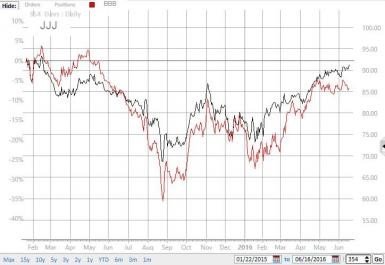
The pair’s price ratio – the price of one share divided by the other – must be determined, giving the trader a midpoint that he can chart. Whatever the price ratio is, the trader must watch the market as it moves to see what it tends to do when it reaches the midpoint of the pair. It indicates which securityPublic SecuritiesPublic securities, or marketable securities, are investments that are openly or easily traded in a market. The securities are either equity or debt-based. the trader should sell short and which security the trader should buy, and when.
Advantages and Disadvantages of Pairs Trading
While there are a variety of advantages to pairs trading, the most obvious advantageous aspect of the strategy, again, is the fact that a trader has the potential to generate earnings no matter which way the overall market moves.
Pairs trading isn’t without flaws, however. The greatest disadvantage to the strategy is often the fact that when a trader seeks to act on the correlation between the pair to his advantage, the market may not correct within a period of time that is advantageous to the trader. It means that the undervalued equity may not see its true valuation in the market and/or the overvalued stock may remain overvalued.
Final Word
Pairs trading is widely seen as a neutral position, allowing a trader to stay comfortably in the middle of a trade, generating profit – often substantially – by hedging against any movement the market makes. The reality is that while skilled traders may be able to take advantage of such a position, the market often doesn’t correct itself as speedily as a trader may want or need. For this reason, pairs trading is typically utilized by more experienced traders.
Additional Resources
CFI is the official provider of the Financial Modeling and Valuation Analyst (FMVA)®Become a Certified Financial Modeling & Valuation Analyst (FMVA)®CFI's Financial Modeling and Valuation Analyst (FMVA)® certification will help you gain the confidence you need in your finance career. Enroll today! certification program, designed to transform anyone into a world-class financial analyst.
To keep learning and developing your knowledge of financial analysis, we highly recommend the additional resources below:
- Margin TradingMargin TradingMargin trading is the act of borrowing funds from a broker with the aim of investing in financial securities. The purchased stock serves as collateral for the loan. The primary reason behind borrowing money is to gain more capital to invest
- Stop-Loss OrderStop-Loss OrderA stop-loss order is a tool used by traders and investors to limit losses and reduce risk exposure. Learn more about stop-loss orders in this article.
- Swing TradingSwing TradingSwing trading is a trading technique that traders use to buy and sell stocks when indicators point to an upward (positive) or downward (negative) trend
- Trade Order TimingTrade Order Timing - TradingTrade order timing refers to the shelf-life of a specific trade order. The most common types of trade order timing are market orders, GTC orders,
-

Understanding Market Exposure: Risk & Portfolio Allocation
Market exposure refers to the absolute amount of funds or the percentage of a portfolio that is invested in a given security, or a bundle of securities that are part of the same industry or market sec
-

Understanding Market Indexes: A Comprehensive Guide
Market index refers to a portfolio of securities that represent a particular section of the stock marketStock MarketThe stock market refers to public markets that exist for issuing, buying and selling
invest
- Direct Market Access (DMA): A Comprehensive Guide for Investors
- Floor Trader (FT): Definition, Role & Strategies
- Head Trader: Definition, Role & Responsibilities
- Understanding Noise Traders: Irrationality in Financial Markets
- Position Trading: A Comprehensive Guide for Long-Term Investors
- Understanding Trading Below Cash: What It Means & Implications
- Trading Curb: Understanding Temporary Market Halts
- Understanding Trading Psychology: Mastering the Mental Game
- Program Trading: Definition, Strategy & Benefits | [Your Company Name]
-
 Understanding Market Cycles: Trends & Economic Environments
Market cycle refers to economic trends observed during different types of business environments. It is also known as a stock market cycle, wherein a given security, or multiple securitiesMarketable Se...
-
 Understanding Market Depth: A Guide for Traders
Market depth refers to the ability of the market to sustain a substantially larger order without making an impact on the security’s market price. Usually, while calculating market depth, trading...