
Par Bonds Explained: Understanding Face Value and Market Interest Rates
A par bond refers to a bond that currently trades at its face value. The bond comes with a coupon rateCoupon RateA coupon rate is the amount of annual interest income paid to a bondholder, based on the face value of the bond. that is identical to the market interest rate.
Summary:
- A par bond is a bond that currently trades at its face value.
- The bond comes with a coupon rate that is identical to the market interest rate.
- As the interest rate continually fluctuates, par bonds are uncommon to see.
Understanding a Par Bond
A bond’s coupon rate is the rate of interest paid by the bond issuers on the bond’s face value. To understand why a bond with a coupon rate equal to the market interest rateInterest RateAn interest rate refers to the amount charged by a lender to a borrower for any form of debt given, generally expressed as a percentage of the principal. is priced at par, consider the following examples:
Example 1: Discount Bond
Consider a bond with a 5-year maturity and a coupon rate of 5%. The market interest rate is 6%.
For the bond above, the coupon rate is below the market interest rate. In such a scenario, a rational investor would only be willing to purchase this bond at a discount to its face value because its coupon return is lower than the current market interest rate. In other words, the bond is generating a returnRate of ReturnThe Rate of Return (ROR) is the gain or loss of an investment over a period of time copmared to the initial cost of the investment expressed as a percentage. This guide teaches the most common formulas lower than the market, and investors would only be willing to purchase the bond if it was issued at a discount.
Example 2: Premium Bond
Consider a bond with a 5-year maturity and a coupon rate of 5%. The market interest rate is 4%.
For the bond above, the coupon rate is above the market interest rate. In such a scenario, a rational investorInvesting: A Beginner's GuideCFI's Investing for Beginners guide will teach you the basics of investing and how to get started. Learn about different strategies and techniques for trading would be willing to purchase the bond at a premium to its face value because its coupon return is higher than the current interest rate. In other words, the bond is generating a return higher than the market interest rate and, therefore, investors are willing to purchase the bond at a premium.
Example 3: Par Bond
Consider a bond with a 5-year maturity and a coupon rate of 5%. The market interest rate is 5%.
For the bond above, the coupon rate is equal to the market interest rate. In such a scenario, a rational investor would only be willing to purchase the bond at par to its face value because its coupon return is the same as the current interest rate. In other words, since the bond is generating a return equal to the market interest rate, investors would not be willing to offer a premium or require a discount – the bond is priced at par.
Bond Pricing Formula
The present value formula is used to price a bond:

Where:
- C equals the coupon payment;
- n equals the number of payment periods;
- i equals the interest rate; and
- FV equals the value at maturity. Face value is also known as par value.
Example of a Par Bond
A bond with a face value of $100 and a maturity of three years comes with a coupon rate of 5% paid annually. The current market interest rate is 5%. Using the bond pricing formula to mathematically confirm that the bond is priced at par,
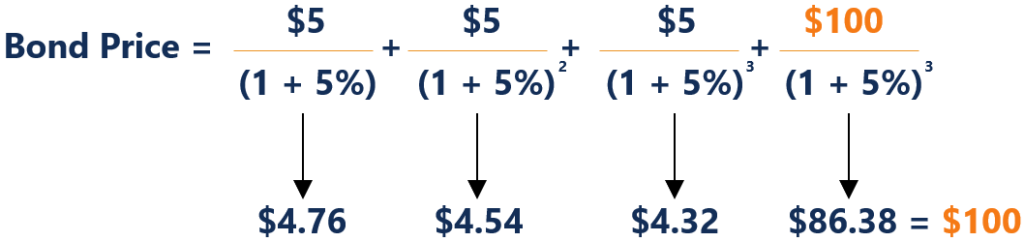
Shown above, with a coupon rate equal to the market interest rate, the resulting bond is priced at par.
The Reality of Par Bonds in the Marketplace
Par bonds are uncommon in the market. The reason is that it is very rare for the market interest rate to equal the coupon rate of the bond. The market interest rate varies constantly. To illustrate the fact, the Bank of Canada provides interest rates on a trended basis. With interest rates constantly changing, it is uncommon for a bond’s coupon rate to match exactly with the market interest rate and be priced at par.
Additional Resources
CFI offers the Financial Modeling & Valuation Analyst (FMVA)™Become a Certified Financial Modeling & Valuation Analyst (FMVA)®CFI's Financial Modeling and Valuation Analyst (FMVA)® certification will help you gain the confidence you need in your finance career. Enroll today! certification program for those looking to take their careers to the next level. To keep learning and advancing your career, the following resources will be helpful:
- Discount BondDiscount BondA discount bond is a bond that is issued at a lower price than its par value or a bond that is trading in the secondary market at a price that is below the par value. It is similar to a zero-coupon bond, only that the latter does not pay interest. A bond is considered to trade at a discount
- Floating Interest RateFloating Interest RateA floating interest rate refers to a variable interest rate that changes over the duration of the debt obligation. It is the opposite of a fixed rate.
- LIBORLIBORLIBOR, which is an acronym of London Interbank Offer Rate, refers to the interest rate that UK banks charge other financial institutions for
- Overnight RateOvernight RateThe overnight rate refers to the interest rate that depository institutions (e.g., banks or credit unions) charge each other for overnight lending. Note that the overnight rate is called something different in different countries.
-

Understanding Interest Rates: A Comprehensive Guide
An interest rate refers to the amount charged by a lender to a borrower for any form of debtCurrent DebtOn a balance sheet, current debt is debts due to be paid within one year (12 months) or less. It
-
Understanding Rate of Return: A Comprehensive Guide
A Rate of Return (ROR) is the gain or loss of an investment over a certain period of time. In other words, the rate of return is the gainCapital Gains YieldCapital gains yield (CGY) is the price appre
invest
- Understanding Coupon Rate: A Key Bond Investment Metric
- Coupon Bonds: Understanding Fixed Income & Interest Payments
- Discount Bonds: Understanding Pricing & Secondary Markets
- Understanding Dividend Yield: A Comprehensive Guide
- Ex-Ante: Understanding Predictions in Finance
- Understanding Key Rate Duration: A Guide for Bond Investors
- Understanding LIBOR: What It Is and How It Works
- Nominal Yield Explained: Definition & Calculation
- Understanding Noncallable Securities: A Comprehensive Guide
-
 Understanding Bond Duration: A Key Fixed Income Metric
Duration is one of the fundamental characteristics of a fixed-income security (e.g., a bondBondsBonds are fixed-income securities that are issued by corporations and governments to raise capital....
-
 Hurdle Rate: Definition, Calculation & Importance for Investors
A hurdle rate, which is also known as minimum acceptable rate of return (MARR), is the minimum required rate of return or target rate that investors are expecting to receive on an investment. The rate...