
Understanding Market Cycles: Trends & Economic Environments
Market cycle refers to economic trends observed during different types of business environments. It is also known as a stock market cycle, wherein a given security, or multiple securitiesMarketable SecuritiesMarketable securities are unrestricted short-term financial instruments that are issued either for equity securities or for debt securities of a publicly listed company. The issuing company creates these instruments for the express purpose of raising funds to further finance business activities and expansion. belonging to the same class of assets, perform better than others. It can be because the prevailing market conditions may be suitable for growth according to the business model the securities run on.
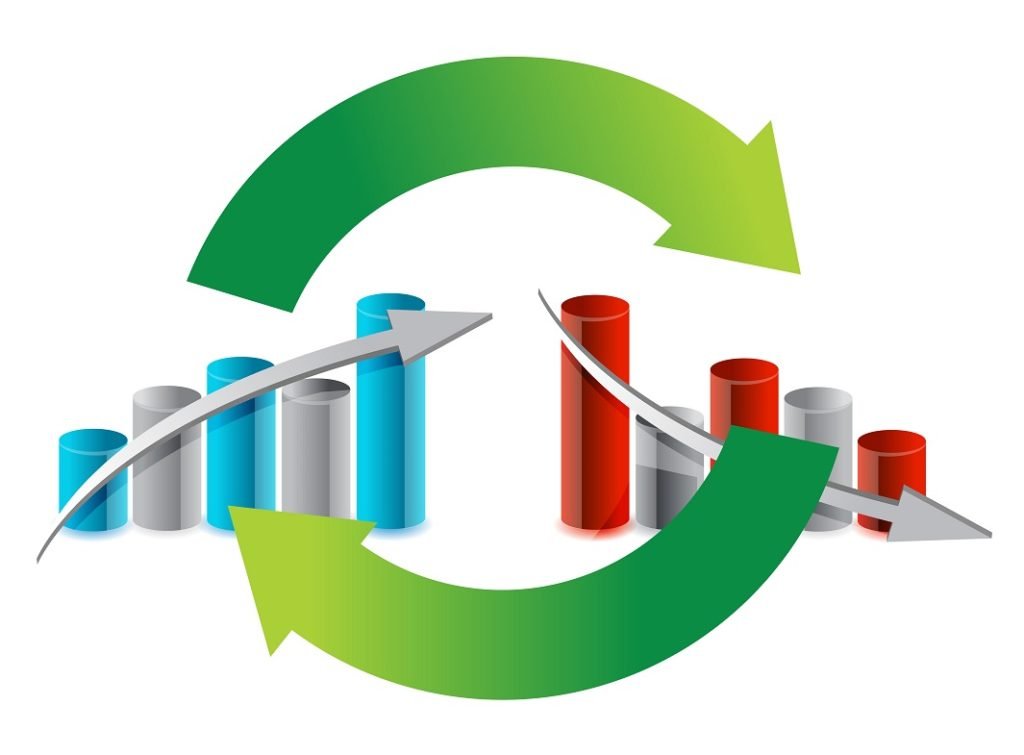
During a cycle, the revenue and profitability of a company may be characterized by high growth. Companies operating within a particular industry may exhibit similar patterns, which are cyclical in nature and are referred to as secular.
Summary
- Market cycle refers to economic trends observed during different types of business environments.
- A new market cycle may be formed when a new technological innovation or a change in market regulations disrupts existing market trends and creates new ones.
- The four phases of a market cycle include the accumulation phase, mark-up phase, distribution phase, and mark-down phase.
How Do New Market Cycles Emerge?
A new market cycle may be formed when a new technological innovation or a change in market regulations disrupts existing market trends and creates new ones. The change is industry-specific, which means that there is no blanket change in all sectors of the market due to the introduction of new products or a new regulatory regime.
A market cycle considers both technical indicators, such as interest ratesFederal Funds RateIn the United States, the federal funds rate is the interest rate that depository institutions (such as banks and credit unions) charge other depository institutions., and fundamental indicators, such as security prices, among other metrics.
How is a Market Cycle Determined?
It is almost impossible to accurately determine which market cycle one is currently in, given that there is no clearly identifiable beginning or end. A market cycle comes with no set duration, which means that it can last for any time horizon – from a few days to a decade. It can prove to be a hindrance to economic and monetary policy formulation.
Usually, the duration of a market cycle depends on perspective. An optionsOptions: Calls and PutsAn option is a derivative contract that gives the holder the right, but not the obligation, to buy or sell an asset by a certain date at a specified price. trader may be interested in price movements during 5-minute bars, while oil investors may want to look at a longer cycle of around 20 years.
Market cycles can be identified in retrospect. Usually, the beginning and end of one market cycle is the duration between the highest and lowest price of a common benchmark, e.g., the S&P 500.
However, many large institutional investors, or even individuals, aim to identify upcoming shifts in the direction of a market cycle ahead of time. It can enable them to profit from the cycles and make profitable trades. It is the basic principle of speculation in finance.
Different Phases of a Market Cycle
Generally, one market cycle exhibits four different stages. At each stage, securities will respond to the prevailing market conditions differently. For example, during an upswing or a boom period, companies selling luxury products exhibit high growth rates.
During a downswing or a recession, the fast-moving consumer good industry (FMCG)Fast-Moving Consumer Goods (FMCG)Fast-moving consumer goods (FMCG), also called consumer packaged goods (CPG), refer to products that are highly in-demand, sold quickly, and affordable is expected to outperform. It is because the demand for basic necessities and consumer durables, such as food and hygiene products, remains constant.
The four phases of a market cycle are as follows:
1. Accumulation phase
The accumulation takes place immediately after the market reaches the bottom. After figuring that the worst is over, value investors, money managers, and experienced traders start buying securities, and valuations become extremely important. During the period, the market sentiment makes a switch from being negative to neutral. However, the market is still bearish.
2. Mark-up phase
During the markup stage, investors begin to jump in by the large, and a substantial rise in market volumes is observed. Valuations start climbing over historical norms, but unemployment and layoff continue to grow.
At the mark-up stage, the market sentiment switches from being neutral to bullish or even euphoric in some cases. A selling climax is observed, which is a last parabolic price rise due to the participation of fence-sitters and hesitant or risk-averse investors.
3. Distribution phase
The distribution phase is the third phase of the market cycle, wherein traders start selling securities. The market sentiment goes from being bullish to mixed. It is the period at the end of which the market changes directions.
The transition is gradual and may last for a long time. Prices tend to remain more or less constant over several months. However, it may accelerate due to a sudden negative geopolitical change or bad economic news, such as pandemic lockdowns.
4. Mark-down phase
The mark-down phase is the final phase of a market cycle and proves to be terrible for investors who still hold positions. Security prices fall way below what investors originally paid for them. Being the last period, it also marks the beginning of the next accumulation phase, wherein new investors will purchase the depreciated investments.
Related Readings
CFI is the official provider of the Commercial Banking & Credit Analyst (CBCA)™Program Page - CBCAGet CFI's CBCA™ certification and become a Commercial Banking & Credit Analyst. Enroll and advance your career with our certification programs and courses. certification program, designed to transform anyone into a world-class financial analyst.
To keep learning and developing your knowledge of financial analysis, we highly recommend the additional resources below:
- Asset ClassAsset ClassAn asset class is a group of similar investment vehicles. They are typically traded in the same financial markets and subject to the same rules and regulations.
- Business Life CycleBusiness Life CycleThe business life cycle is the progression of a business in phases over time, and is most commonly divided into five stages
- Value InvestingStock Investing: A Guide to Value InvestingSince the publication of "The Intelligent Investor" by Ben Graham, what is commonly known as "value investing" has become one of the most widely respected and widely followed methods of stock picking.
- Trading MechanismsTrading MechanismsTrading mechanisms refer to the different methods by which assets are traded. The two main types of trading mechanisms are quote driven and order driven trading mechanisms
-

Understanding Algorithmic Trading Spoofing: Definition & Impact
Spoofing is a disruptive algorithmic trading practice that involves placing bids to buy or offers to sell futures contractsFutures ContractA futures contract is an agreement to buy or sell an underlyi
-
Trading Volume: Understanding & Significance
The term “volume” in trading refers to the total number of shares that are traded during a given period of time. The volume of trade is measured on all types of financial commodities, incl
invest
- Understanding Auction Markets: How Prices Are Determined
- Doji Candlestick Pattern: Meaning & Trading Signals
- Understanding Frothy Markets: Risks & Opportunities
- Understanding Inefficient Markets: Causes & Implications
- Understanding Market Depth: A Guide for Traders
- Understanding Market Exposure: Risk & Portfolio Allocation
- Understanding Market Indexes: A Comprehensive Guide
- Understanding Market Makers: How They Fuel Liquidity
- Understanding Market Manipulation: Definition, Tactics & SEC Role
-
 Understanding Secular Markets: Long-Term Trends & Investment Strategies
A secular market is predominantly driven and impacted by elements or forces that are likely to be present in the foreseeable future. The forces can impact the price or value of a financial assetFinanc...
-
 Sensex Explained: Understanding India's Key Stock Market Index
Sensex, also known as the S&P BSE Sensex Index, is the benchmark index that tracks India’s Bombay Stock Exchange (BSE). The Sensex is composed of the 30 largest and most-traded stocks within...