
Revenue-Based Financing: A Comprehensive Guide
Revenue-based financing, also known as royalty-based financing, is a type of capital-raising method in which investors agree to provide capital to a company in exchange for a certain percentage of the company’s ongoing total gross revenues. It is an alternative investment model to more conventional equity-based investments, such as venture capital and angel investingPrivate Equity vs Venture Capital, Angel/Seed InvestorsCompare private equity vs venture capital vs angel and seed investors in terms of risk, stage of business, size & type of investment, metrics, management. This guide provides a detailed comparison of private equity vs venture capital vs angel and seed investors. It's easy to confuse the three classes of investors, as well as debt financing.
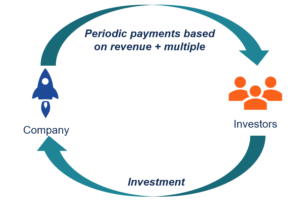
Revenue-based financing is an attractive method of raising capital for companies. A company may successfully raise the required capital without sacrificing part of its equity or pledging a part of its assets as collateralCollateralCollateral is an asset or property that an individual or entity offers to a lender as security for a loan. It is used as a way to obtain a loan, acting as a protection against potential loss for the lender should the borrower default in his payments.. Furthermore, relative to debt and equity financing, revenue-based financing is a much easier process that requires less documentation.
Revenue-based Financing vs. Debt and Equity-based Financing
Revenue-based financing seems similar to debt financing because investors are entitled to regular repayments of their initially invested capital. However, revenue-based funding does not involve interest paymentsInterest ExpenseInterest expense arises out of a company that finances through debt or capital leases. Interest is found in the income statement, but can also. Instead, the repayments are calculated using a particular multiple that results in returns that are higher than the initial investment. Also, in revenue-based financing, a company is not required to provide collateral to investors.
Unlike equity-based investment models, there is no transfer of an ownership stake in a company to investors. However, it is common that some equity warrants may be issued to investors. Finally, in such an investment model, a company is not required to provide investors with seats on the board of directorsBoard of DirectorsA board of directors is a panel of people elected to represent shareholders. Every public company is required to install a board of directors..
How Does Revenue-based Financing Work?
Imagine you are the CEO of a small SaaS company. You believe that further growth of the company may be ensured by an expansion that requires the injection of an additional $1 million in capital. However, you are not able to obtain a loan from banks, and shareholders are not willing to dilute their stake in the company by attracting new investors using equity-based financing. Thus, you decide to raise the capital using revenue-based financing.
Your company arranges a deal with ABC Capital, which specializes in revenue-based financing. The deal states that ABC Capital will provide the required $1 million in exchange for a portion of your revenues. Your company will be required to make monthly installment payments equal to 2.5% of your overall revenue. Additionally, you need to pay 1.5x multiple of the original amount to compensate the investors for the risk.
Final Word
From an investor’s perspective, revenue-based financing provides an opportunity to earn lucrative returns. Nevertheless, an investor should be aware of the risks associated with the financing model because the repayment rate has a direct relationship with revenues. If the company’s revenues experience a significant decline, the repayment rate will drop proportionally.
In addition, the revenue-based financing model is not suitable for every company. The model works only with companies that are generating sufficient revenues. In addition, a company that aims to resort to revenue-based financing must have strong gross margins to ensure their ability to repay the investment. Generally, revenue-based financing works best with SaaS companies.
More Resources
CFI is the official provider of the Financial Modeling and Valuation Analyst (FMVA)™Become a Certified Financial Modeling & Valuation Analyst (FMVA)®CFI's Financial Modeling and Valuation Analyst (FMVA)® certification will help you gain the confidence you need in your finance career. Enroll today! certification program, designed to transform anyone into a world-class financial analyst.
To keep learning and developing your knowledge of financial analysis, we highly recommend the additional resources below:
- Equity CrowdfundingEquity CrowdfundingEquity crowdfunding (also known as crowd-investing or investment crowdfunding) is a method of raising capital used by startups and early-stage companies. Essentially, equity crowdfunding offers the company’s securities to a number of potential investors in exchange for financing.
- Financial IntermediaryFinancial IntermediaryA financial intermediary refers to an institution that acts as a middleman between two parties in order to facilitate a financial transaction. The institutions that are commonly referred to as financial intermediaries include commercial banks, investment banks, mutual funds, and pension funds.
- Private Equity FundsPrivate Equity FundsPrivate equity funds are pools of capital to be invested in companies that represent an opportunity for a high rate of return. They come with a fixed
- Investing: A Beginner’s GuideInvesting: A Beginner's GuideCFI's Investing for Beginners guide will teach you the basics of investing and how to get started. Learn about different strategies and techniques for trading
-

Holding Companies: Definition, Purpose & How They Work
A holding company is a company that doesn’t conduct any operations, ventures, or other active tasks for itself. Instead, it exists for the purpose of owning assets. In other words, the company d
-

Kaizen: Understanding Continuous Improvement for Business
Kaizen is a Japanese word (改善) that means “improvement” or “to improve.” When applied to the world of business, kaizen refers to every action, operation, or rule
invest
- Acquirer Definition: Understanding Corporate Acquisitions
- Understanding Clawbacks: Protecting Stakeholders from Failed Performance
- Debt Financing: A Comprehensive Guide for Businesses
- Equity Financing: A Comprehensive Guide for Business Growth
- Understanding Financial Gearing: Debt & Leverage Explained
- SWORD Financing: Funding Biotech R&D - A Comprehensive Guide
- Understanding Net-Net: A Financial Health Indicator
- Series A Funding: Definition, Stages & What to Expect
- Series B Funding: A Comprehensive Guide for Startups
-
 OIBDA Explained: Understanding Operating Income Before Depreciation & Amortization
OIBDA is an abbreviation for Operating Income Before Depreciation and Amortization. It is a non-GAAP measure of the financial performance of a company during a specific period of time while excluding ...
-
 Understanding Vouchers: A Guide to Accounts Payable Documents
A voucher is an internal document within a company that is issued by the accounts payable Accounts PayableAccounts payable is a liability incurred when an organization receives goods or services from ...