
Equity Financing: A Comprehensive Guide for Business Growth
Equity financing refers to the sale of company shares in order to raise capital. Investors who purchase the shares are also purchasing ownership rights to the company. Equity financing can refer to the sale of all equity instruments, such as common stockCommon StockCommon stock is a type of security that represents ownership of equity in a company. There are other terms – such as common share, ordinary share, or voting share – that are equivalent to common stock., preferred shares, share warrants, etc.

Equity financing is especially important during a company’s startup stage to finance plant assets and initial operating expensesOperating ExpensesOperating expenses, operating expenditures, or "opex," refers to the expenses incurred regarding a business’s operational activities.. Investors make gains by receiving dividends or when their shares increase in price.
Major Sources of Equity Financing
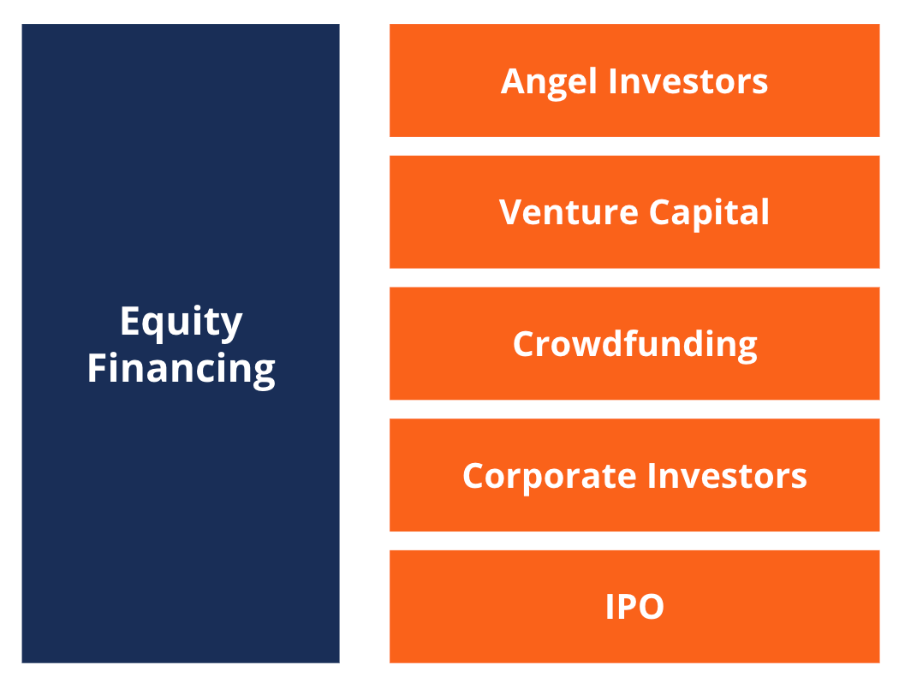
When a company is still private, equity financing can be raised from angel investors, crowdfunding platformsEquity CrowdfundingEquity crowdfunding (also known as crowd-investing or investment crowdfunding) is a method of raising capital used by startups and early-stage companies. Essentially, equity crowdfunding offers the company’s securities to a number of potential investors in exchange for financing., venture capital firms, or corporate investors. Ultimately, shares can be sold to the public in the form of an IPO.
1. Angel investors
Angel investors are wealthy individuals who purchase stakes in businesses that they believe possess the potential to generate higher returns in the future. The individuals usually bring their business skills, experience, and connections to the table, which helps the company in the long term.
2. Crowdfunding platforms
Crowdfunding platforms allow for a number of people in the public to invest in the company in small amounts. Members of the public decide to invest in the companies because they believe in their ideas and hope to earn their money back with returns in the future. The contributions from the public are summed up to reach a target total.
3. Venture capital firms
Venture capital firms are a group of investors who invest in businesses they think will grow at a rapid pace and will appear on stock exchanges in the future. They invest a larger sum of money into businesses and receive a larger stake in the company compared to angel investors. The method is also referred to as private equity financing.
4. Corporate investors
Corporate investors are large companies that invest in private companies to provide them with the necessary funding. The investment is usually created to establish a strategic partnership between the two businesses.
5. Initial public offerings (IPOs)
Companies that are more well-established can raise funding with an initial public offering (IPO)Initial Public Offering (IPO)An Initial Public Offering (IPO) is the first sale of stocks issued by a company to the public. Prior to an IPO, a company is considered a private company, usually with a small number of investors (founders, friends, family, and business investors such as venture capitalists or angel investors). Learn what an IPO is. The IPO allows companies to raise funds by offering its shares to the public for trading in the capital markets.
Advantages of Equity Financing
1. Alternative funding source
The main advantage of equity financing is that it offers companies an alternative funding source to debt. Startups that may not qualify for large bank loans can acquire funding from angel investors, venture capitalists, or crowdfunding platforms to cover their costs. In this case, equity financing is viewed as less risky than debt financing because the company does not have to pay back its shareholders.
Investors typically focus on the long term without expecting an immediate return on their investment. It allows the company to reinvest the cash flow from its operations to grow the business rather than focusing on debt repayment and interest.
2. Access to business contacts, management expertise, and other sources of capital
Equity financing also provides certain advantages to company management. Some investors wish to be involved in company operations and are personally motivated to contribute to a company’s growth.
Their successful backgrounds allow them to provide invaluable assistance in the form of business contacts, management expertise, and access to other sources of capital. Many angel investors or venture capitalists will assist companies in this manner. It is crucial in the startup period of a company.
Disadvantages of Equity Financing
1. Dilution of ownership and operational control
The main disadvantage to equity financing is that company owners must give up a portion of their ownership and dilute their control. If the company becomes profitable and successful in the future, a certain percentage of company profits must also be given to shareholders in the form of dividends.
Many venture capitalists request an equity stake of 30%-50%, especially for startups that lack a strong financial background. Many company founders and owners are unwilling to dilute such an amount of their corporate power, which limits their options for equity financing.
2. Lack of tax shields
Compared to debt, equity investments offer no tax shield. Dividends distributed to shareholders are not a tax-deductible expense, whereas interest payments are eligible for tax benefits. It adds to the cost of equity financing.
In the long term, equity financing is considered to be a more costly form of financing than debt. It is because investors require a higher rate of return than lenders. Investors incur a high risk when funding a company, and therefore expect a higher return.
Learn More
CFI offers the Commercial Banking & Credit Analyst (CBCA)™Program Page - CBCAGet CFI's CBCA™ certification and become a Commercial Banking & Credit Analyst. Enroll and advance your career with our certification programs and courses. certification program for those looking to take their careers to the next level. To keep learning and developing your knowledge base, please explore the additional relevant resources below:
- Capital Raising ProcessCapital Raising ProcessThis article is intended to provide readers with a deeper understanding of how the capital raising process works and happens in the industry today. For more information on capital raising and different types of commitments made by the underwriter, please see our underwriting overview.
- Debt FinancingDebt FinancingDebt financing occurs when a company raises money by selling debt instruments, most commonly in the form of bank loans or bonds. Such a type
- IPO ProcessIPO ProcessThe IPO Process is where a private company issues new and/or existing securities to the public for the first time. The 5 steps discussed in detail
- Rate of ReturnRate of ReturnThe Rate of Return (ROR) is the gain or loss of an investment over a period of time copmared to the initial cost of the investment expressed as a percentage. This guide teaches the most common formulas
-

Debt Financing: A Comprehensive Guide for Businesses
Debt financing occurs when a company raises money by selling debt instruments, most commonly in the form of bank loans or bonds. Such a type of financing is often referred to as financial leverage.&nb
-
Understanding Equity: A Comprehensive Guide for Investors
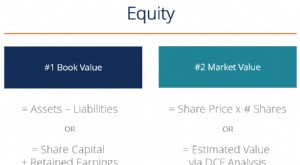
In finance and accounting, equity is the value attributable to the owners of a business. The book value of equity is calculated as the difference between assetsTypes of AssetsCommon types of assets in
finance
- Understanding Liquid Equity: A Guide to Company Stock
- Debt/Equity Swap: Understanding Financial Restructuring
- Equity Multiplier: Definition, Calculation & Financial Significance
- Equity Ratio: Understanding Financial Leverage & Risk
- Mezzanine Financing: Definition, Benefits & How It Works
- Return on Common Equity (ROCE): Definition & Importance
- SWORD Financing: Funding Biotech R&D - A Comprehensive Guide
- Revenue-Based Financing: A Comprehensive Guide
- Portfolio Companies: Definition & How Private Equity Uses Them
-
 Backstop: Understanding Financial Safety Nets and Contingency Funding
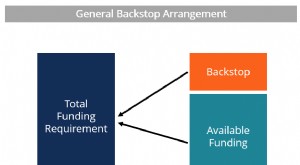
A backstop is a financial arrangement that creates a secondary source of funds in case the primary source is not enough to meet current needs. It can also be thought of as an insurance policy that cov...
-
 Understanding Clawbacks: Protecting Stakeholders from Failed Performance
What happens when a person promises to perform and then fails to deliver on their promises? Or what happens when it is found that a performance reportDue Diligence ReportExample due diligence report o...