
Series A Funding: Definition, Stages & What to Expect
Series A financing (also known as series A round or series A funding) is one of the stages in the capital-raising process by a startup. Essentially, the series A round is the second stage of startup financing and the first stage of venture capital financing.
Similar to seed financingSeed FinancingSeed financing (also known as seed capital, seed money, or seed funding) is the earliest stage of the capital-raising process of a startup. Seed financing is a type of equity-based financing. In other words, investors commit their capital in exchange for an equity interest in a company., series A financing is a type of equity-based financing. This means that a company secures the required capital from investors by selling the company’s shares. However, in most cases, series A financing comes with anti-dilution provisions. Startups usually issue preferred shares that do not provide their owners with voting rights.
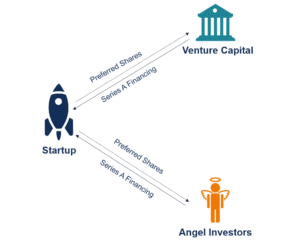
At the same time, it is quite common that the companies issue convertible preferred sharesPreferred SharesPreferred shares (preferred stock, preference shares) are the class of stock ownership in a corporation that has a priority claim on the company’s assets over common stock shares. The shares are more senior than common stock but are more junior relative to debt, such as bonds.. These shares offer investors the option to convert their preferred shares into common stock at some pre-determined future date. Note that the investors’ returns from series A financing are lower than the returns from seed funding.
In addition to more conventional methods, equity crowdfundingEquity CrowdfundingEquity crowdfunding (also known as crowd-investing or investment crowdfunding) is a method of raising capital used by startups and early-stage companies. Essentially, equity crowdfunding offers the company’s securities to a number of potential investors in exchange for financing. can also be used in series A financing.
Objectives of Series A Financing
Series A financing is primarily used to ensure the continued growth of a company. The common goals in the series A round include reaching milestones in product development and attracting new talent. In this stage of development, a company intends to continue the growth of its business to attract more investors to future rounds of financing.
In the series A round, the biggest investors are venture capital firms. Commonly, they are firms that specialize in investments in early-stage companies. The general rule is that capital is provided to companies that already generate revenues but are still in the pre-profit stage.
How Does Series A Financing Work?
Unlike seed capital, series A financing follows a strictly formal approach. Venture capitalists that represent the majority of investors in this round of financing are willing to complete the due diligenceDue DiligenceDue diligence is a process of verification, investigation, or audit of a potential deal or investment opportunity to confirm all relevant facts and financial information, and to verify anything else that was brought up during an M&A deal or investment process. Due diligence is completed before a deal closes. and valuation process before making an investment decision. Thus, these processes start every substantial series A funding.
The valuation of a startup is an essential part of series A financing. Unlike startups in the seed stage, companies looking to secure series A capital are able to provide more information that can be used to make informed investment decisions.
The goals of valuation in series A fundraising include the identification and assessment of progress made by a company using its seed capital, as well as the efficiency of its management team. Additionally, the valuation process demonstrates how well a company and its management use the available resources to earn profits in the future. Only when the due diligence and valuation processes are completed will venture capitalists invest in a company.
Related Readings
CFI offers the Financial Modeling & Valuation Analyst (FMVA)™Become a Certified Financial Modeling & Valuation Analyst (FMVA)®CFI's Financial Modeling and Valuation Analyst (FMVA)® certification will help you gain the confidence you need in your finance career. Enroll today! certification program for those looking to take their careers to the next level. To keep learning and advancing your career, the following resources will be helpful:
- Debt vs Equity FinancingDebt vs Equity FinancingDebt vs Equity Financing - which is best for your business and why? The simple answer is that it depends. The equity versus debt decision relies on a large number of factors such as the current economic climate, the business' existing capital structure, and the business' life cycle stage, to name a few.
- Dilutive SecuritiesDilutive SecuritiesDilution can be caused due to a number of dilutive securities such as stock options, restricted and performance stock units, preferred stock, warrants, and
- Return on Equity (ROE)Return on Equity (ROE)Return on Equity (ROE) is a measure of a company’s profitability that takes a company’s annual return (net income) divided by the value of its total shareholders' equity (i.e. 12%). ROE combines the income statement and the balance sheet as the net income or profit is compared to the shareholders’ equity.
- Startup Valuation MetricsStartup Valuation Metrics (for internet companies)Startup Valuation Metrics for internet companies. This guide outlines the 17 most important e-commerce valuation metrics for internet starts to be valued
-

Accounts Receivable Financing: A Comprehensive Guide for Businesses
Accounts receivable financing is a means of short-term funding that a business can draw on using its receivables. It is very useful if a timing mismatch exists between the cash inflows and outflows of
-
Series A Funding: Definition, Stages & What to Expect
Series A financing (also known as series A round or series A funding) is one of the stages in the capital-raising process by a startup. Essentially, the series A round is the second stage of startup f
invest
- OAC Financing Explained: What It Means and How It Works
- Series B Funding: What It Is & When Your Startup Needs It
- Debt Financing: A Comprehensive Guide for Businesses
- Understanding Business Financing: A Comprehensive Guide
- Vendor Financing: A Comprehensive Guide for Businesses
- Revenue-Based Financing: A Comprehensive Guide
- Seed Financing: A Comprehensive Guide for Startups
- Series B Funding: A Comprehensive Guide for Startups
- Series C Financing: A Comprehensive Guide for Startups
-
 100% Financing: Understanding No Down Payment Loans
When buying property, such as a home or car, the buyer commonly pays some money down when financing the purchase with a loan. In some cases, the lender providers 100 percent of the funds required for ...
-
Understanding Cryptocurrency: A Beginner's Guide to Digital Currency
Cryptocurrency is a kind of digital currency that is intended to act as a medium of exchange. Cryptocurrency has become popular in the last decade, in particular, with Bitcoin becoming the most widel...