
SWORD Financing: Funding Biotech R&D - A Comprehensive Guide
Stock and Warrant Off-Balance R&D (SWORD) financing is a special type of financing developed particularly for biotechnology companies. The main goal of SWORD financing is to subsidize a company’s biotech R&D activitiesResearch and Development (R&D)Research and Development (R&D) is a process by which a company obtains new knowledge and uses it to improve existing products and introduce.
Research and development activities are essential to the success of a biotechnology company. However, R&D activities come with a high degree of uncertainty because of issues related to a project’s viability and regulatory concernsSecurities and Exchange Commission (SEC)The US Securities and Exchange Commission, or SEC, is an independent agency of the US federal government that is responsible for implementing federal securities laws and proposing securities rules. It is also in charge of maintaining the securities industry and stock and options exchanges.
In other words, there is a high probability that the R&D initiatives of biotechnology companies will not result in commercial success. Due to this uncertainty that leads to high investment risk, investors are not typically willing to accept conventional methods of financing in their investments in biotechnology companies.
Breaking Down SWORD Financing
SWORD financing is carried out through a separate entity established solely for the purpose of financing. It provides investors with partial rights to all technologies developed in the course of the company’s R&D activities that deliver additional value to potential financial returns.
This financing arrangement enables biotech companies to obtain the required funds to finance R&D projects that would otherwise be unaffordable. In addition, SWORD financing separates the company’s R&D expenditures from other types of liabilities and expensesFixed and Variable CostsCost is something that can be classified in several ways depending on its nature. One of the most popular methods is classification according. Therefore, the company’s financial performance will not be affected.
How Does SWORD Financing Work?
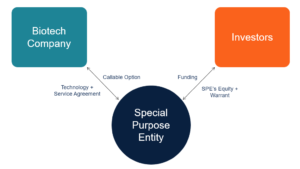
SWORD financing is a more sophisticated type of fundraising relative to conventional equity or debt financing. The process starts with the creation of a special purpose entity (SPE) that is separate from the parent company. The newly created venture acts as the middleman between the parent company and the investors.
After the creation of the entity, it obtains the technology license agreement from the parent company that allows the use of the parent company’s research materials that can be used in further R&D activities. The parent company usually receives the option to purchase the technologies developed by the special purpose entity in exchange for royalty payments.
The new venture also establishes a service agreement with the parent company. According to the agreement, the parent company provides all the necessary management and administrative services.
Then, the special purpose entity issues financial securitiesPublic SecuritiesPublic securities, or marketable securities, are investments that are openly or easily traded in a market. The securities are either equity or debt-based. (units) to investors. Each unit includes one share of the special purpose entity’s equity with the call option for the parent’s company to buy back the shares, as well as one warrant to purchase the shares of the parent’s company. The investors use the warrants as a form of insurance for investors in case the parent company would not recall the shares.
More Resources
Thank you for reading CFI’s guide to SWORD financing. CFI offers the Financial Modeling & Valuation Analyst (FMVA)™Become a Certified Financial Modeling & Valuation Analyst (FMVA)®CFI's Financial Modeling and Valuation Analyst (FMVA)® certification will help you gain the confidence you need in your finance career. Enroll today! certification program for those looking to take their careers to the next level. To keep learning and advancing your career, the following CFI resources will be helpful:
- Equity Risk PremiumEquity Risk PremiumEquity risk premium is the difference between returns on equity/individual stock and the risk-free rate of return. It is the compensation to the investor for taking a higher level of risk and investing in equity rather than risk-free securities.
- Options: Calls and PutsOptions: Calls and PutsAn option is a derivative contract that gives the holder the right, but not the obligation, to buy or sell an asset by a certain date at a specified price.
- Product CostsProduct CostsProduct costs are costs that are incurred to create a product that is intended for sale to customers. Product costs include direct material
- Seed FinancingSeed FinancingSeed financing (also known as seed capital, seed money, or seed funding) is the earliest stage of the capital-raising process of a startup. Seed financing is a type of equity-based financing. In other words, investors commit their capital in exchange for an equity interest in a company.
-

Understanding Vouchers: A Guide to Accounts Payable Documents
A voucher is an internal document within a company that is issued by the accounts payable Accounts PayableAccounts payable is a liability incurred when an organization receives goods or services from
-

Holding Companies: Definition, Purpose & How They Work
A holding company is a company that doesn’t conduct any operations, ventures, or other active tasks for itself. Instead, it exists for the purpose of owning assets. In other words, the company d
finance
- Acquirer Definition: Understanding Corporate Acquisitions
- Understanding Clawbacks: Protecting Stakeholders from Failed Performance
- Debt Financing: A Comprehensive Guide for Businesses
- Equity Financing: A Comprehensive Guide for Business Growth
- Understanding Financial Gearing: Debt & Leverage Explained
- Leverage in Finance: Strategies, Types & Risks
- Parent Company Explained: Definition, Control & Examples
- Understanding Stocks: A Beginner's Guide to Share Ownership
- Revenue-Based Financing: A Comprehensive Guide
-
 Goodwill in Accounting: Definition & Value
In accounting, goodwill is an intangible assetIntangible AssetsAccording to the IFRS, intangible assets are identifiable, non-monetary assets without physical substance. Like all assets, intangible as...
-
 OIBDA Explained: Understanding Operating Income Before Depreciation & Amortization
OIBDA is an abbreviation for Operating Income Before Depreciation and Amortization. It is a non-GAAP measure of the financial performance of a company during a specific period of time while excluding ...