
Understanding Rising Star Companies in Debt Capital Markets
A Rising Star is a business or a company that is relatively new to the debt capital markets, with little or no history of debt repaymentDebt ScheduleA debt schedule lays out all of the debt a business has in a schedule based on its maturity and interest rate. In financial modeling, interest expense flows, which makes it difficult to assess its creditworthiness. Despite the lack of history, the company’s performance is strong enough to attract a certain group of investors. However, because of a low credit rating, the company’s bonds are often considered high risk, and must, therefore, offer a premium yield.
If a rising star continues to improve its credit quality and attains the required asset ratioLeverage RatiosA leverage ratio indicates the level of debt incurred by a business entity against several other accounts in its balance sheet, income statement, or cash flow statement. Excel template, its bonds will be upgraded to investment gradeS&P – Standard and Poor'sStandard & Poor’s is an American financial intelligence company that operates as a division of S&P Global. S&P is a market leader in the. At this level, it comes with a relatively low risk of default. Bonds rated somewhat higher than the usual BB – something like BBB or A3 – indicate a relatively safe investment.
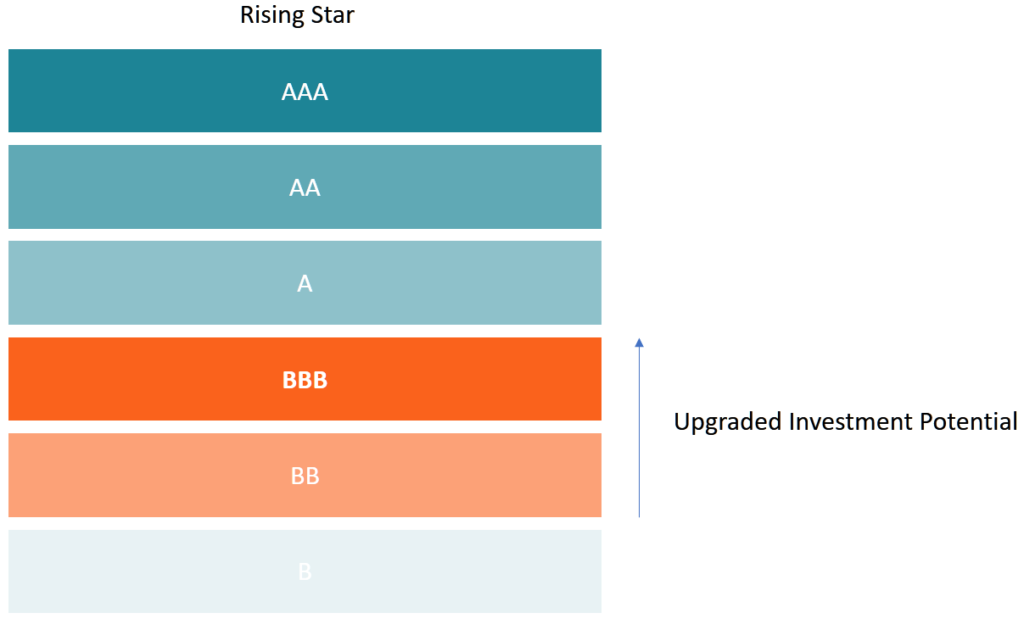
Example of a Credit Rating Upgrade
Assume three-year-old Company X dealing with oil exploration discovers oil deposits in a practically unexplored country. The FAM (Financial Accountant Manager) and the board realize that their operations will be futile without substantive funding. They work to solve their financial shortfall of $1.2 billion by issuing bonds. Unfortunately, due to their low reputation in the market, their only initial option is to issue high-yield bonds that will be graded junk bondsJunk BondsJunk Bonds, also known as high-yield bonds, are bonds that are rated below investment grade by the big three rating agencies (see image below). Junk bonds carry a higher risk of default than other bonds, but they pay higher returns to make them attractive to investors..
The credit rating issue arises despite the company’s recent completion of the first phase of pipeline construction that catapulted it to being one of the most profitable businesses in the country and put the spotlight on a number of large investors in the company. These successes may lead to a credit rating upgrade and brand the company as a “rising star”. However, it will still have to work on establishing a more solid credit history in order to receive substantially higher ratings from the bond rating agencies.
In short, a rising star is a company that shows good potential future prospects, and that has made some progress in terms of its rating in the capital markets, but which still has work to do in order to secure the highest investment-grade ratings for its bonds.
Rising Star vs Fallen Angel
Both the rising star and fallen angelFallen AngelA fallen angel is a bond that was rated investment-grade but has since been downgraded to junk status due to the declining financial position of its issuer. The bond is downgraded by one or more of the big three rating services - Fitch, Moody’s and Standard & Poor’s (S&P). bonds may be found under the big umbrella of junk bonds. The difference is in their perceived direction. Rising stars are seen as companies moving upward toward obtaining higher credit ratings for their debt issues. In contrast, fallen angels are companies that have a longer history and previously had a higher credit rating, but that have fallen on hard times, resulting in their debt being downgraded to junk bond status.
Rising stars are seeing their credibility steadily improve, although their credit rating may remain relatively low for the moment. But they’re considered as being on track to gaining credit quality worthy of investment-grade. Thus, their bonds are typically considered less risky as compared to fallen angel bonds.
Challenges for a Rising Star
A rising star company’s most significant challenge usually lies in funding significant growth. It faces the difficulty of gaining the trust of investors, due to lack of an established credit record.
Specifically, it may face challenges such as:
- Adapting to a changing marketplace
- Adopting new strategic plans
- Cash flows and financial management complexities
Investment Opportunities with a Rising Star
It is often difficult to identify a rising star at the right stage of the market cycle. However, successfully doing so can lead to substantial returns for investors.
1 – Investors may be able to obtain the company’s bonds when they are still rated as junk bonds and therefore offer a high yield, even though the company is steadily growing and becoming less and less of a credit/default risk. An investor may then enjoy higher yields free of the correspondingly higher level of risk.
2 – As the rising star’s credit rating improves, its bonds will appreciate in value. Investors who acquired the bonds earlier, when the company had a lower credit rating, may then be able to sell the bonds for a profit in the secondary market.
Rising stars in the debt capital markets can provide good opportunities for investors. Investing wisely in rising stars requires careful research, caution, and usually patience, as it may take some time for the company’s credit ratings to significantly improve.
Additional Resources
Thank you for reading CFI’s explanation of a Rising Star. CFI is the official global provider of the Financial Modeling and Valuation Analyst (FMVA)™Become a Certified Financial Modeling & Valuation Analyst (FMVA)®CFI's Financial Modeling and Valuation Analyst (FMVA)® certification will help you gain the confidence you need in your finance career. Enroll today! designation, a leading financial analyst certification program. To continue learning and advancing your career, these additional resources will be helpful:
- Corporate VenturingCorporate VenturingCorporate venturing (also known as corporate venture capital) is the practice of directly investing corporate funds into external startup companies. This is usually done by large companies who wish to invest small but innovative startup firms. They do so through joint venture agreements and acquisition of equity stakes.
- Private Equity vs Venture Capital, Angel/Seed InvestorsPrivate Equity vs Venture Capital, Angel/Seed InvestorsCompare private equity vs venture capital vs angel and seed investors in terms of risk, stage of business, size & type of investment, metrics, management. This guide provides a detailed comparison of private equity vs venture capital vs angel and seed investors. It's easy to confuse the three classes of investors
- Private Equity FundsPrivate Equity FundsPrivate equity funds are pools of capital to be invested in companies that represent an opportunity for a high rate of return. They come with a fixed
- Rating AgencyRating AgencyA rating agency assesses the financial strength of companies and government entities, especially their ability to meet principal and interest payments
-

Bond Defeasance: Understanding a Key Financial Strategy
Corporations and governmental entities issue bonds in order to borrow money from investors. The bonds require the issuer to pay interest and repay the principal on appointed dates. Bond defeasance is
-

Mortgage Bonds: Understanding Real Estate-Backed Investments
What are mortgage bonds? A mortgage bond is a bond in which holders have a claim on the real estate assets put up as its collateral. A lender might sell a collection of mortg
invest
- Baby Bonds: A Comprehensive Guide to Investing in Children's Futures
- Understanding Bonds: A Comprehensive Guide for Investors
- Callable Bonds: Understanding Issuer Redemption Rights
- Convertible Bonds: A Comprehensive Guide for Investors
- Understanding Fallen Angels: Bond Downgrades Explained
- Green Bonds: Financing a Sustainable Future | [Your Company Name]
- High-Yield Bonds: Understanding Risk & Potential Returns
- Investment-Grade Bonds: Understanding Credit Risk & Ratings
- Understanding Bonds: A Comprehensive Guide for Investors
-
 Revenue Bonds: A Comprehensive Guide for Investors
A revenue bond is a type of municipal bond in which the repayment of the obligation is primarily guaranteed by the operating revenuesRevenueRevenue is the value of all sales of goods and services reco...
-
 Sovereign Bonds: A Comprehensive Guide to National Debt
A sovereign bond is a national government-issued debt securityDebt SecurityA debt security is any debt that can be bought or sold between parties in the market prior to maturity. Its structure represe...