
Understanding Trading Instruments: A Comprehensive Guide
Trading instruments are all the different types of assets and contracts that can be traded. Trading instruments are classified into various categories, some more popular than others. They range from equities and forward contractsForward ContractA forward contract, often shortened to just "forward", is an agreement to buy or sell an asset at a specific price on a specified date in the future to indices, currencies, and more.
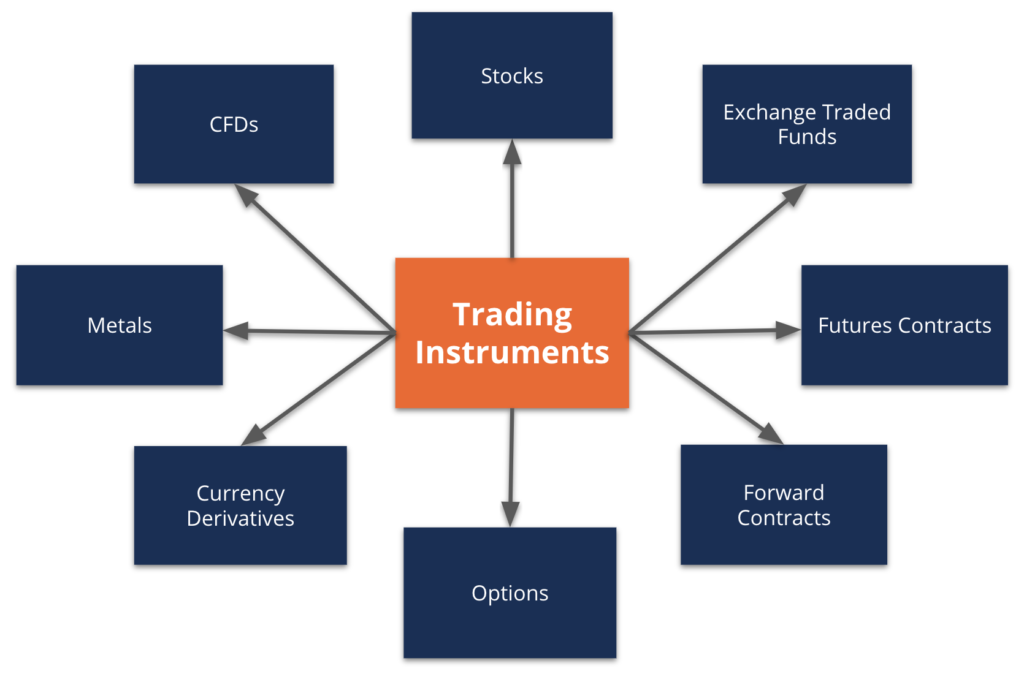
The Most Popular Trading Instruments
Popular trading instruments usually see high trading volumesVolume of TradeVolume of trade, also known as trading volume, refers to the quantity of shares or contracts that belong to a given security traded on a daily basis daily. They include:
1. Stocks
Stocks are investments in a company that change in value depending on their performance. Stocks are traded on stock exchanges. A single stock is often referred to as a “share,” and buying a share makes the investor a shareholder in the company.
2. Exchange-Traded Funds (ETFs)
An exchange-traded fund (ETF) is a basket of assets that is traded on the stock exchange. ETFs track the composite value of the securities they own. There are several different types of ETFs, ranging from metal ETFs to technology stock ETFs and more.
3. Futures Contracts
Futures contracts are standardized contracts (i.e., fixed quantity, price, and delivery location) that serve as a legal agreement to buy a particular asset at a fixed price in the future. Most commonly, futures contracts are used for trading commodities, such as soybean, cocoa, crude oil, and more.
4. Forward Contracts
Forward contracts are slightly different from futures contracts in that they are customizable, unlike futures contracts that are standardized. They are commonly used to hedge and reduce risk from other investments.
5. Options
Options contracts give the buyer the right to buy or sell an asset at an agreed-upon date and price. Call options provide the option to buy, whereas put optionsPut OptionA put option is an option contract that gives the buyer the right, but not the obligation, to sell the underlying security at a specified price (also known as strike price) before or at a predetermined expiration date. It is one of the two main types of options, the other type being a call option. provide the option to sell. Unlike a futures contract, an options contract does not oblige the buyer to buy or sell.
6. Currency Derivatives
Currency derivatives refer to futures, forwards, and options contracts that trade a particular currency. They are commonly used by forex traders that trade based on currency fluctuations.
7. Metals
Metals like gold, silver, and copper not only serve as assets for futures contracts but also as trading instruments themselves. The trading of physical metals – especially the precious metals gold and silver – is quite common.
8. Contract For Differences (CFDs)
A contract for difference (CFD) refers to an agreement between two parties to trade financial instruments based on the difference between the entry prices and closing prices.
Are Trading Instruments Regulated?
In the U.S., most trading instruments are regulated by the Securities and Exchange Commission (SEC)Securities and Exchange Commission (SEC)The US Securities and Exchange Commission, or SEC, is an independent agency of the US federal government that is responsible for implementing federal securities laws and proposing securities rules. It is also in charge of maintaining the securities industry and stock and options exchanges, which monitors trading instruments and the compliance of companies involved in trading. Notably, contracts for differences are banned by the SEC.
Examples of Trading Instruments
1. Futures Contracts
WTI Crude Oil Futures Contract (CME)
- Unit: 1,000 barrels
- Prices in U.S. dollars and cents per barrel
- Settlement Method: Deliverable
Copper Futures (CME)
- Unit: 25,000 pounds
- Prices in U.S. dollars and cents per pound
- Settlement Method: Deliverable
3. Exchange-traded Funds
- SPDR S&P 500 (SPY)SPDR S&P 500 ETF (SPY)The Standard and Poor Depositary Receipts (SPDR) S&P 500 ETF is an exchange-traded fund that tracks the S&P 500 stock market index. – Tracks the performance of the S&P 500
- iShares Silver Trust (SLV) – Tracks the performance of physical silver
- ARK Innovation ETF – Tracks the performance of select technology stocks
4. Options
A (hypothetical) Apple (AAPL) Call Option
- Strike price: $160
- Maturity date: February 23, 2021
A (hypothetical) Tesla (TSLA) Put Option
- Strike price: $350
- Maturity date: March 15, 2021
Additional Resources
CFI offers the Capital Markets & Securities Analyst (CMSA)®Program Page - CMSAEnroll in CFI's CMSA® program and become a certified Capital Markets &Securities Analyst. Advance your career with our certification programs and courses. certification program for those looking to take their careers to the next level. To keep learning and advance your career, the following resources will be helpful:
- Contract for Difference (CFD)Contract for Difference (CFD)Contract for Difference (CFD) refers to a contract that enables two parties to enter into an agreement to trade on financial instruments based on the price difference between the entry prices and closing prices.
- Financial InstrumentFinancial InstrumentFinancial instruments are contracts for monetary assets that can be purchased, traded, created, modified, or settled for. In terms of
- Options: Calls and PutsOptions: Calls and PutsAn option is a derivative contract that gives the holder the right, but not the obligation, to buy or sell an asset by a certain date at a specified price.
- Marketable SecuritiesMarketable SecuritiesMarketable securities are unrestricted short-term financial instruments that are issued either for equity securities or for debt securities of a publicly listed company. The issuing company creates these instruments for the express purpose of raising funds to further finance business activities and expansion.
-
Trading Channels: Understanding Uptrends & Downtrends
A trading channel is a chart pattern highlighted by two parallel lines bordering resistance and support within which a security trades during a period. Within a valid uptrend trading channel, an oppor
-
Understanding Trading Instruments: A Comprehensive Guide
Trading instruments are all the different types of assets and contracts that can be traded. Trading instruments are classified into various categories, some more popular than others. They range from e
invest
- Understanding Algorithms: A Guide to Algorithmic Trading
- Automated Trading Systems: A Comprehensive Guide
- Understanding Commodities: A Beginner's Guide to Investing
- Currency Futures Contracts: A Comprehensive Guide
- Understanding Financial Derivatives: A Comprehensive Guide
- Securitized Debt Instruments: Definition & How They Work
- Trading Assets: Definition, Types & How They Work
- Trading Securities: Definition, Types & Short-Term Investment Strategies
- Smart Contracts: A Comprehensive Guide to Blockchain Agreements
-
 Spread Trading: A Comprehensive Guide to Relative Value Trading
Spread trading – also known as relative value trading – is a method of trading that involves an investor simultaneously buying one security and selling a related security. The securities b...
-
 Trading Authorization: Empowering Your Broker & Account Security
Trade authorization is the level of power or authority extended to a broker or an agent by a client to execute all transactions, thereby establishing accountability of the trading accountsTrading Acco...