
Tactical Asset Allocation (TAA): A Comprehensive Guide
Tactical asset allocation (TAA) refers to an active management portfolio strategy that shifts asset allocations in a portfolio to take advantage of market trends or economic conditions. In other words, tactical asset allocation refers to an investment style in which asset classesAsset ClassAn asset class is a group of similar investment vehicles. They are typically traded in the same financial markets and subject to the same rules and regulations. such as stocks, bonds, cash, etc. are adjusted in the portfolio to account for macroeconomic events.

Quick Summary:
- Tactical asset allocation refers to an active management portfolio strategy that shifts the asset allocations in a portfolio to take advantage of macroeconomic conditions.
- The tactical asset allocation strategy can be used to increase returns, adapt to market conditions, and provide diversification.
- Tactical asset allocation can be used within an asset class.
Understanding Tactical Asset Allocation
The underlying premise behind tactical asset allocation is to first focus on asset allocation and securities selection second. Those who invest using a tactical asset allocation looks at the “bigger picture” and believes that the allocation of assets exerts a greater impact on portfolio returns than individually selecting securities.
For example, consider the data below regarding the S&P 500 return (“stock return”) and Barclays U.S. Aggregate Bond Index (“bond return”) return provided by The Balance. Note that cash does not generate a return:
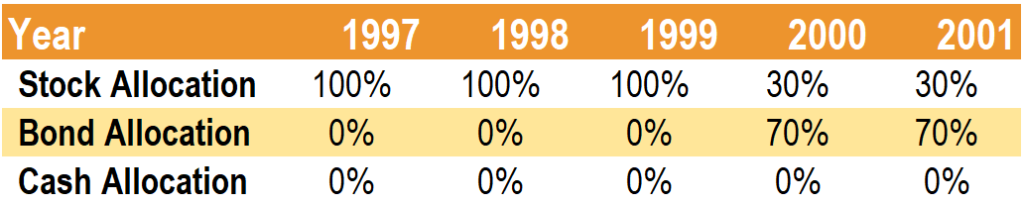
As one can see, stock returns outpaced bond returns from 1997 to 1999. From 2000 to 2001, bond returns outpaced stock returns. A tactical asset allocation strategy might show the following asset class allocation over the years:
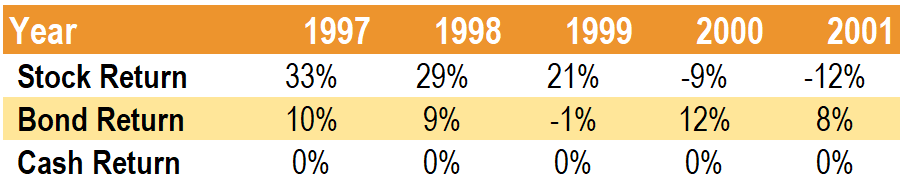
Compared to an investor that might have solely invested in stocks from 1997 to 2001, tactical asset allocation would have mitigated the poor performance of stocks in 2000 and 2001 by shifting the asset allocation to bonds.
In essence, the goal of tactical asset allocation is to adjust the asset class in a portfolio to asset classes that are expected to perform better relative to other asset classes.
Reasons for Tactical Asset Allocation
Tactical asset allocations serve many functions, including:
1. Increasing returns
Using tactical asset allocation to shift asset allocations to stronger performers increases the portfolio return. Doing so allows the portfolio to capture the upside in an asset class while moving away from poorly performing asset classes.
2. Adapting to market conditions
Tactical asset allocation is flexible and responds to macroeconomic events. As seen with the stock market in 2000 and 2008, stocks significantly underperformed several other asset classes. A tactical asset allocation strategy shifts the asset allocation accordingly to account for macroeconomic conditions.
3. Providing diversification
Investing solely in one asset class increases the risk of the portfolio. By diversifying through tactical asset allocation, greater returns can potentially be realized with lower risks.
Example of Tactical Asset Allocation
In his investment policy statementInvestment Policy Statement (IPS)An investment policy statement (IPS), a document drafted between a portfolio manager and a client, outlines the rules and guidelines that the portfolio, John indicated that he wants an asset allocation consisting of 45% stocks / 45% bonds / 10% cash. Historically, stocks have performed extremely well.
The portfolio manager of John recently noted that the yield curveYield CurveThe Yield Curve is a graphical representation of the interest rates on debt for a range of maturities. It shows the yield an investor is expecting to earn if he lends his money for a given period of time. The graph displays a bond's yield on the vertical axis and the time to maturity across the horizontal axis. has inverted, a leading indicator of a recession. The portfolio manager tells John that the portfolio’s asset class should be shifted to 20% stocks / 70% bonds / 10% cash due to fears of a recession and potentially poor stock returns. In doing so, the portfolio manager is employing a tactical asset allocation strategy.
Tactical Asset Allocation Within an Asset Class
We saw that tactical asset allocation was used to shift asset classes within a portfolio. For example, in the example above, A tactical asset allocation strategy was used to shift the asset classes of John’s portfolio below:
From:
- 45% stock
- 45% bond
- 10% cash
To:
- 20% stock
- 70% bond
- 10% cash
Tactical asset allocation can also be used within an asset class. For example, consider the asset class allocation of 20% stocks / 70% bonds / 10% cash. We can use tactical asset allocation within an asset class as follows:
Within 20% stock allocation:
- 20% large-cap domestic stocks
- 50% medium-cap domestic stocks
- 15% small-cap domestic stocks
- 5% micro-cap domestic stocks
- 10% foreign stocks
Within 70% bond allocation:
- 30% treasury bonds
- 50% investment-grade bonds
- 20% non-investment grade bonds
Within 10% cash allocation:
- 100% cash
More Resources
CFI is the official provider of the global Financial Modeling & Valuation Analyst (FMVA)™Become a Certified Financial Modeling & Valuation Analyst (FMVA)®CFI's Financial Modeling and Valuation Analyst (FMVA)® certification will help you gain the confidence you need in your finance career. Enroll today! certification program, designed to help anyone become a world-class financial analyst. To keep advancing your career, the additional resources below will be useful:
- Active Bond Portfolio ManagementActive Bond Portfolio ManagementA bond portfolio can be managed in several ways; however, the primary methods are active, passive, or a hybrid of the two. Active bond portfolio management,
- DiversificationDiversificationDiversification is a technique of allocating portfolio resources or capital to a variety of investments.The goal of diversification is to mitigate losses
- Portfolio ManagerPortfolio ManagerPortfolio managers manage investment portfolios using a six-step portfolio management process. Learn exactly what does a portfolio manager do in this guide. Portfolio managers are professionals who manage investment portfolios, with the goal of achieving their clients’ investment objectives.
- Investing: A Beginner’s GuideInvesting: A Beginner's GuideCFI's Investing for Beginners guide will teach you the basics of investing and how to get started. Learn about different strategies and techniques for trading
-

Understanding Analyst Recommendations: Investment Insights & Advice
Analyst recommendations are recommendations and advice given by financial analysts and investment researchers to their clients with regards to what assets to invest in and what assets not to invest in
-

Understanding Asset Classes: A Comprehensive Guide
An asset class is a group of similar investment vehicles. Different classes, or types, of investment assets – such as fixed-income investmentsFixed Income Bond TermsDefinitions for the most comm
invest
- Constant Weight Asset Allocation: A Simple Guide
- Dynamic Asset Allocation: A Comprehensive Guide
- Strategic Asset Allocation (SAA): A Comprehensive Guide
- Asset Allocation: A Comprehensive Guide to Investment Risk Management
- Asset Allocation: A Comprehensive Guide to Portfolio Diversification
- Tactical Asset Allocation: A Guide to Dynamic Portfolio Management
- Socially Responsible Investing: Understanding Asset Allocation
- Asset Allocation: A Comprehensive Guide for Investors
- Asset Allocation: A Comprehensive Guide to Portfolio Diversification
-
 Asset Allocation: A Comprehensive Guide for Investors
div.cust...
-
 Synthetix: A Decentralized Platform for Synthetic Asset Trading
Trading on exchanges has been traditionally dominated by major financial centres and exchanges, such as the London or New York stock exchanges. It has been hard to trade without going through these la...