
Strategic Asset Allocation (SAA): A Comprehensive Guide
Strategic asset allocation refers to a long-term portfolio strategy that involves choosing asset class allocations and rebalancing the allocations periodically. Rebalancing occurs when the asset allocation weights materially deviate from the strategic asset allocation weights due to unrealized gains/losses in each asset classAsset ClassAn asset class is a group of similar investment vehicles. They are typically traded in the same financial markets and subject to the same rules and regulations..

An SAA strategy is used to diversify a portfolio and generate the highest rate of returnRate of ReturnThe Rate of Return (ROR) is the gain or loss of an investment over a period of time copmared to the initial cost of the investment expressed as a percentage. This guide teaches the most common formulas at a given level of risk. It is similar to a buy-and-hold strategy in that target asset weights are chosen and maintained over a long period of time. Target allocations in the SAA strategy depend on several factors, including investor risk tolerance, time horizon, and return objectives.
Quick Summary:
- A strategic asset allocation strategy involves choosing asset class allocations and rebalancing periodically to match the asset class allocations.
- Factors that affect strategic asset allocation weights include risk tolerance, time horizon, and return objectives.
- The SAA method follows a contrarian approach to investing.
Example of Strategic Asset Allocation
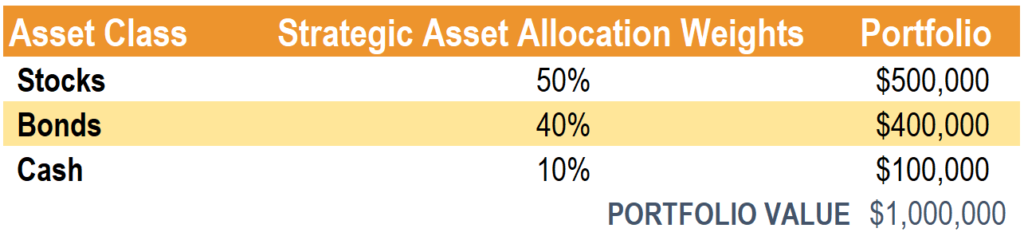
Jeff, in his investment policy statementInvestment Policy Statement (IPS)An investment policy statement (IPS), a document drafted between a portfolio manager and a client, outlines the rules and guidelines that the portfolio, indicated that he wants a strategic asset allocation of 50% stocks / 40% bonds / 10% cash. Jeff’s portfolio is valued at $1 million, and he rebalances annually. At the beginning of the year, his portfolio looks as follows:
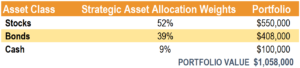
After one year, the stocks generated a return of 10% while the bonds generated a return of 2%. Jeff’s unbalanced portfolio looks as follows:
To follow an SAA strategy, Jeff would rebalance the portfolio above to 50% stocks / 40% bonds / 10% cash. He can do so through selling stocks and putting them in bonds and cash. His rebalanced portfolio would look as follows:
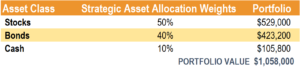
Therefore, at the end of the year, the SAA strategy would involve selling $21,000 worth of stocks and putting $15,200 in bonds and $5,800 in cash.
Factors Affecting Strategic Asset Allocation
There are many factors that affect strategic asset allocation weights. Below, we will discuss the major factors:
1. Risk tolerance
Investors with a high risk tolerance are able to accept higher volatilityVolatilityVolatility is a measure of the rate of fluctuations in the price of a security over time. It indicates the level of risk associated with the price changes of a security. Investors and traders calculate the volatility of a security to assess past variations in the prices. Therefore, they will likely put a greater asset class weight to stocks and a lower asset class weight to bonds and cash. Investors with a low risk tolerance would likely place a lower asset class weight to stocks and a higher asset class weight to bonds and cash.
2. Investment horizon
Investors with a longer investment horizon would likely invest in riskier asset classes. The reason being is that due to having a longer investment horizon, the investor is able to “weather the storm” and hold during poor market conditions without having to liquidate to meet their retirement or cash needs.
For example, a 20-year old student would likely follow an SAA strategy consisting of mainly stocks. A senior that is retiring in two years and needs money to fund his retirement would likely adopt a strategic asset allocation consisting of mainly bonds.
3. Return objectives
The returns desired from an investor significantly affects strategic asset allocation weights. For example, consider the annual return profile for stocks, bonds, and cash:
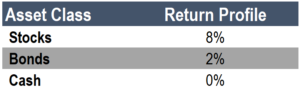
If an investor wanted their portfolio to generate an annual expected return of 6.5%, she would be forced to adopt the following weights: 75% stocks / 25% bonds / 0% cash.
Therefore, the return desired by an investor exerts a significant effect on the strategic asset allocation weight. A higher return requires a higher asset allocation to a specific asset class to achieve that desired return.
Strategic Asset Allocation: A Contrarian Approach
It is interesting to note that a strategic asset allocation follows a contrarian approach to investing. When an asset class performs well relative to other asset class, the SAA strategy would be to sell positions in that asset class and distribute it to the poorer performing asset classes – following a contrarian strategy. Consider the table below:

As indicated, stocks performed better than bonds, generating a return of 10% versus 5% of bonds. Since stocks performed better, the resulting unbalanced portfolio owns $5.50 in stocks and $5.25 in bonds, resulting in a strategic asset allocation of 51% in stocks and 49% in bonds. To balance the portfolio, the manager must sell the better performing asset class (stocks) and put it into bonds. Therefore, an SAA strategy follows a contrarian approach to investing.
Related Readings
CFI is the official provider of the Financial Modeling and Valuation Analyst (FMVA)™Become a Certified Financial Modeling & Valuation Analyst (FMVA)®CFI's Financial Modeling and Valuation Analyst (FMVA)® certification will help you gain the confidence you need in your finance career. Enroll today! certification program, designed to transform anyone into a world-class financial analyst.
To keep learning and developing your knowledge of financial analysis, we highly recommend the additional resources below:
- Active Bond Portfolio ManagementActive Bond Portfolio ManagementA bond portfolio can be managed in several ways; however, the primary methods are active, passive, or a hybrid of the two. Active bond portfolio management,
- DiversificationDiversificationDiversification is a technique of allocating portfolio resources or capital to a variety of investments.The goal of diversification is to mitigate losses
- Investing: A Beginner’s GuideInvesting: A Beginner's GuideCFI's Investing for Beginners guide will teach you the basics of investing and how to get started. Learn about different strategies and techniques for trading
- Tactical Asset Allocation (TAA)Tactical Asset Allocation (TAA)Tactical asset allocation (TAA) refers to an active management portfolio strategy that shifts asset allocations in a portfolio to take advantage of market
-

Asset Allocation: A Comprehensive Guide for Investors
div.cust
-

Synthetix: A Decentralized Platform for Synthetic Asset Trading
Trading on exchanges has been traditionally dominated by major financial centres and exchanges, such as the London or New York stock exchanges. It has been hard to trade without going through these la
invest
- Asset Swap Explained: Definition, OTC Trading & Key Concepts
- Constant Weight Asset Allocation: A Simple Guide
- Dynamic Asset Allocation: A Comprehensive Guide
- Tactical Asset Allocation (TAA): A Comprehensive Guide
- Asset Allocation: A Comprehensive Guide to Investment Risk Management
- Asset Allocation: A Comprehensive Guide to Portfolio Diversification
- Socially Responsible Investing: Understanding Asset Allocation
- Asset Allocation: A Comprehensive Guide for Investors
- Asset Allocation: A Comprehensive Guide to Portfolio Diversification
-
Asset Allocation: 4 Key Benefits for Investors
Asset allocation is an investment strategy in which investors set aside a certain percentage of their investment dollars for multiple types of asset classes. Part of their money might go to stoc...
-
Strategic Asset Allocation: A Comprehensive Guide
Strategic asset allocation is an investment strategy that many people use to govern the decisions that pertain to their portfolios. Here are the basics of strategic asset allocation and how it w...