
Understanding Analyst Recommendations: Investment Insights & Advice
Analyst recommendations are recommendations and advice given by financial analysts and investment researchers to their clients with regards to what assets to invest in and what assets not to invest in. Financial analysts usually conduct extensive research on a specific asset classAsset ClassAn asset class is a group of similar investment vehicles. They are typically traded in the same financial markets and subject to the same rules and regulations. and also on the overall state of the financial markets before issuing a recommendation.

Modern financial marketsFinancial MarketsFinancial markets, from the name itself, are a type of marketplace that provides an avenue for the sale and purchase of assets such as bonds, stocks, foreign exchange, and derivatives. Often, they are called by different names, including "Wall Street" and "capital market," but all of them still mean one and the same thing. are incredibly diverse, with different asset classes behaving differently at different times. For example, fixed income markets behave very differently from equity markets. Furthermore, even within fixed income markets, the market for sovereign debt behaves very differently from the market for corporate debt. As a result, financial analysts usually specialize in only one or two asset classes.
Quick Summary:
- Analyst recommendations are recommendations and advice given by financial analysts and investment researchers to their clients with regards to what assets to invest in and what assets not to invest in.
- Modern financial markets are incredibly diverse, with different asset classes behaving differently at different times. As a result, financial analysts usually specialize in only one or two asset classes.
- Analyst recommendations fall on a spectrum ranging from a “Strong Buy” to a “Strong Sell.”
Types of Analyst Recommendations
Analyst recommendations fall on a spectrum ranging from a “Strong Buy” to a “Strong Sell.” It is shown below:

Strong Sell
The analyst expects the price of the asset to fall in the future and strongly recommends investors to sell their holdings of the asset. In addition, the analyst recommends that investors take leveraged short positions in the asset.
Sell
The analyst expects the price of the asset to fall in the future and recommends investors to sell their holdings of the asset. A “Sell” is a weaker recommendation than a “Strong Sell” and does not usually imply a recommendation for a leveraged short position.
Hold
The analyst expects the price of the asset to remain unchanged in the future and recommends investors not to change their existing stance on this asset. A “Hold” recommendation is the analyst telling investors that there is no new information that can substantially affect the price of the asset.
Buy
The analyst expects the price of the asset to rise in the future and recommends to investors to increase their holdings of this asset. A “Buy” is a weaker recommendation than a “Strong Buy.”
Strong Buy
The analyst expects the price of the asset to rise in the future and strongly recommends investors to increase their holdings of the asset. Investors are recommended to leverage up in order to increase their long positionLong and Short PositionsIn investing, long and short positions represent directional bets by investors that a security will either go up (when long) or down (when short). In the trading of assets, an investor can take two types of positions: long and short. An investor can either buy an asset (going long), or sell it (going short). in the asset.
Illustrative Example
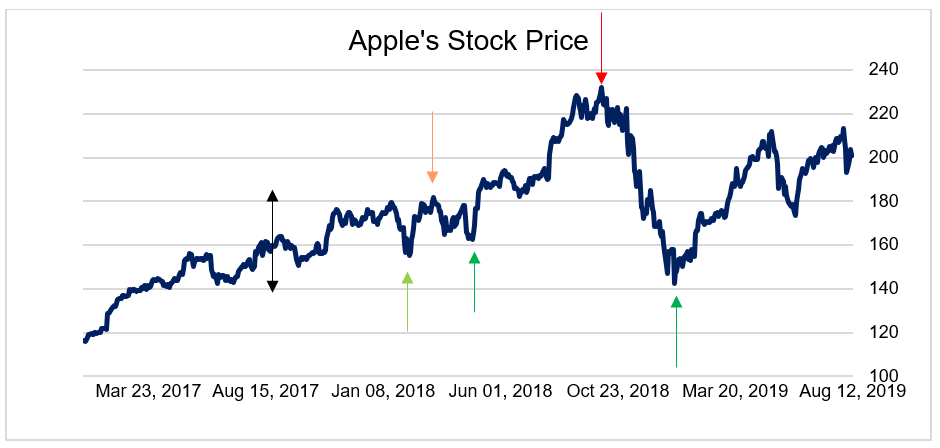
An equity research analystEquity Research AnalystAn equity research analyst provides research coverage of public companies and distributes that research to clients. We cover analyst salary, job description, industry entry points, and possible career paths. analyzes the balance sheets of a business, the state of the industry, the overall state of the economy, and other fundamental measures of overall company health and come up with recommendations for investors. Consider the stock price of Apple (AAPL). An analyst may issue a HOLD recommendation in August 2017. The analyst then changes his recommendation to a BUY recommendation in February 2018 after Apple’s stock price falls below $160.
Afterward, the stock price rises to $180, at which point (March 2019) the analyst changes his BUY recommendation into a SELL recommendation. In May 2019, after Apple share prices fall close to $160, the analyst changes his SELL recommendation into a STRONG BUY recommendation. In October 2018, after Apple share prices cross $230, the analyst changes his STRONG BUY into a STRONG SELL. In January 2019, the analyst again changes his STRONG SELL into a STRONG BUY recommendation.
More Resources
CFI offers the Financial Modeling & Valuation Analyst (FMVA)™ Become a Certified Financial Modeling & Valuation Analyst (FMVA)®CFI's Financial Modeling and Valuation Analyst (FMVA)® certification will help you gain the confidence you need in your finance career. Enroll today!certification program for those looking to take their careers to the next level. To keep learning and advancing your career, the following resources will be helpful:
- Economic IndicatorsEconomic IndicatorsAn economic indicator is a metric used to assess, measure, and evaluate the overall state of health of the macroeconomy. Economic indicators
- Equity vs Fixed IncomeEquity vs Fixed IncomeEquity vs Fixed Income. Equity and fixed income products are financial instruments that have very important differences every financial analyst should know. Equity investments generally consist of stocks or stock funds, while fixed income securities generally consist of corporate or government bonds.
- Types of MarketsTypes of Markets - Dealers, Brokers, ExchangesMarkets include brokers, dealers, and exchange markets. Each market operates under different trading mechanisms, which affect liquidity and control. The different types of markets allow for different trading characteristics, outlined in this guide
- Investing: A Beginner’s GuideInvesting: A Beginner's GuideCFI's Investing for Beginners guide will teach you the basics of investing and how to get started. Learn about different strategies and techniques for trading
-

Investment-Grade Bonds: Understanding Credit Risk & Ratings
An investment-grade bond is a bond classification used to denote bonds that carry a relatively low credit riskCredit RiskCredit risk is the risk of loss that may occur from the failure of any party to
-
Understanding Junk Bonds: Risks, Rewards, and Investment Strategies
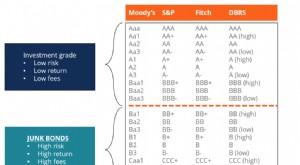
Junk bonds, also known as high-yield bonds, are bonds that are rated below investment grade by the big three rating agencies (see image below). Junk bonds carry a higher risk of defaultMarket Ri
invest
- Understanding Carry Benefits: Maximizing Investment Returns
- Asset Swap Explained: Definition, OTC Trading & Key Concepts
- Baby Bonds: A Comprehensive Guide to Investing in Children's Futures
- Understanding Bonds: A Comprehensive Guide for Investors
- Understanding Commodities: A Beginner's Guide to Investing
- Defensive Industries: Stability in Economic Uncertainty | [Your Company Name]
- Understanding Financial Derivatives: A Comprehensive Guide
- Understanding Lease Classifications: Operating vs. Capital Leases
- Understanding Stranded Assets: Risks and Impacts
-
 Understanding Historical Returns: A Guide for Investors
The historical return of a financial asset, such as a bond, stock, security, index, or fund, is its past rate of return and performance. The historical data is commonly used in financial analysisTypes...
-
 Income Stocks: A Guide to Dividend Investing
Income stocks are equity financial securities that pay regular and predictable dividendsDividendA dividend is a share of profits and retained earnings that a company pays out to its shareholders. When...