
Trading Desks: Function, Role & Importance in Finance
A trading desk is a department within a company or investment bank where securities are sold and purchased to provide market liquidity. Some of the securities traded on trading desks include stocks, bonds, commoditiesCommoditiesCommodities are another class of assets just like stocks and bonds. Most commodities are products that come from the earth that possess, and currencies.
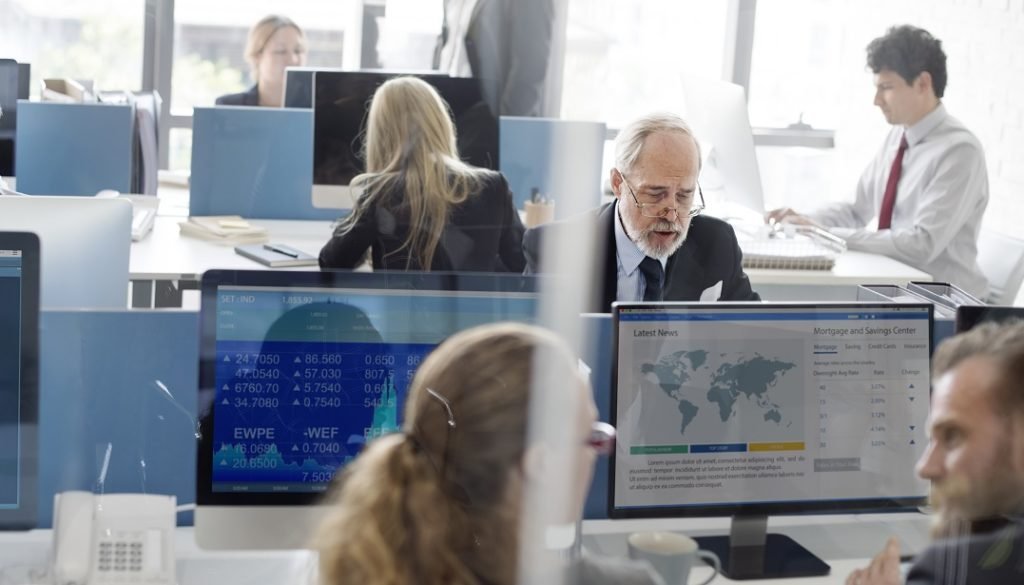
Firms with trading desks can add value to their portfolio by supplying expertise in transactional cost analysis, identifying counterparties, and formulating trading strategies. In return, the firms earn commissions from client’s trading activities.
Apart from facilitating the trading of securities, a trading desk supports investors on how to structure financial products, create supporting documents, and identify trading opportunities.
Summary
- A trading desk is a central location where all activities related to the selling and buying of securities occur.
- Broker-dealers and large investment firms use trading desks to provide services to their clients.
- Trading desks are common in firms dealing with equities, commodities, foreign exchange, and fixed income assets.
Understanding Trading Desks
Usually, traders dealing with various investment vehicles meet on a trading floor. The trading floor hosts multiple trading desks, which focus on either specific securities or market segments. The desks serve as managed services layers where traders purchase and sell securities.
Before the regulatory changes in capital market requirements were introduced, financial institutions split their capital market investments across various regions into numerous departments. However, the regulatory changes by the National Association of Securities Dealers Automated Quotations (NASQD) in the 1970s marked the introduction of trading desks, and all investment firms were required to set up trading desks.
Since then, most large institutions outsource the work of managing trading desks to professional managers with the technologies and competence to draw valuable insights on the future profitability of specific securities.
Types of Trading Desks
- Fixed-income trading desks: They involve trading bond-based instruments that offer a fixed income to investors.
- Commodity trading desks: They focus on commodity products, such as agricultural produce or gold.
- Equity trading desks: They facilitate a wide range of trading, from exotic options to equity trading.
- Foreign exchange trading desks: They act as markers and handle trading in currency pairsCurrency PairA currency pair is a quotation of two different currencies, where one is quoted against the other. The first listed currency within a currency or proprietary trading activities.
Trading Desks in Action
Trading desks are under the watch of professional managers who are skilled in managing certain classes of securities. Professional traders are selected based on their past performance, alongside market traders and electronic trading systems, to identify the best strike pricesStrike PriceThe strike price is the price at which the holder of the option can exercise the option to buy or sell an underlying security, depending on for investors.
The trading personnel receives clients’ orders and executes all the trading activities according to the investors’ objectives. The trading manager also receives all the necessary information from the sales desk personnel responsible for recommending trading strategies.
Trading desks can also be used to structure financial products or to identify market opportunities. For each trade executed on their trading desks, firms usually charge clients a commission.
In other scenarios, broker-dealers may manage trading desks as counterparties to the investor’s trade. Such trades are unlikely to reach the interbank market; rather, they may remain within the liquidity pool of a broker’s account.
The presence of any securities in the market means that traders can utilize the different forms of trading desks in the market, depending on the type of asset being traded.
Benefits of Trading Desks
Traders enjoy the following benefits when using trading desks:
1. Lower costs
Trading desks provide services to a large number of customers, thus reducing the operation, training, and software costs. Professional managers are hired to conduct trading activities on behalf of clients in various market segments. They leverage their own expertise and technology to come up with insightful information to help improve trading activities.
2. Domain expertise
Professional managers working at agency trading desks can gain more knowledge and experience in managing portfolios, improving their efficiency in spotting trading opportunities.
3. Sustained performance
Trading desks are associated with sustainable performance over adjustment periods. High-performance trading desks can improve portfolio management by adopting optimal trading strategies.
4. Monitoring broker performance
Investors can use trading desks to track the performance of broker-dealers and decide the best-performing ones for each class of security.
5. Advanced technology
Trading desks employ the latest technological solutions to monitor and track trading activities, minimizing human error. Humans get influenced by their emotions, and it can affect the outcome of their trading activities. By leveraging technological solutions, trading desks eliminate the human factor in trading activities and help preserve trading discipline.
Special Considerations
Trading desks may also be offered in the equity day trading market or foreign exchange market by broker-dealers to their clients. Intermediaries are better placed because of their ability to execute trade instantly. Most large investment firms serve their external clients and in-house teams using their own trading desks.
Thus, institutional trading desks can sustain profitable performance for a long time. Additionally, a majority of these firms use decentralized trade desk services to promote client satisfaction.
Related Readings
CFI is the official provider of the global Capital Markets & Securities Analyst (CMSA)®Program Page - CMSAEnroll in CFI's CMSA® program and become a certified Capital Markets &Securities Analyst. Advance your career with our certification programs and courses. certification program, designed to help anyone become a world-class financial analyst. To keep advancing your career, the additional CFI resources below will be useful:
- Brokerage FirmBrokerageA brokerage provides intermediary services in various areas, e.g., investing, obtaining a loan, or purchasing real estate. A broker is an intermediary who
- Trading AccountTrading AccountA trading account is an online investment account that traders use to purchase securities and monitor trades. It allows investors to buy and
- Portfolio ManagerPortfolio ManagerPortfolio managers manage investment portfolios using a six-step portfolio management process. Learn exactly what does a portfolio manager do in this guide. Portfolio managers are professionals who manage investment portfolios, with the goal of achieving their clients’ investment objectives.
- Transaction CostsTransaction CostsTransaction costs are costs incurred that don’t accrue to any participant of the transaction. They are sunk costs resulting from economic trade in a market. In economics, the theory of transaction costs is based on the assumption that people are influenced by competitive self-interest.
-
Circuit Breakers: Understanding Trading Halts & Market Stability
A circuit breaker is a regulatory instrument that halts the trading of a securityStockWhat is a stock? An individual who owns stock in a company is called a shareholder and is eligible to claim part o
-

Understanding Commodities: A Beginner's Guide to Investing
Commodities are another class of assets just like stocks and bondsBondsBonds are fixed-income securities that are issued by corporations and governments to raise capital. The bond issuer borrows capit
invest
- CFD Trading Explained: A Comprehensive Guide for Investors
- Day Trading Explained: Strategies, Risks & How It Works
- Proprietary Trading: A Comprehensive Guide for Investors
- Quantitative Trading: A Deep Dive into Models & Analysis
- Spread Trading: A Comprehensive Guide to Relative Value Trading
- Trading Authorization: Empowering Your Broker & Account Security
- Trading Channels: Understanding Uptrends & Downtrends
- Trading Plan: A Comprehensive Guide to Successful Trading
- Understanding Trading Sessions: Hours & Global Markets
-
 After Hours Trading Explained: A Comprehensive Guide
After hours trading refers to the time outside regular trading hours when an investor can buy and sell securities. The main exchanges in the United States, NASDAQ and NYSENew York Stock Exchange (NYSE...
-
 Basis Trading: Definition, Strategy & How It Works
Basis trading is a financial arbitrage trading strategy that involves the trading of a financial instrument, such as a financial derivative or a commodityCommoditiesCommodities are another class of as...