
Understanding Trading Mechanisms & Intangible Assets
Trading mechanisms refer to the logistics behind trading assetsIntangible AssetsAccording to the IFRS, intangible assets are identifiable, non-monetary assets without physical substance. Like all assets, intangible assets and securitiesPublic SecuritiesPublic securities, or marketable securities, are investments that are openly or easily traded in a market. The securities are either equity or debt-based., regardless of the type of market. These markets can be exchanges, dealers or OTC markets. The mechanisms are the operations by which buyers of an asset are matched with sellers.
There are two main types of trading mechanisms:
- Order driven markets
- Quote driven markets
Trading Mechanisms: Quote Driven
In a quote driven market, continuous prices or “quotes” are provided to buyers and sellers. These prices are provided by market makers, which mean these types of systems are better suited for dealer or OTC markets. For a buyer, the price provided is the price a dealer is willing to sell at. For a seller, the price provided is the price a dealer is willing to buy at. Typically, the quoted buy price will be lower than the sell price. The spread is the profitProfitability RatiosProfitability ratios are financial metrics used by analysts and investors to measure and evaluate the ability of a company to generate income (profit) relative to revenue, balance sheet assets, operating costs, and shareholders' equity during a specific period of time. They show how well a company utilizes its assets to produce profit that the market maker, the dealer, makes.
Trading Mechanisms: Order Driven
In an order driven market, buyers and sellers of assets are able to place orders for assets they wish to purchase or sell. They can list at market price, which executes a market order instantaneously at the best available price. Alternatively, they can list a fixed/limit price, which executes either a limit or stop order,Trade Orders - TradingTrade orders refer to the different types of orders that can be placed on trading exchanges for financial assets, such as stocks or futures contracts. not to be executed until certain pricing conditions are met.
In an order driven market, counterparties are not necessarily available immediately, depending on the listed price. Because this is so, order driven trading mechanisms are more suited for exchanges. Orders will execute once a suitable counterparty is found for each buyer or seller. In other words, a buy order will only execute if a seller is found who is willing to sell at the specified limit price.
Order driven trading mechanisms are often supported by an order book.
Order Book
An order book is the system or database that operates behind an order driven trading mechanism. The book lists all buyers and sellers, as well as their intended bid or ask prices.
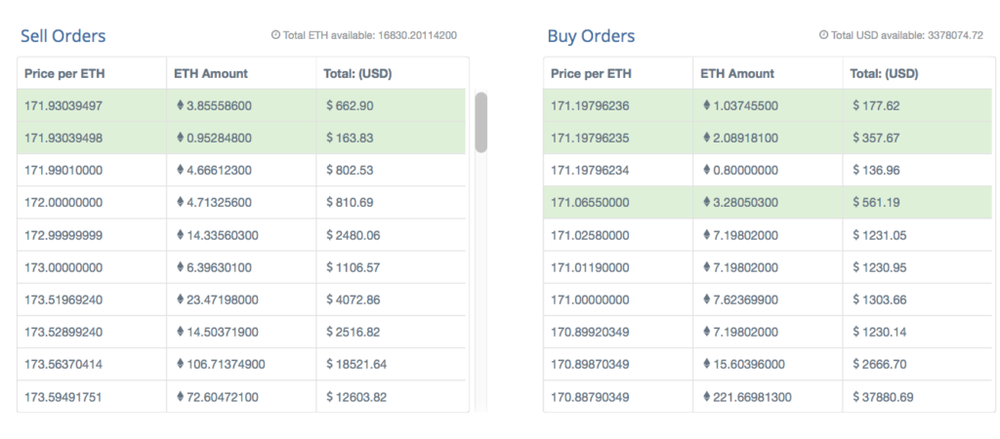
In the above shown order book, we see sell orders listed in ascending order and buy orders listed in descending order, sorted by list price. Orders in an order driven trading mechanism execute when the lowest sell order and the highest buy order match, or exceed each other. In the case of the EthereumEthereumEthereum is one of the growing cryptocurrencies to contend against Bitcoin. With the rise of Bitcoin (BTC), the cryptocurrency market has been validated. order book above (courtesy of CEX.io), no order will execute as the lowest sell order price is higher than the highest buy order price.
Order books will typically continue updating as new orders are added in real-time.
Disadvantages of the Order Driven Market
As demonstrated by the order book above, the order driven style of trading mechanisms will have lower liquidity than the quote driven market. In a quote driven market, a market maker is always readily available to sell or buy, as long as the trader is willing to meet the slightly higher premiums of quoted price. In an order driven market, trades can stagnate if buyers are not willing to meet seller prices, or vice versa.
Because of this automated matching system, order driven market trading mechanisms are most suitable for assets that are frequently traded and naturally very liquid. These markets include stocksStockWhat is a stock? An individual who owns stock in a company is called a shareholder and is eligible to claim part of the company’s residual assets and earnings (should the company ever be dissolved). The terms "stock", "shares", and "equity" are used interchangeably., optionsStock OptionA stock option is a contract between two parties which gives the buyer the right to buy or sell underlying stocks at a predetermined price and within a specified time period. A seller of the stock option is called an option writer, where the seller is paid a premium from the contract purchased by the stock option buyer., bondsFixed Income TradingFixed income trading involves investing in bonds or other debt security instruments. Fixed income securities have several unique attributes and factors that and some currenciesCryptocurrencyCryptocurrency is a form of digital currency that is based on blockchain networking. Cryptocurrency like Bitcoin and Ethereum are becoming widely accepted., among others.
Trading Mechanisms: Order Types
In order driven trading mechanisms, there are several different order types that a trader can take advantage of. These are briefly described above, but are further described in one of our other articles.Trade Orders - TradingTrade orders refer to the different types of orders that can be placed on trading exchanges for financial assets, such as stocks or futures contracts.
The presence of the real-time order book allows traders to take advantage of limit and stop pricing that will not fulfill until their conditions are met. This differs from market pricing, which executes immediately, and may be unfavorable for traders.
Trading Mechanisms: Order Timing
Additionally, order driven trading mechanisms allow traders to specify the shelf life of a specific orderTrade Order Timing - TradingTrade order timing refers to the shelf-life of a specific trade order. The most common types of trade order timing are market orders, GTC orders,. Orders, for example, can be kept indefinitely until executed, set to last only a day, or set to last until a specific time.
The Bottom Line
Knowing the different trading mechanisms is important know-how for traders. Understanding the game allows the trader to play it better. Certain markets, for example, will use algorithms in conjunction with order driven markets, and knowing this will allow a trader to make the most out of their trades. As such, knowing the difference between the quote and order driven trading mechanisms is definitely profitable information.
More Resources:
CFI offers the Financial Modeling & Valuation Analyst (FMVA)™Become a Certified Financial Modeling & Valuation Analyst (FMVA)®CFI's Financial Modeling and Valuation Analyst (FMVA)® certification will help you gain the confidence you need in your finance career. Enroll today! certification program for those looking to take their careers to the next level. To keep learning and advancing your career, the following resources will be helpful:
- How to Read Stock ChartsHow to Read Stock ChartsIf you’re going to actively trade stocks as a stock market investor, then you need to know how to read stock charts. Even traders who primarily use fundamental analysis to select stocks to invest in still often use technical analysis of stock price movement to determine specific buy and sell, stock charting
- Equities TraderEquity TraderAn equity trader is someone who participates in the buying and selling of company shares on the equity market. Similar to someone who would invest in the debt capital markets, an equity trader invests in the equity capital markets and exchanges their money for company stocks instead of bonds. Bank careers are high-paying
- ECMEquity Capital Market (ECM)The equity capital market is a subset of the capital market, where financial institutions and companies interact to trade financial instruments
- BitcoinBitcoinBitcoin is the forerunner of the cryptocurrency market. Operating on blockchain technology, Bitcoin is set to disrupt the currency market. Invented in 2008
-

Proprietary Trading: A Comprehensive Overview for Financial Professionals
Proprietary trading is carried out by certain traders in the stock market. It is done through what is called the prop desk or the proprietary trading desk. This is a kind of trade wherein the fi
-
Profitable Intraday Trading: 3 Essential Strategies
Utilizing the best intraday trading tips can make a big difference in your success as a trader overall. Here are some of the best intraday trading tips to keep in mind when you start to get invo
invest
- CFD Trading Explained: A Comprehensive Guide for Investors
- Day Trading Explained: Strategies, Risks & How It Works
- FinViz: Financial Data & Stock Market Analysis - Visualizations
- Understanding Held Orders: A Quick Guide for Traders
- Proprietary Trading: A Comprehensive Guide for Investors
- Quantitative Trading: A Deep Dive into Models & Analysis
- Spread Trading: A Comprehensive Guide to Relative Value Trading
- Stop Orders: A Comprehensive Guide for Investors
- Intraday Trading on Groww: A Beginner's Guide
-
 Understanding Market Types: Dealers, Exchanges & Brokers
In the exchange of assets, there are several different types of markets to facilitate trade. Each market operates under different trading mechanisms,Trading MechanismsTrading mechanisms refer to the d...
-
 Wash Trading: Definition, Risks & How It Impacts Markets
Wash trading – also referred to as round trip trading – is an illegal practice where investors buy and sell the same financial instrumentsMarketable SecuritiesMarketable securities are unr...