
Dividend Growth Rate (DGR): Definition & Calculation
The dividend growth rate (DGR) is the percentage growth rate of a company’s dividendDividendA dividend is a share of profits and retained earnings that a company pays out to its shareholders. When a company generates a profit and accumulates retained earnings, those earnings can be either reinvested in the business or paid out to shareholders as a dividend. achieved during a certain period of time. Frequently, the DGR is calculated on an annual basis. However, if necessary, it can also be calculated on a quarterly or monthly basis.

The dividend growth rate is an important metric, particularly in determining a company’s long-term profitability. Since dividends are distributed from the company’s earningsRetained EarningsThe Retained Earnings formula represents all accumulated net income netted by all dividends paid to shareholders. Retained Earnings are part, one can assess and analyze its ability to sustain its profitability by comparing the DGR over time.
Dividend Growth Rate and a Security’s Pricing
Also, the dividend growth rate can be used in a security’s pricing. It is an essential variable in the Dividend Discount Model (DDM).
The dividend discount model is based on the idea that the company’s current stock price is equal to the net present valueNet Present Value (NPV)Net Present Value (NPV) is the value of all future cash flows (positive and negative) over the entire life of an investment discounted to the present. of the company’s future dividends. Mathematically, the dividend discount model is written using the following equation:
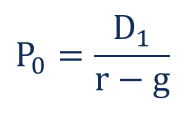
Where:
- P0 – the current company’s stock price
- D1 – the next year dividends
- r – the company’s cost of equity
- g – the dividend growth rate
How to Calculate the Dividend Growth Rate
The simplest way to calculate the DGR is to find the growth rates for the distributed dividends.
Let’s say that ABC Corp. paid its shareholders dividends of $1.20 in year one and $1.70 in year two. To determine the dividend’s growth rate from year one to year two, we will use the following formula:
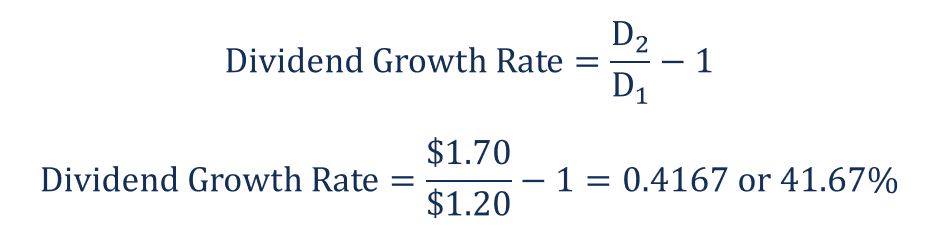
However, in some cases, such as in determining the dividend growth rate in the dividend discount model, we need to come up with the forward-looking growth rate.
Prior to studying the approaches, let’s consider the following example. Below is ABC Corp.’s schedule of paid dividends with the calculated annual DGR:
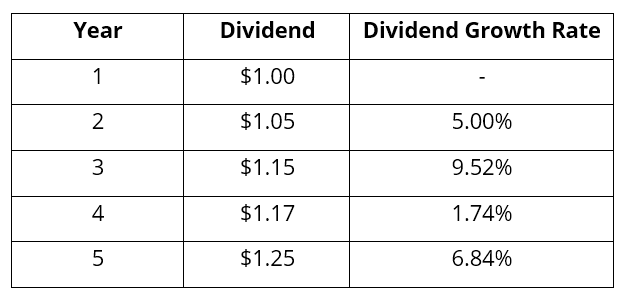
There are three main approaches to calculate the forward-looking growth rate:
- Use historical dividend growth rates.
a. Using the historical DGR, we can calculate the arithmetic average of the rates:

b. We can also use the company’s historical DGR to calculate the compound annual growth rate (CAGR):

2. Observe the dividend growth rate prevalent in the industry in which the company operates.
Imagine that the average DGR in the industry in which the ABC Corp. is operating is 4%. Then, we can use that rate for ABC Corp.
- Calculate the sustainable growth rate.
The sustainable growth rate is the maximum growth rate that a company can sustain without external financing. The sustainable growth rate can be found using the following formula:

If ABC Corp.’s ROEReturn on Equity (ROE)Return on Equity (ROE) is a measure of a company’s profitability that takes a company’s annual return (net income) divided by the value of its total shareholders' equity (i.e. 12%). ROE combines the income statement and the balance sheet as the net income or profit is compared to the shareholders’ equity. is 15% and its dividend payout ratio is 65%, then the company’s sustainable growth rate will be:

More Resources
CFI offers the Financial Modeling & Valuation Analyst (FMVA)™Become a Certified Financial Modeling & Valuation Analyst (FMVA)®CFI's Financial Modeling and Valuation Analyst (FMVA)® certification will help you gain the confidence you need in your finance career. Enroll today! certification program for those looking to take their careers to the next level. To keep learning and advancing your career, the following CFI resources will be helpful:
- CAGR CalculatorCAGR CalculatorThis CAGR calculator will help you determine the Compound Annual Growth rate of an investment. CAGR is a great measure of growth, as it isolated the effect of compounding on growth, which is sometimes concealed on other metrics for growth. CAGR stands for compound annual growth rate.
- Capital Gains YieldCapital Gains YieldCapital gains yield (CGY) is the price appreciation on an investment or a security expressed as a percentage. Because the calculation of Capital Gain Yield involves the market price of a security over time, it can be used to analyze the fluctuation in the market price of a security. See calculation and example
- Ex-Dividend DateEx-Dividend DateThe ex-dividend date is an investment term that determines which stockholders are eligible to receive declared dividends. When a company announces a dividend, the board of directors set a record date when only shareholders recorded on the company’s books as of that date are entitled to receive the dividends.
- Return on Total CapitalReturn on Total CapitalReturn on Total Capital (ROTC) is a return on investment ratio that quantifies how much return a company has generated through the use of its capital structure. This ratio is different from return on common equity (ROCE), as the former quantifies the return a company has made on its common equity investment.
-

Understanding AER: Annual Equivalent Rate Explained
The Annual Equivalent Rate (AER) is the rate of interest after taking into account the effects of compounding to normalize the interest rateInterest RateAn interest rate refers to the amount charged b
-

Understanding the Overnight Interest Rate: Impact on the Economy
Overnight rate might sound like the five-dollars-more alternative to the hourly rate for the least reputable hotel in town, but in fact it’s a number that has a profound effect on a country’s entire e
finance
- Compound Growth Rate: Definition & Calculation | [Your Brand]
- Understanding Forward Rates: A Comprehensive Guide
- H-Model Explained: A Quantitative Stock Valuation Method
- Understanding the Overnight Interest Rate: A Comprehensive Guide
- Prime Rate Explained: Understanding Interest Rates for Businesses & Consumers
- Understanding Average Annual Growth Rate (AAGR): Definition & Uses
- Understanding Dividend Yield: A Comprehensive Guide
- Understanding Implied Rates: A Comprehensive Guide
- Dividend Stocks vs. Growth Stocks: Understanding the Key Differences
-
 Understanding Swap Rate Curves: A Comprehensive Guide
The swap rate curve is a chart that depicts the relationship between swap rates and all available corresponding maturities. Essentially, it indicates the expected returnsExpected ReturnThe expected re...
-
Understanding the Policy Interest Rate: Its Impact on the Economy
Three more sleep inducing words have perhaps never been strung together, but the policy interest rate is actually pretty exciting insofar as it's a little number that has a profound effect on a c...