
Understanding Currency Depreciation: Causes & Economic Factors
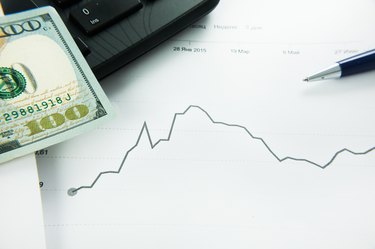
Currency depreciation occurs when the value of a particular currency falls during a specific relative to other world currencies. Factors such as a country's economic condition, monetary policy and global market conditions impact currencies on a regular basis. Other major economic, social and political events can trigger sudden or extended drops in currency value.
Regular Depreciation Factors
- Economic conditions: When global demand for a country's exports is low, the value of its currency declines. Similarly, if a country imports a proportionately high volume of goods and experiences a trade deficit, the value of its currently depreciates as well.
- Monetary policy: Central banks in each country establish monetary policies that cause immediate movements in currency value, and contribute to long-term trends. In general, when a country raises its interest rates to combat inflation, it puts downward pressure on its currency. Some country leaders use interest rate controls to intentionally drive down the relative value of their currencies in the global market.
- Global market conditions: The overall global economic picture impacts currencies in specific regions as well. If the United States is in the midst of a recession, for instance, the value of the U.S. dollar tends to depreciate against currencies in more stable economies.
Temporary or Event-based Depreciation
Currency trading, or foreign exchange trading, also contributes to the direction of currencies. When speculators believe a currency likely will depreciate moving forward, they short or sell that currency against others. Due to speculative response, a number of major economic and political events can trigger near-term, medium-term and long-term depreciation, including:
- Economic events - Any negative, major economic news can cause a currency value to decrease. If prominent sectors or companies have weak earnings reports, for instance, a currency's value may drop based on anticipation of rough economic times ahead. Central bank policy decision statements can trigger an immediate currency sell-off as well.
- Political events - In general, fear or uncertainty about the political stability in a country can cause currency depreciation. Wars are a potential trigger, as speculators consider the investments a country will have to make for a long war. When certain political parties come to power in a country, a currency can depreciate based on anticipated policies of the new administration.
-

Understanding the S&P Sectors: A Comprehensive Guide
The S&PS&P – Standard and PoorsStandard & Poor’s is an American financial intelligence company that operates as a division of S&P Global. S&P is a market leader in the
-
Currency Futures Contracts: A Comprehensive Guide
Currency futures contracts also referred to as foreign exchangeForeign ExchangeForeign exchange (Forex or FX) is the conversion of one currency into another at a specific rate known as the foreign exc
investing
- Understanding Non-Performing Loans: Causes & Consequences
- Understanding Dollar Value: Factors Influencing Appreciation & Depreciation
- Common Causes of Financial Problems: Understanding & Avoiding Them
- Understanding Low Savings Rates: Causes & the Wealth Effect
- Understanding Bond Face Value: Definition & Importance
- Factors Influencing Money Value: A Comprehensive Overview
- Value vs. Worth: Understanding the Key Differences
- Carrying Amount: Definition, Calculation & Importance
- Understanding Depreciation Methods: A Comprehensive Guide
-
 Understanding Foreign Exchange Rates: A Comprehensive Guide
Foreign currency exchange rates measure one currency’s strength relative to another. A strong currency is considered to be one that is valuable, and this manifests itself when comparing its valu...
-
 Interbank Market: A Comprehensive Overview of Foreign Exchange Trading
As the name suggests, the interbank market is a market where foreign currency is traded between large privately held banks. The interbank market is what people refer to when talking about the currency...