
Bullish & Bearish: Understanding Stock Market Trends
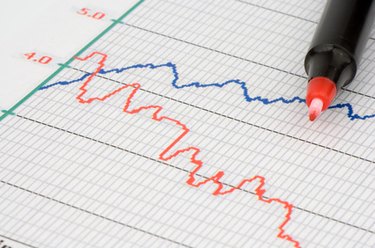
Stock prices move in trends. When the trend is up, it's called "bullish;" when it is down, it's labeled "bearish." An uptrend is characterized by higher highs and higher lows; a down trend by lower highs and lower lows. A major market uptrend lasting three to four years is called a bull market, while a major down trend -- typically 12 to 24 months -- is called a bear market. "Bullish" and "bearish" can also refer to events, stock charts, opinions and people.
Market-Affecting Events
Certain events can affect a stock and change its current trend. For example, a stock can be in an uptrend but a particular event may be considered bearish in that it may reverse the trend from up to down. Events can also be viewed as bullish or bearish for the entire market.
Stock Patterns
Certain technical patterns are bullish or bearish. For example, a stock can be down but form a pattern that is bullish because it forecasts a reversal of the downward trend. The whole chart may be bullish or bearish in that it reflects the current direction of the stock.
Investor Opinions
Market pundits and talking heads like to proffer outlooks. Their opinions can be bullish or bearish depending on where they think the market or a particular stock is or should be headed.
People
When someone believes that the market should be going up (or down) -- regardless of what the market is actually doing at the moment -- they are said to be bullish (or bearish) on the market. Investors can also be bullish or bearish on a particular stock or sector.
A Word of Caution
Do not confuse opinions with trends. As legendary trader Jesse Livermore used to say: "Markets are never wrong -- opinions often are." If the market is in a bullish trend, it's indisputable. But someone might think that the market should not be going up, or that it has gone up too far and should be going down. The fact that someone is bearish does not necessarily mean that they are correct.
-

Understanding Market Sentiment: A Guide for Investors
The term market sentiment, also known as investor sentiment, refers to the general outlook or attitude of investors toward a particular security or the overall financial market. The optimism or pessim
-
![Market Timing: Strategies & How It Works | [Your Company Name]](https://www.etffin.com/article/uploadfiles/202110/2021100815253643_S.jpeg)
Market Timing: Strategies & How It Works | [Your Company Name]
Market timing refers to an investing strategy through which a market participant makes buying or selling decisions by predicting the price movements of a financial asset in the future. Investors follo
investing
- Understanding Market Capitalization: A Comprehensive Guide
- Understanding Bullish Markets: A Guide for Investors
- Eurodollars: Understanding Foreign Currency Time Deposits
- Understanding Markets: Definition, Types & Examples
- Understanding Auction Markets: How Prices Are Determined
- Doji Candlestick Pattern: Meaning & Trading Signals
- Understanding Illiquidity: Definition, Examples & Implications
- Understanding Underperformance: Causes, Effects & Solutions
- Cornering the Market: Definition, Strategies & Risks
-
 Understanding Market Manipulation: Definition, Tactics & SEC Role
Market manipulation refers to artificial inflation or deflation of the price of a security. Also known as price manipulation or stock manipulation, it involves the literal manipulation of a financial ...
-
 Understanding Market Risk: A Comprehensive Guide
The term market risk, also known as systematic risk, refers to the uncertainty associated with any investment decision. Price volatility often arises due to unanticipated fluctuations in factors that ...