
Understanding Accounting Ethics: Principles & Importance
Accounting ethics is an important topic because, as accountants, we are the key personnel who access the financial informationThree Financial StatementsThe three financial statements are the income statement, the balance sheet, and the statement of cash flows. These three core statements are of individuals and entities. Such power also involves the potential and possibilities for abuse of information or manipulation of numbers to enhance company perceptions or enforce earningsCash Earnings Per ShareCash earnings per share (cash EPS) is the operating cash flow generated by a company divided by the number of shares outstanding. Cash earnings per share (Cash EPS) is different from traditional earnings per share (EPS), which takes the company’s net income and divides it by the number of shares outstanding. management. Ethics is also absolutely required in the course of an audit. Without meeting the requirements of auditing and accounting ethics, an audit must instantly be paused.
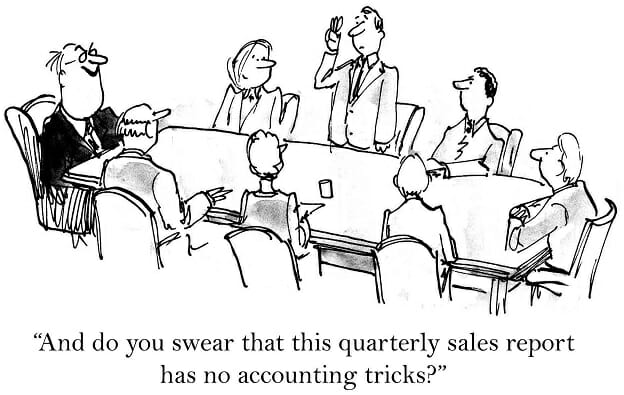
Ethics and the Code of the Conduct
Ethics and ethical behavior refer more to general principles such as honesty, integrity, and morals. The code of professional conduct, however, is a specific set of rules set by the governing bodies of certified public accountants. Although the rules set out by different bodies around the world are unique, some rules are universal. Let’s take a closer look at some of these important rules.
Rules and Guidance
One of the key rules set out by professional accounting bodies in North America is the idea of independence. This is the idea that, as an auditor, you must be totally objective and must be without ties to or relationships with the client since that could potentially impair your judgment and impair the overall course of the audit work.
There are two forms of independence:
- Independent in fact
- Independent in appearance
Independence in fact refers to any factual information such as whether you, as an auditor, own any shares or other investments in the client firm. These facts are usually easy to determine.
Independence in appearance, however, is more subjective. Let’s say, for example, that as an auditor you were invited to a year-end party at the client firm. The party turns out to be extremely luxurious and you also receive a nice watch as a gift. In appearance, would the auditor, who was invited to the party and who also received a gift, be able to maintain independence in the audit? In order to solve a potential conflict of interest, a reasonable observer’s test is used – i.e., what would a reasonable observer say about the situation?
Threats to Independence
There are always threats and situations that can reduce the level of independence. Let’s take a look at some of these threats:
- Familiarity Threat: If the auditor has a long relationship with the client or they are close friends/relatives
- Intimidation Threat: If the auditor changes the financial statements, the client threatens to switch auditors
- Self-Interest Threat: If the auditor has a direct financial interest through shares or a large fee outstanding from the client
- Self-Review Threat: If the auditor performs both audit and bookkeeping services, it is a review of the auditor’s own work
Other Important Rules
Some other rules outlined by professional accounting bodies include the following:
- Contingent fees are not allowed – For example, audit fees that are based on a percentage of the net income figure or a percentage of a bank loan received
- Integrity and due care – Audit work must be done thoroughly, diligently, and in a timely manner.
- Professional competence – Auditors must be competent, which means he/she must have both the necessary academic knowledge and experience in the relevant industry.
- Duty to report a breach of rules – This rule is commonly referred to as the whistleblower rule. If a CPA observes a fellow CPA violating any of these rules, he/she has a responsibility to report it.
- Confidentiality – Auditors must not disclose any information regarding the client to outsiders.
Related Resources
CFI is the official provider of the global Commercial Banking & Credit Analyst (CBCA)™Program Page - CBCAGet CFI's CBCA™ certification and become a Commercial Banking & Credit Analyst. Enroll and advance your career with our certification programs and courses. certification program, designed to help anyone become a world-class financial analyst. To keep advancing your career, the additional resources below will be useful:
- Forensic Audit GuideForensic Audit GuideA forensic audit is a detailed audit of a company's records to be used in a court of law in a legal proceeding. Accountants, lawyers, and
- Audited Financial StatementsAudited Financial StatementsPublic companies are obligated by law to ensure that their financial statements are audited by a registered CPA. The purpose of the
- Big Four Accounting FirmsBig Four Accounting FirmsThe Big Four accounting firms refer to Deloitte, PricewaterhouseCoopers (PwC), KPMG, and Ernst & Young. These firms are the four largest professional services firms in the world that provide audit, transaction advisory, taxation, consulting, risk advisory, and actuarial services.
- Top Accounting ScandalsTop Accounting ScandalsThe last two decades saw some of the worst accounting scandals in history. Billions of dollars were lost as a result of these financial disasters. In this
-
Modified Accrual Accounting: A Comprehensive Guide
Modified accrual accounting refers to an accounting method that combines cash-basis accounting and accrual-basis accounting. It follows the cash-basis method to record short-term events and follows th
-
Payroll Accounting: A Comprehensive Guide for Businesses
Payroll accounting is essentially the calculation, management, recording, and analysis of employees’ compensationRemunerationRemuneration is any type of compensation or payment that an individua
Accounting
- Understanding Auditors: Roles, Responsibilities & Audit Processes
- Accounting Explained: Understanding Financial Records & Reporting
- Accounting Conservatism: Definition, Examples & Importance
- Accounting vs. Tax Depreciation: Key Differences Explained
- Understanding Accounting Ethics: Principles & Importance
- Understanding Accounting Income: A Key Financial Metric
- Understanding Accounting Methods: Cash vs. Accrual
- Hedge Accounting Explained: A Comprehensive Guide
- Understanding Inflation Accounting: A Guide for Multinational Corporations
-
 Free Accounting Software: A Comprehensive Guide for Businesses
Free accounting software provides businesses from sole proprietors to and small- and medium-sized enterprises (SMEs)Small and Medium-sized Enterprises (SMEs)SMEs, or small and medium-sized enterprises...
-
 Managerial Accounting: Definition, Uses, and Differences from Financial Accounting
Managerial accounting (also known as cost accounting or management accounting) is a branch of accounting that is concerned with the identification, measurement, analysis, and interpretation of account...