
Understanding the Completed Contract Method: Revenue Recognition Explained
The completed contract method of revenue recognitionRevenue RecognitionRevenue recognition is an accounting principle that outlines the specific conditions under which revenue is recognized. In theory, there is a is a concept in accountingAccountingAccounting is a term that describes the process of consolidating financial information to make it clear and understandable for all that refers to a method in which all of the revenue and profit associated with a project is recognized only after the completion of the project.
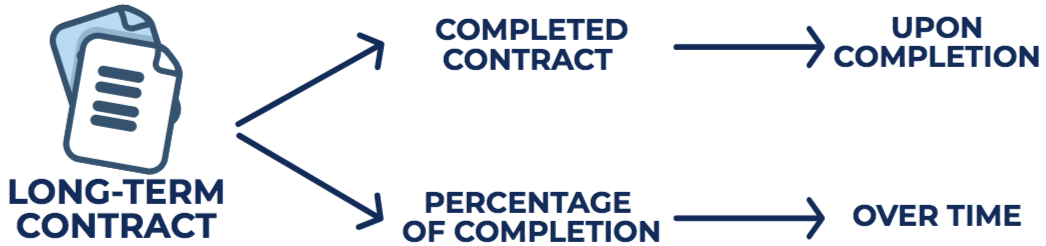
In addition to the completed contract method, another way to recognize revenue for a long-term contract is the percentage of completion method. The two revenue recognition methods are commonly seen in construction companiesCorporate StructureCorporate structure refers to the organization of different departments or business units within a company. Depending on a company’s goals and the industry, engineering companies, and other businesses that mainly generate revenue on long-term contracts for projects.
Understanding the Completed Contract Method
The completed contract method defers all revenue and expense recognition until the contract is completed. The method is used when there is unpredictability in the collection of funds from the customer. It is simple to use, as it is easy to determine when a contract is complete. In addition, under the completed contract method, there is no need to estimate costsCapital ExpenditureA capital expenditure (“CapEx” for short) is the payment with either cash or credit to purchase long term physical or fixed assets used in a to complete a project – all costs are known at the completion of the project.
Journal Entries
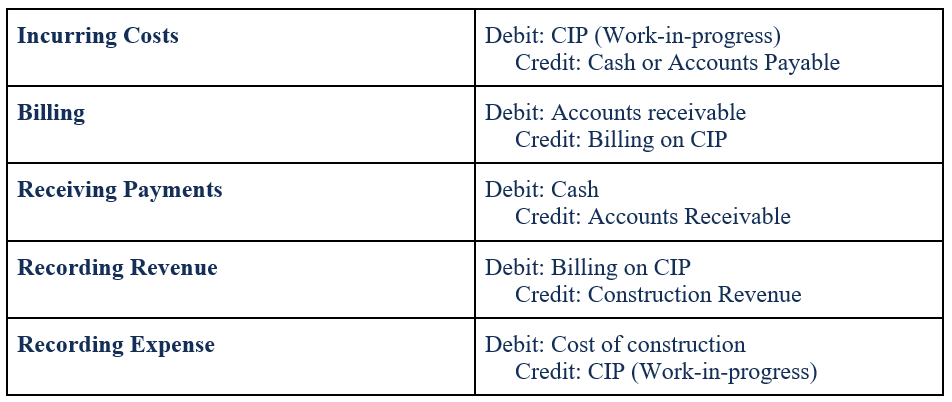
Journal entries for the completed contract method are as follows:
Example
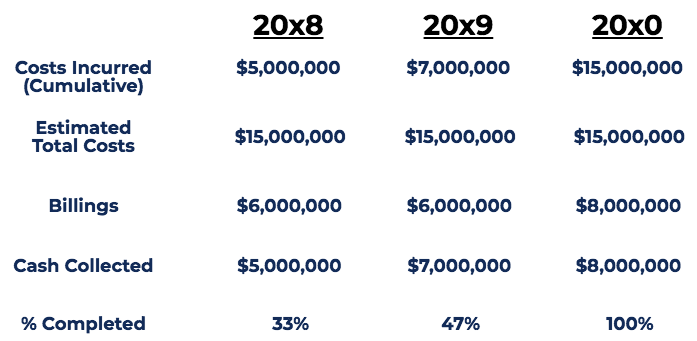
StrongBridges Ltd. was awarded a $20 million contract to build a bridge. The estimated time to complete the project is three (3) years with an estimated cost of $15 million. Assuming that the cost estimates do not change, the project is expected to generate $5 million in profit. The following is a schedule on the project using the alternate percentage of completion method:
Notes:
- Costs Incurred is the costs incurred to build the bridge as estimated by the company’s engineer.
- Billings is the amount of money StrongBridges Ltd. billed for the construction of the bridge. Billing amounts are set by the company.
- Cash Collected is the amount of money StrongBridges Ltd. received for the construction of the bridge. The variation in billings and cash collected is due to timing differences.
- % Completed is determined as costs incurred divided by estimated total costs.
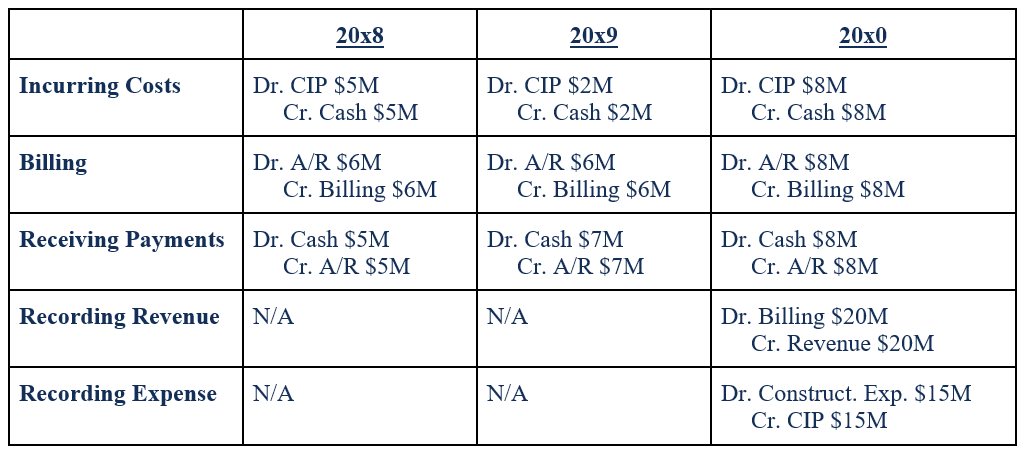
For the completed contract method, revenue and expense are only recognized at the end of the contract. The journal entries are as follows:
Related Readings
CFI is the official provider of the global Financial Modeling & Valuation Analyst (FMVA)®Become a Certified Financial Modeling & Valuation Analyst (FMVA)®CFI's Financial Modeling and Valuation Analyst (FMVA)® certification will help you gain the confidence you need in your finance career. Enroll today! certification program, designed to help anyone become a world-class financial analyst. To keep advancing your career, the additional CFI resources below will be useful:
- Capital ExpendituresCapital ExpendituresCapital expenditures refer to funds that are used by a company for the purchase, improvement, or maintenance of long-term assets to improve
- Due Diligence in Project FinanceDue Diligence in Project FinanceDue diligence in project finance involves managing and reviewing the aspects related to a deal. Proper due diligence ensures no surprises arise in regard to a financial transaction. The process involves a comprehensive examination of the transaction and preparation of a credit appraisal note.
- Project BudgetProject BudgetThe Project Budget is a tool used by project managers to estimate the total cost of a project. A project budget template includes a detailed estimate of all costs that are likely to be incurred before the project is completed.
- RAID LogRAID LogA RAID Log is a project management tool that is aimed at centralizing and simplifying the collection, monitoring, and tracking of project data
-

Variable Prepaid Forward Contracts: Tax-Efficient Stock Sales Explained
A variable prepaid forward contract is a technique that stockholders use in market equity transactions to cash in some of their stock to defer the tax liability owed on the capital gainsCapital GainA
-

Understanding Accounting Methods: Cash vs. Accrual
An accounting method refers to a set of rules that a company adheres to when keeping its financial records and reporting financial transactions. The transactions are recorded in a manner that accurate
Accounting
- Consolidation Method Explained: A Comprehensive Guide
- Cost Method Explained: Accounting & Investment Strategies
- Cost Recovery Method: Understanding Revenue Recognition
- Direct Method for Cash Flow Statements: A Comprehensive Guide
- Equity Method Accounting: Definition & Intercorporate Investments
- High-Low Method: Understanding & Application in Cost Accounting
- Percentage of Completion Method: Accounting Explained
- Profitability Index (PI): Definition, Formula & Investment Ranking
- Specific Identification Method: A Comprehensive Guide for Inventory Valuation
-
 Understanding the Temporal Method for Currency Translation
The temporal method is a currency exchange method used to convert the currency that a foreign subsidiary ordinarily does business in into the currency used by its parent company. The parent company&rs...
-
 Effective Interest Method Explained: Bond Amortization & Accounting
The Effective Interest Method is a technique used for amortizing bonds to show the actual interest rate in effect during any period in the life of a bond before maturity. It is based on the bond&rsquo...