
Variable Prepaid Forward Contracts: Tax-Efficient Stock Sales Explained
A variable prepaid forward contract is a technique that stockholders use in market equity transactions to cash in some of their stock to defer the tax liability owed on the capital gainsCapital GainA capital gain is an increase in the value of an asset or investment resulting from the price appreciation of the asset or investment. In other words, the gain occurs when the current or sale price of an asset or investment exceeds its purchase price.. The contract opens transactions and relates to future commitment, making it synonymous with stock options.

Investors with an accumulated number of shares in a single company prefer the strategy as an alternative portfolio diversification option to the open market. The number of shares to be returned by the investor depends on the current share value during the due date, hence the name “variable.” The execution of the contract generally presets the capped claim and the floor price to subsequent capital gain.
How Variable Prepaid Forward Contracts Work
Most top executives of corporations or founders are the typical users of variable prepaid forward contract strategies. Occasionally, they want to diversify their investment portfolio or lock in profits in the stock because of the relatively large stock ownership.
A variable prepaid forward contract allows investors to receive 75% to 90% of the current market value of the stock in prepaid payments, in exchange for a variable number of stocks in the future. Since the tax liabilities on capital gains are not due until the transaction is settled, investors preset the price range of shares to cushion against downside loss when turning them over.
Arguments Against Variable Prepaid Forward Contracts
The use of variable prepaid forward contracts is controversial and elicits mixed reactions from different quarters. Arguments against it are hinged on the violation of corporate ethics, such as the intention of investors to defer taxes due on capital gains, preserve voting rightsVoting SharesVoting shares are shares of a company that entitle the shareholder to vote on key issues of the company. It is generally one vote per share. The shares, retain limited upside gain, and reduce litigation risk.
However, the technique is useful in some scenarios. For example, in some circumstances, executives are barred from trading the shares for a specified period. Also, insiders are capable of divesting a large proportion of a company’s portfolio to unwind company-specific risks through hedged transactions.
The practice also offers an option for a share or cash settlement, implying that the transaction is either a zero-coupon loan combined with a zero-cost collar or as the sale of underwater call option combined with a differed and prepaid sale of stock. By the same token, the trading strategy can protect a company from the anticipated future performance decline, as well as hedge a company against future uncertainties.
In either case, a variable prepaid forward contract is apt to reflect private information. It is attributed to the fact that the transaction covers a large amount of company-based stock. The strategy is linked with a relatively average decline in excess returns comparative to the Center for Research in Security Price (CSRP)‘s value-weighted index, the CSRP‘s equally-weighted index, an average of the industry, and a matched sample on size and industry.
Technically, the practice is a zero-cost collar transaction, which is manifested in a short call option Call OptionA call option, commonly referred to as a "call," is a form of a derivatives contract that gives the call option buyer the right, but not the obligation, to buy a stock or other financial instrument at a specific price - the strike price of the option - within a specified time frame.and a long put option on the stock.
Additionally, the third feature involves a prepaid variable forward contract using a loan against the underlying stock to monetize the transaction. The advancement of financial engineering helps reduce the complexity of off-market transactions. The complicated modern features are embedded to facilitate the incorporation of insiders’ private information when performing the transaction.
Practical Example
Consider a hypothetical investor, who owns a relatively large number of shares in Company X. The shares are priced at $9 each, and the investor commits $100,000 in a variable prepaid forward contract and trades them at $ 9.50 per share with a maturity of three years. The capped floor and upper floor prices are set at $8 and $10, respectively. The total sale or the principle would amount to $950,000.
At the end of the third year, the investor will deliver all the pledged shares if they sell below $8. In such a case, the investor is under no obligation to compensate for the loss through financial consideration or additional shares.
Nevertheless, if the shares are trading at the preset values of $8, $9.50, or $10, one can obtain the due share by dividing the principal ($950,000) and the current market value of the stock (either $8, $9.5, or $10).
If the price per share is $8, the investor delivers $118,750 ($950,000 / $8).
If the price per share is $9.50, the investor will deliver $100,000 ($950,000 / $9.50).
If the price per share is $10, the investor will deliver $95,000 ($950,000 / $10).
At the other end of the spectrum, the investor will deliver a sum of the principal ($950,000) plus the excess of the share above $10 if the shares are traded at a value that exceeds the preset upper strike.
It then follows that:
If the price per share is $12, the investor will deliver $1,150,000 ($950,000 + 100,000 ($12 – $10).
Alternatively, the investor can deliver approximately 95,833 shares ($1,150,000 / 12).
The deferred capital gain tax only becomes due relative to the previous gains after the shareholder delivered the shares and settled the transaction.
Additional Resources
CFI is the official provider of the global Commercial Banking & Credit Analyst (CBCA)™Program Page - CBCAGet CFI's CBCA™ certification and become a Commercial Banking & Credit Analyst. Enroll and advance your career with our certification programs and courses. certification program, designed to help anyone become a world-class financial analyst. To keep advancing your career, the additional resources below will be useful:
- DiversificationDiversificationDiversification is a technique of allocating portfolio resources or capital to a variety of investments.The goal of diversification is to mitigate losses
- Founder’s StockFounders StockFounders stock refers to the equity that is given to the early founders of an organization. This type of stock differs in a few important ways from common stock sold in the secondary market. Key differences are (1) that founders stock can only be issued at face value, and (2) it comes with a vesting schedule.
- Futures ContractFutures ContractA futures contract is an agreement to buy or sell an underlying asset at a later date for a predetermined price. It’s also known as a derivative because future contracts derive their value from an underlying asset. Investors may purchase the right to buy or sell the underlying asset at a later date for a predetermined price.
- Options: Calls and PutsOptions: Calls and PutsAn option is a derivative contract that gives the holder the right, but not the obligation, to buy or sell an asset by a certain date at a specified price.
-

Equity Futures Contracts: Definition, Types & Uses
An equity futures contract is a financial arrangement between two counterparties to buy or sell equity at a specified date, amount, and price. They are regulated on derivative exchanges and used for s
-
![Forward Markets Explained: Contracts for Future Delivery | [Your Brand]](https://www.etffin.com/article/uploadfiles/202110/2021100815234066_S.jpeg)
Forward Markets Explained: Contracts for Future Delivery | [Your Brand]
A forward market is a marketplace that offers financial instruments that are priced in advance for future delivery. It tends to be referenced as the foreign exchange market, but it can also apply to s
invest
- Forward Contracts: Definition, How They Work & Examples
- Understanding Forward Rates: A Comprehensive Guide
- Dow 30 Explained: Understanding the Dow Jones Industrial Average
- Fixed Income Forward Contracts: Definition & Uses
- Understanding the Forward Curve: A Comprehensive Guide
- Understanding Forward Prices: Definition & How They Work
- Rule of 72: Calculate Investment Doubling Time | [Your Brand Name]
- Understanding the Completed Contract Method: Revenue Recognition Explained
- Variable Cost Ratio: Definition, Calculation & Importance
-
 Understanding the Dow Divisor: How It Impacts the DJIA
The Dow divisor, in simple terms, is a number used to help calculate the Dow Jones Industrial Average (DJIA)Dow Jones Industrial Average (DJIA)The Dow Jones Industrial Average (DJIA), also referred to...
-
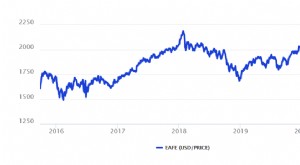 EAFE Index: Understanding Developed Market Performance
The EAFE Index (Europe, Australasia, and the Far East) was created to measure the performance of the stock markets in developed markets – excluding the U.S. and Canada. The indicator is maintain...