
Consolidation Method Explained: A Comprehensive Guide
The consolidation method is a type of investment accountingInvestment MethodsThis guide and overview of investment methods outlines they main ways investors try to make money and manage risk in capital markets. An investment is any asset or instrument purchased with the intention of selling it for a price higher than the purchase price at some future point in time (capital gains), or with the hope that the asset will directly bring in income (such as rental income or dividends). used for incorporating and reporting the financial results of majority-owned investments. This method can only be used when the investor possesses effective control of the investee or subsidiary, which often, but not always, assumes the investor owns at least 50.1% of the subsidiary shares or voting rights.

The consolidation method works by reporting the subsidiary’s balances in a combined statement along with the parent company’s balances, hence “consolidated”. Under the consolidation method, a parent company combines its own revenue with 100% of the revenue of the subsidiary.
Learn more about the various types of mergers and amalgamationsAmalgamationIn corporate finance, an amalgamation is the combination of two or more companies into a larger single company. In accounting, it refers to the combination of financial statements..
How does the Consolidation Method Work?
The parent company will report the “investment in subsidiary” as an asset, with the subsidiarySubsidiaryA subsidiary (sub) is a business entity or corporation that is fully owned or partially controlled by another company, termed as the parent, or holding, company. Ownership is determined by the percentage of shares held by the parent company, and that ownership stake must be at least 51%. reporting the equivalent equity owned by the parent as equity on its own accounts. When the companies are consolidated, an elimination entry must be made to eliminate these amounts to ensure there is no overstatement.
The elimination adjustment is made with the intent of offsetting the intercompany transaction and the shareholders’ equity, such that the values are not double-counted at the consolidated level.
Consolidation Method Example
Parent Company has recently just begun operation and, thus, has a simple financial structure. Mr. Parent, the sole owner of Parent Company, injects $20M cash into his business. This appears as the following journal entry.
Dr.Cash20,000,000Cr. Shareholder’s Equity20,000,000
As such, Parent Company’s balances are now 20M in assets and 20M in equity.
The next month, Parent Company sets up Child Inc, a new subsidiary. Parent Company invests $10M in the company for 100% of its equity. On Parent’s books, this shows up as the following.
Dr.Investments in Subsidiary10,000,000Cr. Cash10,000,000
Parent Company now has $10M less cash, but still has a total of $20M in assets.
On Child’s books, the same transaction would show up as follows.
Dr.Cash10,000,000Cr. Shareholder’s Equity10,000,000
At the end of the year, Parent Company must create a consolidated statement for itself and Child Inc. Assuming no other transactions occur in the year, the consolidated statement would look like the following:
Parent Company Child Inc. Elimination Adjustment Consolidated AssetsCash10,000,00010,000,00020,000,000Investment in Subsidiary10,000,000-10,000,0000EquityShareholder's Equity20,000,00010,000,000-10,000,00020,000,000
As can be seen above, the elimination adjustment is necessary so as not to overstate the consolidated balance sheetBalance SheetThe balance sheet is one of the three fundamental financial statements. The financial statements are key to both financial modeling and accounting.. If the elimination adjustment were not made, the consolidated assets of both companies would total 30,000,000, which is not true, as money was simply moved between the two companies. In other words, not making the elimination adjustment would result in a false creation of value.
Other Accounting Methods
When an investor does not exercise effective controlInvestor InfluenceThe level of investor influence a company holds in an investment transaction determines the method of accounting for said private investment. The accounting for the investment varies with the level of control the investor possesses. of the company it invests in, the investor may possess a minority interest in the company. Depending on the influence this minority interest holds, the investor may either account for the investment using the cost method or the equity method.
The cost method records the investment as an asset and records dividends as income to the investor. The equity method records the investment as an asset, more specifically as an investment in associates or affiliates, and the investor accrues their proportionate share of the investee’s income. This share is known as the “equity pick-up”.
Additional Resources
This has been a guide to the consolidation method of accounting for investments. CFI is the official provider of the Financial Modeling and Valuation Analyst (FMVA)®Become a Certified Financial Modeling & Valuation Analyst (FMVA)®CFI's Financial Modeling and Valuation Analyst (FMVA)® certification will help you gain the confidence you need in your finance career. Enroll today! designation.
To learn more, check out these other relevant CFI articles:
- Cost Method AccountingCost MethodThe cost method of accounting is used for recording certain investments in a company's financial statements. The investment is recorded at historical cost
- Equity Method AccountingEquity MethodThe equity method is a type of accounting used in investments. It is used when the investor holds significant influence over investee but does
- Private Equity CareersPrivate Equity Career ProfilePrivate equity analysts & associates perform similar work as in investment banking. The job includes financial modeling, valuation, long hours & high pay. Private equity (PE) is a common career progression for investment bankers (IB). Analysts in IB often dream of “graduating” to the buy side,
- Financial Modeling GuideFree Financial Modeling GuideThis financial modeling guide covers Excel tips and best practices on assumptions, drivers, forecasting, linking the three statements, DCF analysis, more
-

Direct Capitalization Method: Definition & Application
The direct capitalization method is obtained by taking the income recorded over time and dividing it by the respective capitalization rates taken over the same period. The cap rate is obtained by divi
-

Understanding the Earnings Multiplier (P/E Ratio): A Comprehensive Guide
The earnings multiplier, or the price-to-earnings ratio, is a method used to compare a company’s current share price to its earnings per share (EPS)Earnings Per Share (EPS)Earnings per share (EP
Accounting
- Fixed-Charge Coverage Ratio (FCCR): Definition & Importance
- Modigliani-Miller Theorem: Understanding Capital Structure & Firm Value
- Cost Method Explained: Accounting & Investment Strategies
- Cost Recovery Method: Understanding Revenue Recognition
- Direct Method for Cash Flow Statements: A Comprehensive Guide
- Just-in-Time (JIT) Inventory Management: A Comprehensive Guide
- Understanding the Matching Principle in Accounting
- Percentage of Completion Method: Accounting Explained
- Understanding the Accounting Reporting Cycle: A Comprehensive Guide
-
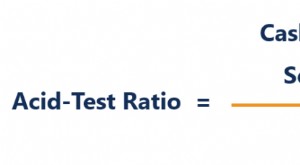 Acid-Test Ratio: Understanding Your Company's Short-Term Liquidity
The Acid-Test Ratio, also known as the quick ratioQuick RatioThe Quick Ratio, also known as the Acid-test, measures the ability of a business to pay its short-term liabilities with assets readily conv...
-
 Treasury Stock Method: Calculating Diluted Earnings Per Share
The treasury stock method is a way for companies to calculate how many additional shares may be generated from outstanding in-the-money warrants and options. The new additional shares are then used in...