
Understanding Current Debt: Definition & Implications
Current debt includes the formal borrowings of a company outside of accounts payableAccounts PayableAccounts payable is a liability incurred when an organization receives goods or services from its suppliers on credit. Accounts payables are. This appears on the balance sheet as an obligation that must be paid off within a year’s time. Thus, current debt is classified as a current liability. This is not to be confused with the current portion of long-term debt, which is the portion of long-term debt due within a year’s time.
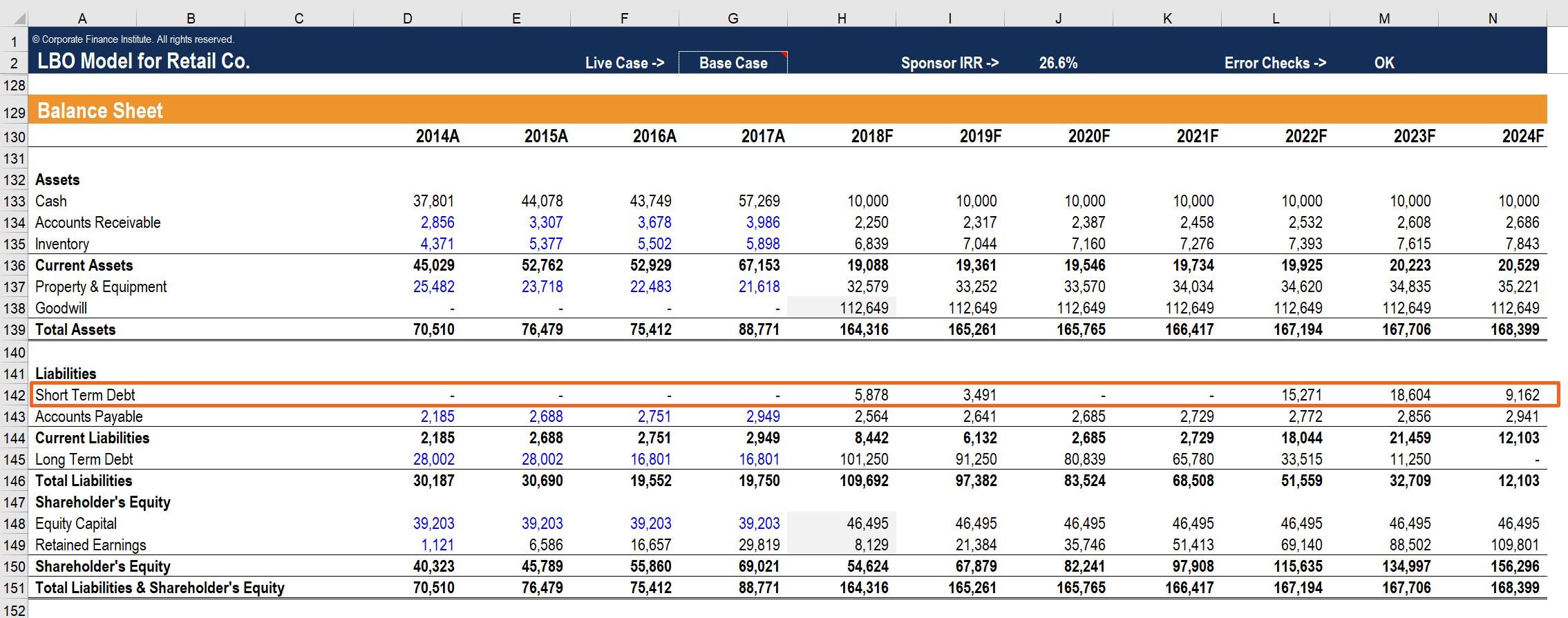
Not all companies have a current debt line item, but those that do use it explicitly for loans incurred with a maturity of less than a year. Some firms call this “notes payableNotes PayableNotes payable are written agreements (promissory notes) in which one party agrees to pay the other party a certain amount of cash..” This differs from accounts payable, as accounts payable refers to goods or services purchased on credit. Notes payable, on the other hand, refers to funds or cash borrowed.
Current Ratio
Current debt is often assessed using the current ratioCurrent Ratio FormulaThe Current Ratio formula is = Current Assets / Current Liabilities. The current ratio, also known as the working capital ratio, measures the capability of a business to meet its short-term obligations that are due within a year. The ratio considers the weight of total current assets versus total current liabilities. It indicates the financial health of a company. The current ratio is a liquidity metric that compares current assets to current liabilities. This ratio is used to gauge the ability of a company to pay off its financial obligations for the next year. If a company has current assets of $500,000 and current liabilities of $250,000, then it has a current ratio of 2:1.
Generally speaking, a company should always have a current ratio of at least 1:1 or higher to indicate that it is financially sound. A ratio of less than 1:1 indicates the company has more financial obligations than its current assets can cover.
To get a good reading of a company’s relative financial stability, it is best to compare its current ratio to the average current ratio of similar companies operating in the same industry. You can also compare it to the company’s own current ratio in previous years, to identify whether the company is trending toward a higher or lower ratio.
Related Readings
Thank you for reading this CFI guide to assets. CFI’s mission is to create world-class financial analysts via the Financial Modeling & Valuation Analyst (FMVA)® Certification ProgramBecome a Certified Financial Modeling & Valuation Analyst (FMVA)®CFI's Financial Modeling and Valuation Analyst (FMVA)® certification will help you gain the confidence you need in your finance career. Enroll today!. To continue learning and advancing your career, these additional CFI resources will be helpful:
- Intangible AssetsIntangible AssetsAccording to the IFRS, intangible assets are identifiable, non-monetary assets without physical substance. Like all assets, intangible assets
- Bonds PayablesBond PayablesBonds payable are generated when a company issues bonds to generate cash. Bonds payable refers to the amortized amount that a bond issuer
- PP&EPP&E (Property, Plant and Equipment)PP&E (Property, Plant, and Equipment) is one of the core non-current assets found on the balance sheet. PP&E is impacted by Capex,
- Share CapitalShare CapitalShare capital (shareholders' capital, equity capital, contributed capital, or paid-in capital) is the amount invested by a company’s
-
Understanding Debt: Types, Obligations & Financial Implications
Debt is the money borrowed by one party from another to serve a financial need that otherwise cannot be met outright. Many organizationsTypes of OrganizationsThis article on the different types of org
-
Understanding Debt Capacity: A Guide for Businesses
Debt capacity refers to the total amount of debt a business can incur and repay according to the terms of a debt agreementDebt ScheduleA debt schedule lays out all of the debt a business has in a sche
Accounting
- Asset Coverage Ratio: Understanding Financial Solvency
- Cash Flow to Debt Ratio: Understanding and Calculation
- Coverage Ratio: Understanding Your Company's Debt Repayment Ability
- Current Ratio: Definition, Calculation & Financial Health
- Debt-to-Assets Ratio: Definition, Calculation & Risk Assessment
- Debt-to-Equity Ratio: Definition, Calculation & Importance
- Understanding Liquidity Ratios: A Guide to Short-Term Solvency
- Understanding Bad Debt: Definition and Financial Statement Impact
- Understanding Current Assets: Definition & Importance
-
 Understanding Capital: Types, Categories & Value Creation
Capital is anything that increases one’s ability to generate value. It can be used to increase value across a wide range of categories, such as financial, social, physical, intellectualInterpers...
-
 Cash Ratio: Understanding Your Company's Short-Term Liquidity
The cash ratio, sometimes referred to as the cash asset ratio, is a liquidity metric that indicates a company’s capacity to pay off short-term debt obligationsCurrent LiabilitiesCurrent liabilit...