
Understanding the Matching Principle in Accounting
The matching principle is an accounting concept that dictates that companies report expensesAccrued ExpensesAccrued expenses are expenses that are recognized even though cash has not been paid. They are usually paired up against revenue via the matching principle at the same time as the revenuesSales RevenueSales revenue is the income received by a company from its sales of goods or the provision of services. In accounting, the terms "sales" and they are related to. Revenues and expenses are matched on the income statementIncome StatementThe Income Statement is one of a company's core financial statements that shows their profit and loss over a period of time. The profit or for a period of time (e.g., a year, quarter, or month).
Example of the Matching Principle
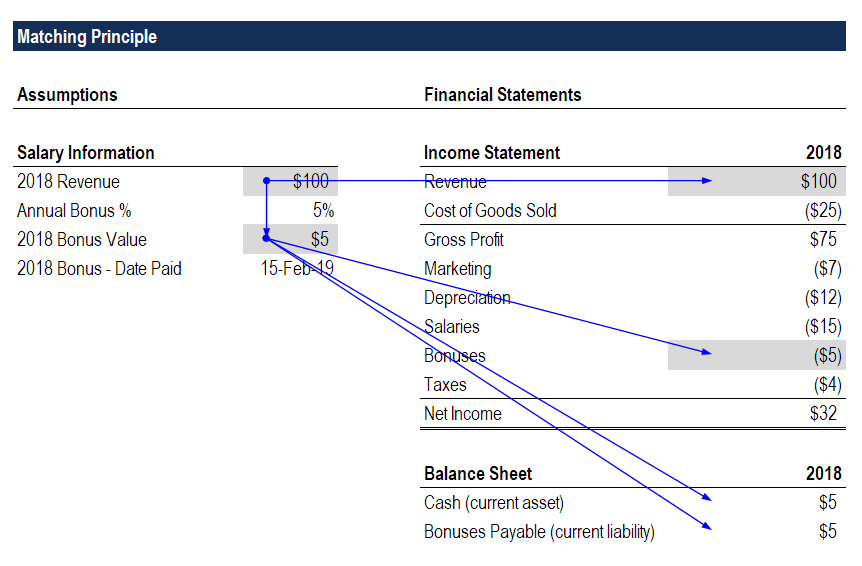
Imagine that a company pays its employees an annual bonus for their work during the fiscal yearFiscal Year (FY)A fiscal year (FY) is a 12-month or 52-week period of time used by governments and businesses for accounting purposes to formulate annual. The policy is to pay 5% of revenues generated over the year, which is paid out in February of the following year.
In 2018, the company generated revenues of $100 million and thus will pay its employees a bonus of $5 million in February 2019.
Even though the bonus is not paid until the following year, the matching principle stipulates that the expense should be recorded on the 2018 income statement as an expense of $5 million.
On the balance sheet at the end of 2018, a bonuses payable balance of $5 million will be credited, and retained earnings will be reduced by the same amount (lower net income), so the balance sheet will continue to balance.
In February 2019, when the bonus is paid out there is no impact on the income statement. The cash balance on the balance sheet will be credited by $5 million, and the bonuses payable balance will also be debited by $5 million, so the balance sheet will continue to balance.
Download CFI’s Matching Principle template to see how the numbers work on your own!
Benefits of the Matching Principle
The matching principle is a part of the accrual accounting method Accrual AccountingIn financial accounting, accruals refer to the recording of revenues that a company has earned but has yet to receive payment for, and theand presents a more accurate picture of a company’s operations on the income statement.
Investors typically want to see a smooth and normalized income statement where revenues and expenses are tied together, as opposed to being lumpy and disconnected. By matching them together, investors get a better sense of the true economics of the business.
It should be mentioned though that it’s important to look at the cash flow statement in conjunction with the income statement. If, in the example above, the company reported an even bigger accounts payable obligation in February, there might not be enough cash on hand to make the payment. For this reason, investors pay close attention to the company’s cash balance and the timing of its cash flows.
Challenges with the Matching Principle
The principle works well when it’s easy to connect revenues and expenses via a direct cause and effect relationship. There are times, however, when that connection is much less clear, and estimates must be taken.
Imagine, for example, that a company decides to build a new office headquarters that it believes will improve worker productivity. Since there’s no way to directly measure the timing and impact of the new office on revenues, the company will take the useful life of the new office space (measured in years) and depreciate the total cost over that lifetime.
For example, if the office costs $10 million and is expected to last 10 years, the company would allocate $1 million of straight-line depreciation expense per year for 10 years. The expense will continue regardless of whether revenues are generated or not.
Another example would be if a company were to spend $1 million on online marketing (Google AdWords). It may not be able to track the timing of the revenue that comes in, as customers may take months or years to make a purchase. In such a case, the marketing expense would appear on the income statement during the time period the ads are shown, instead of when revenues are received.
Additional resources
Thank you for reading this guide to understanding the accounting concept of the matching principle.
CFI is the official provider of the Financial Modeling and Valuation Analyst (FMVA)T® Become a Certified Financial Modeling & Valuation Analyst (FMVA)®CFI's Financial Modeling and Valuation Analyst (FMVA)® certification will help you gain the confidence you need in your finance career. Enroll today!designation, created to help transform anyone into a world-class financial analyst. To continue learning and advancing your career, these additional CFI resources will be useful:
- Projecting Income Statement Line ItemsProjecting Income Statement Line ItemsWe discuss the different methods of projecting income statement line items. Projecting income statement line items begins with sales revenue, then cost
- Three Financial StatementsThree Financial StatementsThe three financial statements are the income statement, the balance sheet, and the statement of cash flows. These three core statements are
- Revenue Recognition PrinciplesRevenue RecognitionRevenue recognition is an accounting principle that outlines the specific conditions under which revenue is recognized. In theory, there is a
- Accrued ExpensesAccrued ExpensesAccrued expenses are expenses that are recognized even though cash has not been paid. They are usually paired up against revenue via the matching principle
-

Cost Method Explained: Accounting & Investment Strategies
The cost method of accounting is used for recording certain investmentsInvestment MethodsThis guide and overview of investment methods outlines they main ways investors try to make money and manage ri
-

5C Analysis: A Comprehensive Framework for Business Strategy
5C Analysis is a marketing framework to analyze the environment in which a company operates. It can provide insight into the key drivers of success, as well as the risk exposureSystemic RiskSystemic r
Accounting
- Acid-Test Ratio: Understanding Your Company's Short-Term Liquidity
- Understanding the Earnings Multiplier (P/E Ratio): A Comprehensive Guide
- Understanding the IPO Process: A Comprehensive Guide
- Modigliani-Miller Theorem: Understanding Capital Structure & Firm Value
- Accrual Accounting Principle: Definition & Explanation
- Full Disclosure Principle: Understanding Public Company Financial Reporting
- Understanding the Accounting Reporting Cycle: A Comprehensive Guide
- Revenue Recognition Principle: Definition & Importance
- Understanding the Matching Principle in Accounting
-
 Understanding Below-the-Line Items in Financial Statements
Below the Line refers to items in a profit and loss Profit and Loss Statement (P&L)A profit and loss statement (P&L), or income statement or statement of operations, is a financial report...
-
 Consolidation Method Explained: A Comprehensive Guide
The consolidation method is a type of investment accountingInvestment MethodsThis guide and overview of investment methods outlines they main ways investors try to make money and manage risk in capita...