
Negative Confirmation: Definition, Purpose & Audit Evidence
Negative confirmation is a common industry practice for auditors to gather audit evidenceEvidence in an AuditEvidence in an audit is information that is collected and required in the review of an entity’s financial transactions, balances, and internal from external stakeholders. A negative confirmation is a letter addressed to a debtor, requesting a response if the debtor disagrees with the stated account balance.
Confirmation occurs if the third party doesn’t respond, or when a correction is submitted by the third party. The process is used in testing managerial assertions about account balances.
Summary
- Negative confirmation is a common industry practice for auditors to accumulate audit evidence from external stakeholdersStakeholderIn business, a stakeholder is any individual, group, or party that has an interest in an organization and the outcomes of its actions. Common examples.
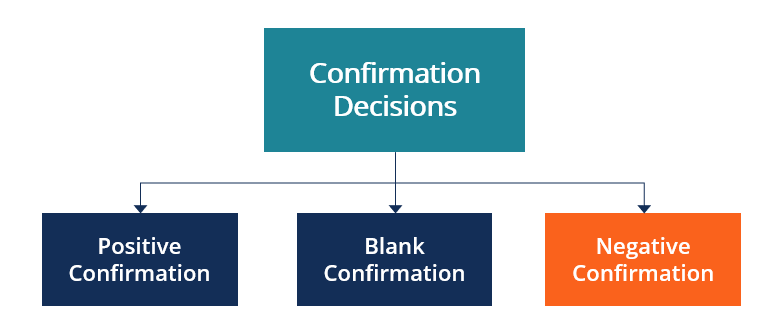
- The three types of confirmation forms are positive confirmation, blank confirmation forms, and negative confirmation.
- Negative confirmation is best applied when the risk of material misstatement is low, meaning that inherent risk and control risk are relatively low.
Auditors’ Assumptions Underlying Confirmations
Auditors apply professional judgment in deciding which confirmation method is most appropriate in reference to the audit’s risk for material misstatement. An auditor must employ analytical, systematic, and objective judgment when deciding on which confirmation procedure to apply. Below are two primary judgments an auditor must make when deciding to accept an external confirmation from a third party:
- The external party’s independence
- The external party’s knowledge of the account and intent
The confirmation’s value is completely reliant on the independence of the external party. For example, consider when an auditor sends a confirmation of a fraudulent account receivable to the person who committed the fraud. In such a scenario, the value of the confirmation is nil, as the fraudster would act in their self-interest and conceal their behavior.
Confirmation of the account balance with a third party is important because it explains the managerial assertions behind the stated balance. It is important to assess managerial accounting assertions relative to generally accepted accounting principles (GAAP), as well as to apply testing procedures that comply with generally accepted auditing standards (GAAS).
If the auditor is not satisfied with the third party”s quality of confirmation, they should practice further professional skepticism, and implement further audit procedures.
Types of Confirmation Decisions
1. Positive confirmation
A letter sent to the debtor requesting direct confirmation of the account balance’s accuracy. If inaccurate, the debtor must produce a reason for the discrepancy and update the account balance. If accurate, the debtor must simply confirm the account balance through a response.
2. Blank confirmation form
Blank confirmation forms are a type of positive confirmation requiring the debtor to return a letter detailing the account balance. The number is then used to cross-reference against the listed receivable balance to ensure accuracy.
3. Negative confirmation
A letter sent to the debtor that denotes a specific account and value associated with its balance. The third party can choose to reject the balance and supply their number for the suggested account, or they can choose not to respond to the letter. A suggestion of a differing balance or nonresponse is considered confirmation.
When to Use Negative Confirmation
Negative confirmation is best applied in cases where the risk of material misstatement is low. The primary drivers of the risk of material misstatement are inherent risk and control risk. If acceptable audit risk is held equal, a decreased risk of material misstatement increases the detection risk of an auditor failing to identify material misstatements.
Logically, the auditor is willing to accept a higher risk of failing to identify material misstatements due to a less perceived risk of the business’ operating environment and internal processes.
Generally, negative confirmations are most effective when the following are true:
- The risk of material misstatement is low
- The items are similar in nature and are relatively small balances
- Low probability of the external party’s number not being aligned with the internal figures
- The expectation that the third party will read and consider the confirmation
Why Use Negative Confirmations?
Negative confirmations are advantageous in terms of cost and efficiency. It is measurably less expensive to distribute negative confirmations instead of positive confirmations, and therefore, more can be distributed for the same total cost.
Depending on the auditor’s detection risk, the auditor may need confirmation from hundreds of customers, and it can be more efficient to use negative confirmations to collect audit evidence in such a manner.
Practical Usage of Negative Confirmations
If an auditor significantly tests internal controls, negative confirmations are utilized to provide audit evidence of the account balance. Generally, negative confirmations are most often used in audits, where the primary consumer is the general public.
For example, municipalities, retail stores, and banksTop Banks in the USAAccording to the US Federal Deposit Insurance Corporation, there were 6,799 FDIC-insured commercial banks in the USA as of February 2014. are all typical audit clients where negative confirmations are utilized in the evidence-gathering process.
The primary factors affecting the confirmation decision are:
- Materiality of receivables
- The number and size of individual accounts
- Control risk
- Inherent risk
- Effectiveness of confirmation technique
- Availability of corroborative audit evidence
More Resources
CFI offers the Commercial Banking & Credit Analyst (CBCA)™Program Page - CBCAGet CFI's CBCA™ certification and become a Commercial Banking & Credit Analyst. Enroll and advance your career with our certification programs and courses. certification program for those looking to take their careers to the next level. To keep learning and developing your knowledge base, please explore the additional relevant resources below:
- Auditor’s ReportAuditor's ReportAn independent Auditor’s Report is an official opinion issued by an external or internal auditor as to the quality and accuracy of the
- Fraud in AuditsAccountingOur Accounting guides and resources are self-study guides to learn accounting and finance at your own pace. Browse hundreds of guides and resources.
- Legal Liability of AuditorsLegal Liability of AuditorsConcerns about the legal liability of auditors continue to grow every day. Auditors are highly important people because, ultimately, they are
- Materiality Threshold in AuditsMateriality Threshold in AuditsThe materiality threshold in audits refers to the benchmark used to obtain reasonable assurance that an audit does not detect any material
-
Audit Risk Model: Definition, Purpose & Application
An audit risk model is a conceptual tool applied by auditors to evaluate and manage the various risks arising from performing an audit engagement. The tool helps the auditor decide on the types of evi
-

Negative Goodwill Explained: Understanding Bargain Purchases
The negative goodwill (NGW) amount, also known as the “bargain purchase” amount, is the difference between the purchase price paid for an asset and its actual fair market value.
Accounting
- Understanding Risk Grades: An Investor's Guide
- Understanding Risk Preference: A Comprehensive Guide
- Negative Correlation Explained: Understanding Inverse Relationships
- Understanding Negative Equity: Causes, Risks & Solutions
- Understanding Negative Growth: Causes, Impacts & Examples
- Understanding Operating Risk: A Key Component of Business Risk
- Understanding Financial Risk: A Comprehensive Guide
- Understanding Inherent Risk: A Key Concept in Risk Management
- Negative Assurance Explained: Auditor's Confirmation & Its Significance
-
 Value at Risk (VaR): Understanding Investment Risk
Value at risk is a method that is used to determine the possible risk of loss for a particular type of investment. This is a strategy that attempts to determine what the worst-case scenario is f...
-
Understanding Risk Aversion in Investing: A Beginner's Guide
The term risk aversion is often applied to certain types of investors. Here are the basics of risk aversion and what it means to investors. Risk Aversion The term risk aversion basically means t...