
Understanding Negative Equity: Causes, Risks & Solutions
The concept of negative equity arises when the value of an asset (which was financed using debt) falls below the amount of the loan/mortgage that is owed to the bank in exchange for the assetTangible AssetsTangible assets are assets with a physical form and that hold value. Examples include property, plant, and equipment. Tangible assets are. It normally occurs when the value of the asset depreciates rapidly over the period of use, resulting in negative equity for the borrower.

Summary
- Negative equity occurs when the value of a borrowed asset falls below the amount of the loan/mortgage taken in lieu of the asset.
- Negative shareholder equity is a similar concept, whereby the company incurs losses that are greater than the combined value of payments made to shareholders and accumulated earnings from prior periods.
- For assets, negative equity can appear due to a reduction in the asset value or for companies if there is a large dividend paid, or there are significant accumulated losses.
What is Positive Equity?
To understand negative equity better, it is important that we first understand what positive equity is. A typical asset that is financed by a loan is denoted as positive equity for the owner.
For example, a person puts up a portion of the money as a down payment and purchases a house. Because the person did not pay the entire amount of the house, but he still owns the property, it counts as positive equity.
Positive equity can grow when the value of the borrowed asset goes up or the amount of the loan owed to the bank in lieu of the asset goes down.
Negative Equity – Implications
Negative equity can prevail under several circumstances. Below, we identify three scenarios and describe its implications to the concerned parties:
1. Negative equity for an asset
Negative equity for assets is common in the housing and automobile sector. A house or car is normally financed through some sort of debt (such as a bank loan or mortgage). The price of a house can decline due to fluctuating real estate prices, and the price of a car can fall due to rapid use (depreciationDepreciation MethodsThe most common types of depreciation methods include straight-line, double declining balance, units of production, and sum of years digits.). When the value of the asset drops below the loan/mortgage amount, it results in negative equity.
Another related concept is negative amortization. It happens when the value of the asset remains constant, but the amount of the loan balance goes up. It can be due to the borrower not making sufficient repayments to the lender.
2. Negative shareholder equity
For listed companies, at times, a negative balance can appear for the equity line-item of the balance sheet. It happens when the company’s liabilities exceed its assets, and in more financial terms, the company’s incurred losses that are greater than the combined value of payments made to shareholders and accumulated earnings from previous periods.
A typical example of negative shareholder equity is when significant dividend payments are made to investors, which erode the retained earningsRetained EarningsThe Retained Earnings formula represents all accumulated net income netted by all dividends paid to shareholders. Retained Earnings are part and make the equity of the company go into the negative zone. It is usually a sign of financial distress for the company.
3. Negative net worth
Net worth is used in the context of individuals. A person who has negative equity is said to have a negative net worth, which essentially means that the person’s liabilities exceed the assets he owns.
A common example of people who have a negative net worth are students with an education line of credit. Although student loans allow people to acquire an education, which, in turn, makes them more financially stable, it cannot be counted as a physical asset. Therefore, while the student loan is being repaid, the person who owns the loan has a negative net worth.
Example of Negative Equity in the Real World
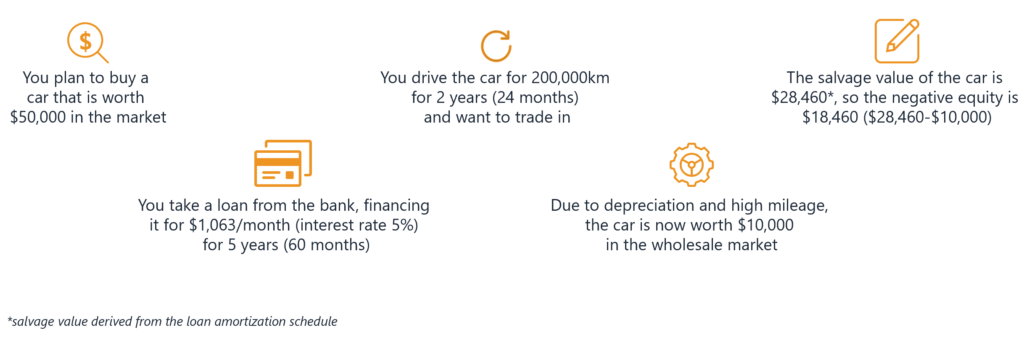

Figure 2 illustrates an example of how to compute negative equity in the real world. A person buys a car that is worth $50,000 in the market, and he finances it using a loan with an interest rate of 5%, which needs to be paid over five years.
Using the given data, we can build a loan amortizationAmortizationAmortization refers to the process of paying off a debt through scheduled, pre-determined installments that include principal and interest schedule similar to that in Figure 3 (some rows are hidden for simplicity). The monthly payment comes out to be $1,063 (which includes the principal repayment and the interest charged).
Suppose the person drives the car for 200,000 kilometers over two years and wants to trade in the vehicle afterward. As the car has been used excessively, the depreciation and high mileage have resulted in the car being valued at $10,000 in the market.
Going back to our loan amortization schedule (Figure 3), the outstanding amount on the loan is $28,460 at the end of two years. We can see that there is a large difference of $18,460 between the value of the loan and the value of the asset. The amount is negative equity.
More Resources
CFI is the official provider of the global Commercial Banking & Credit Analyst (CBCA)™Program Page - CBCAGet CFI's CBCA™ certification and become a Commercial Banking & Credit Analyst. Enroll and advance your career with our certification programs and courses. certification program, designed to help anyone become a world-class financial analyst. To keep advancing your career, the additional CFI resources below will be useful:
- Personal FinancePersonal FinancePersonal finance is the process of planning and managing personal financial activities such as income generation, spending, saving, investing, and protection. The process of managing one’s personal finances can be summarized in a budget or financial plan.
- Projecting Balance Sheet Line ItemsProjecting Balance Sheet Line ItemsProjecting balance sheet line items involves analyzing working capital, PP&E, debt share capital and net income. This guide breaks down how to calculate
- Statement of Retained EarningsStatement of Retained EarningsThe statement of retained earnings provides an overview of the changes in a company's retained earnings during a specific accounting cycle. It is structured as an equation, such that it opens with the retained earnings at the beginning of the reporting period, makes adjustments for items such as net income and dividends
- Tangible Net WorthTangible Net WorthTangible net worth is an estimate of the net worth of an entity that excludes all intangible assets such as patents, trademarks, and intellectual property,
-

Understanding Interest Rate Gaps: A Guide for Financial Institutions
Negative gap is a term used to describe a situation in which a bank’s interest-sensitive liabilities exceed its interest-sensitive assets. Interest rate gap is important because it sh
-

Pro-Rata Rights: Understanding Investor Ownership in Funding Rounds
Pro-rata right is a legal term that describes the right, but not the obligation, that can be given to an investor to maintain their initial level of percentage ownershipStockholders EquityStockholders
finance
- Backstop: Understanding Financial Safety Nets and Contingency Funding
- Understanding Equity: A Comprehensive Guide for Investors
- Equity Crowdfunding: A Comprehensive Guide for Startups & Investors
- Negative Correlation Explained: Understanding Inverse Relationships
- Understanding Negative Growth: Causes, Impacts & Examples
- Growth Equity: Investing in Expanding Businesses | [Your Company Name]
- Understanding Negative Carry: Risks and Strategies
- Negative Gearing Explained: Understanding Investment Losses & Tax Benefits
- Understanding Home Equity: A Comprehensive Guide
-
 Understanding Junior Equity: Risks and Returns
Junior equity refers to the equity or shares issued by a company that ranks below other shares or stocks issued by the same company. The stock issued is said to be subordinate to other stocks issued b...
-
 Mezzanine Financing: Definition, Benefits & How It Works
Mezzanine financing is a layer of financing that fills the gap between senior debt and equity in a company. It can be structured either as preferred stockPreferred SharesPreferred shares (preferred st...