
Understanding Negative Growth: Causes, Impacts & Examples
Negative growth implies a decline in value over a stated period. It is commonly observed in economic, industry, and business analysis. Typically, negative growth is expressed as a percentage over a period of time.
Summary
- Negative growth implies a decline in value over a stated period.
- Negative growth in the economy occurs when the gross domestic product (GDP) reduces year over year.
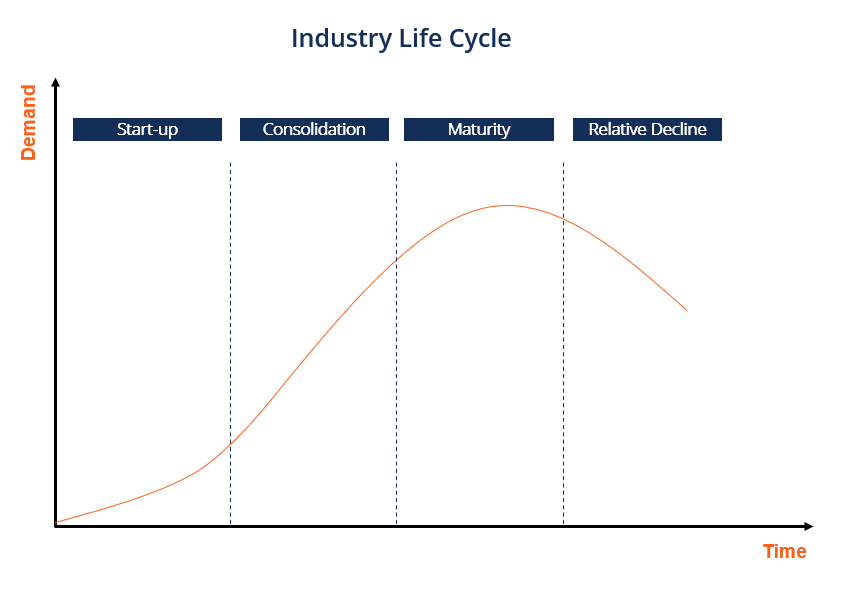
- It can be commonly observed in the maturity and relative decline stage of the industry life cycle.
Negative Growth in an Economic Context
A country’s economy can experience negative growth when its gross domestic product (GDP)Gross Domestic Product (GDP)Gross domestic product (GDP) is a standard measure of a country’s economic health and an indicator of its standard of living. Also, GDP can be used to compare the productivity levels between different countries. reduces year over year. GDP refers to the dollar value of all final goods and services produced within a country’s borders in a given year. The four primary drivers of GDP are individual consumption expenditure, investment, net exports, and governmental expenditure.
If a country’s real gross domestic product declines for two or more quarters, it is indicative of a recession in the business cycle. Negative growth rates are often accompanied by declining real income, increasing unemploymentUnemploymentUnemployment is a term referring to individuals who are employable and actively seeking a job but are unable to find a job. Included in this, and reduced production.
Negative Growth in Business
Negative growth can be identified in business by conducting horizontal analysis to identify year over year declines. A horizontal analysis involves contrasting financial results across several fiscal periods to illustrate a trend. Accurately identifying negative growth can be performed on a nominal basis or a proportionate basis.
Identifying negative nominal growth is achieved when comparing an account balance year over year. It is a useful metric to assess if a business is shrinking in terms of scale. For example, say a company’s property, plant, and equipment (PP&E)PP&E (Property, Plant and Equipment)PP&E (Property, Plant, and Equipment) is one of the core non-current assets found on the balance sheet. PP&E is impacted by Capex, is declining year over year; it can be inferred that the company is selling off or disposing of its capital assets. Ultimately, it can imply a reduction in expected future cash flows to be generated from its productive assets.
Identifying proportionate negative growth is achieved by making financial statements common size. The financial statements can be made common size by dividing balance sheet accounts by total assets or by dividing income sheet accounts by total revenues.
Horizontal analysis of common size financial statements allows for the observation of trends over a period of time. For example, if there is negative growth between the common size cost of goods sold accounts year over year, it would imply that the growth in the company’s revenues has been quicker than that of its cost of goods soldCost of Goods Sold (COGS)Cost of Goods Sold (COGS) measures the “direct cost” incurred in the production of any goods or services. It includes material cost, direct, boosting its gross profitability.
Observing Negative Growth in the Industry Life Cycle
The industry life cycle is a theoretical framework used to analyze the maturity of an industry. The four stages of the industry life cycle are:
1. Start-up stage
The start-up stage is a period where industry players see rapid increasing growth. It is often difficult to identify the industry leaders, as all industry players experience substantial risk. Generally, the start-up stage is characterized by disruptive technology and offers the potential for large-scale growth.
2. Consolidation stage
The consolidation stage is a period of stable positive growth, where industry players begin to emerge. It is characterized by a few companies controlling a sizable amount of market share. Overall, industries at the consolidation stage grow faster than the economy.
3. Maturity stage
The maturity stage represents the period where industry players all offer similar value propositions, and competition is primarily driven on a price basis. It leads to reduced negative growth in profit margins for industry players.
4. Relative decline stage
The relative decline stage shows an industry growing slower than the economy. At such a stage, it is common to see minimal or negative growth in market share and profitability.
Related Readings
CFI is the official provider of the global Commercial Banking & Credit Analyst (CBCA)™Program Page - CBCAGet CFI's CBCA™ certification and become a Commercial Banking & Credit Analyst. Enroll and advance your career with our certification programs and courses. certification program, designed to help anyone become a world-class financial analyst. To keep advancing your career, the additional CFI resources below will be useful:
- Business CycleBusiness CycleA business cycle is a cycle of fluctuations in the Gross Domestic Product (GDP) around its long-term natural growth rate. It explains the
- Gross National ProductGross National ProductGross National Product (GNP) is a measure of the value of all goods and services produced by a country’s residents and businesses. It
- Industry Life CycleIndustry Life CycleAn industry life cycle depicts the various stages where businesses operate, progress, and slump within an industry. An industry life cycle typically
- Economic DepressionEconomic DepressionAn economic depression is an occurrence wherein an economy is in a state of financial turmoil, often the result of a period of negative activity based on the country’s Gross Domestic Product (GDP) rate. It is a lot worse than a recession, with GDP falling significantly, and usually lasts for many years.
-

Dividend Growth Rate (DGR): Definition & Calculation
The dividend growth rate (DGR) is the percentage growth rate of a company’s dividendDividendA dividend is a share of profits and retained earnings that a company pays out to its shareholders. Wh
-

H-Model Explained: A Quantitative Stock Valuation Method
The H-model is a quantitative method of valuing a company’s stock priceStock PriceThe term stock price refers to the current price that a share of stock is trading for on the market. Every publi
finance
- Understanding Exponential Growth: Definition, Examples & Applications
- Growth Capex: Definition, Examples & Strategic Importance
- Negative Correlation Explained: Understanding Inverse Relationships
- Understanding Negative Equity: Causes, Risks & Solutions
- Understanding Interest Rate Gaps: A Guide for Financial Institutions
- Growth Equity: Investing in Expanding Businesses | [Your Company Name]
- Understanding Negative Carry: Risks and Strategies
- Negative Gearing Explained: Understanding Investment Losses & Tax Benefits
- Negative Assurance Explained: Auditor's Confirmation & Its Significance
-
![Compound Growth Rate: Definition & Calculation | [Your Brand]](https://www.etffin.com/article/uploadfiles/202110/2021100815133620_S.jpeg) Compound Growth Rate: Definition & Calculation | [Your Brand]
Compound Growth Rate: Definition & Calculation | [Your Brand]The compound growth rate is a measure used specifically in business and investing contexts, that indicates the growth rate over multiple time periods. It is a measure of the constant growth of a data ...
-
 Negative Pledge Explained: Protecting Bondholders
A negative pledge is a type of clause in a financial contract that states that the company that is borrowing money will not pledge its assets to any other debt if it negatively affects the curre...